
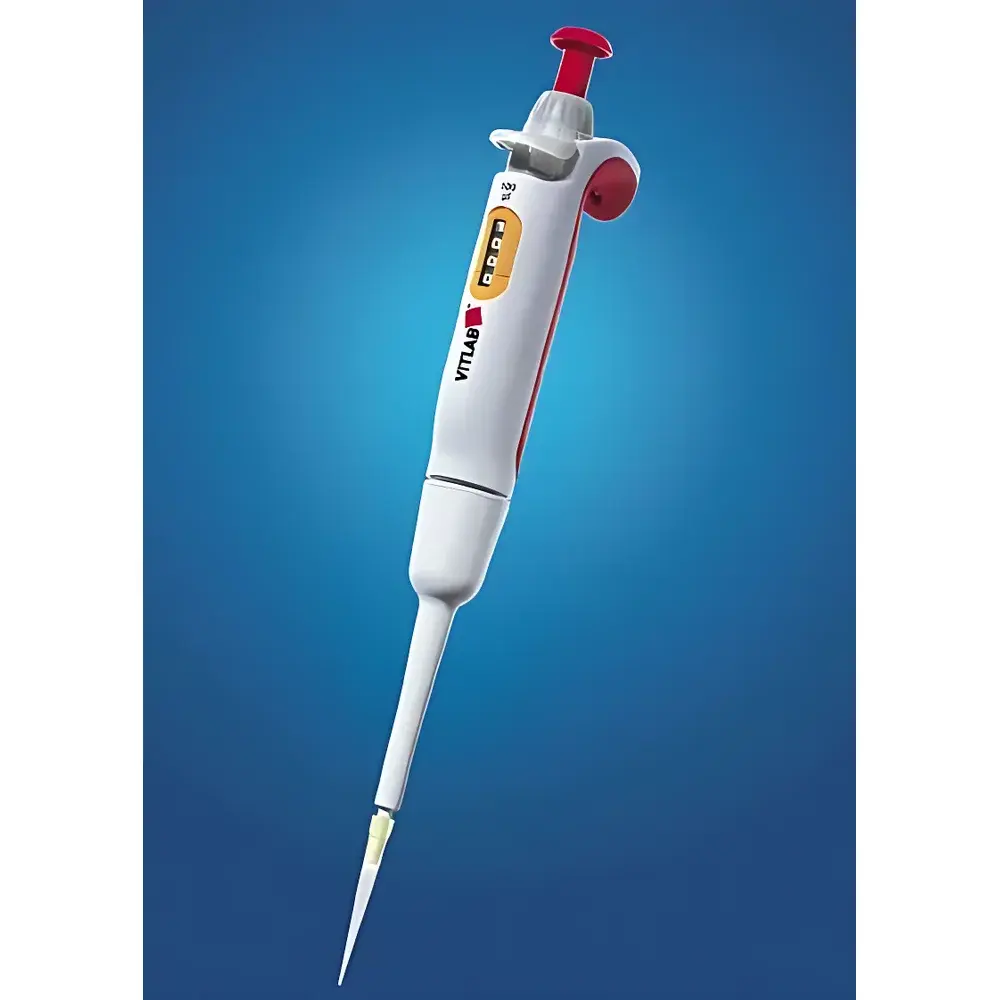
VITLAB Precision Manual Pipette Series (0.5–10,000 µL)
| Brand | VITLAB |
|---|---|
| Origin | Germany |
| Pipette Type | Single-channel Manual Pipette |
| Volume Range | 0.5–10,000 µL |
| Maximum Capacity | 10 mL |
| Accuracy (±%) | 0.2–0.6% |
| Coefficient of Variation (CV) | 0.05–0.2% |
| Sterilization | Autoclavable at 121 °C / 2 bar per DIN EN 285 |
| Compliance | DIN 12600, CE-IVD |
| Tip Compatibility | Standard conical universal pipette tips (e.g., 10 µL, 200 µL, 1000 µL, 10 mL) |
Overview
The VITLAB Precision Manual Pipette Series is a high-performance line of single-channel air-displacement pipettes engineered for reproducible, traceable liquid handling across analytical, clinical, pharmaceutical, and research laboratories. Designed and manufactured in Germany, each pipette operates on the fundamental principle of air displacement—where piston-driven volume aspiration and dispensing ensure consistent volumetric transfer without direct contact between the sample and internal mechanisms. This architecture minimizes carryover risk and supports reliable operation with aqueous, viscous, volatile, or mildly corrosive liquids when used with appropriate tip materials. The series spans twelve calibrated volume ranges—from ultra-low-volume 0.5 µL to high-capacity 10,000 µL—enabling seamless workflow integration from molecular biology assays to bulk reagent preparation. All models comply with DIN 12600 performance specifications for accuracy and precision, and are certified CE-IVD for in vitro diagnostic use where applicable.
Key Features
- Full autoclavability: Entire pipette body withstands steam sterilization at 121 °C and 2 bar pressure (per DIN EN 285), eliminating cross-contamination risks in GLP/GMP environments.
- Ergonomic design: Centrally positioned large plunger button ensures uniform piston actuation force; oversized tip ejector enables rapid, one-handed tip disposal—even with gloves.
- Optimized user interface: Four-digit volume display with magnified digit view; color-coded volume rings for intuitive tip selection; ambidextrous thumb rest and adjustable grip geometry reduce repetitive strain injury (RSI) risk.
- Tool-free calibration: Integrated adjustment mechanism allows field recalibration using standard gravimetric or photometric methods—no disassembly or external tools required.
- Corrosion-resistant construction: Piston and tip ejector components are coated with chemically inert, wear-resistant materials compatible with common laboratory solvents and disinfectants.
- ISO-compliant metrology: Each unit ships with individual factory calibration certificate traceable to national standards (e.g., PTB or UKAS), supporting audit readiness under ISO/IEC 17025 and FDA 21 CFR Part 11 requirements.
Sample Compatibility & Compliance
VITLAB manual pipettes accommodate a broad spectrum of liquid classes—including buffers, cell suspensions, ethanol/water mixtures, and diluted acids—when paired with appropriate polypropylene or low-retention pipette tips. They are validated for use with ISO 8655-compliant tip geometries and exhibit minimal evaporation loss during aspiration of volatile solvents (e.g., acetone, chloroform) due to optimized internal air cushion dynamics. Regulatory alignment includes full adherence to DIN 12600 (accuracy and repeatability tolerances), CE marking under Directive 98/79/EC (IVDR), and conformity with IVD classification rules for Class A devices. Documentation packages include calibration records, conformity declarations, and sterilization validation summaries suitable for quality system audits.
Software & Data Management
While inherently manual, the VITLAB pipette series integrates seamlessly into digitally governed workflows through compatibility with third-party electronic lab notebook (ELN) platforms and LIMS systems. Calibration logs, maintenance history, and usage tracking can be manually entered or imported via CSV templates aligned with ALCOA+ data integrity principles. Optional accessories—including rack-mounted calibration verification kits and digital balance interfaces—enable automated gravimetric verification reports compliant with USP and ISO/IEC 17025 clause 7.7. Audit trails generated during calibration events support 21 CFR Part 11 compliance when paired with validated ELN software.
Applications
- Molecular biology: Accurate dispensing of restriction enzyme cocktails, PCR master mixes, and nucleic acid dilutions (0.5–100 µL range).
- Clinical diagnostics: Reproducible transfer of serum, plasma, and urine samples for immunoassays and hematology analyzers (100–2000 µL).
- Pharmaceutical QC: Gravimetric preparation of reference standards and dissolution media (1000–10,000 µL).
- Cell culture: Gentle handling of trypsin-EDTA solutions and growth media without foaming or shear-induced cell damage.
- Environmental testing: Precise spiking of internal standards in GC-MS and LC-MS sample prep workflows.
FAQ
Are these pipettes suitable for handling organic solvents such as DMSO or acetonitrile?
Yes—provided standard polypropylene tips are used and pipetting technique accounts for vapor pressure differences; extended exposure to strong solvents may require more frequent maintenance.
Can the pipettes be calibrated in-house without specialized equipment?
Yes—tool-free adjustment is supported, but final verification requires an ISO 17025-accredited balance and distilled water at controlled temperature (20 ± 0.5 °C) per ISO 8655-6.
What is the recommended recalibration frequency under routine laboratory use?
Annual calibration is advised for non-GxP labs; GMP/GLP facilities typically mandate quarterly verification with documented uncertainty budgets.
Do the pipettes meet ISO 8655 certification requirements?
They conform to ISO 8655-2 (performance specification) and ISO 8655-5 (calibration methodology), though formal ISO 8655 certification applies to calibration laboratories—not end-user instruments.
Is tip ejection force adjustable?
No—the ejection mechanism is fixed for consistency and safety; however, the large surface area of the ejector button reduces required finger pressure by ~40% versus conventional designs.



