
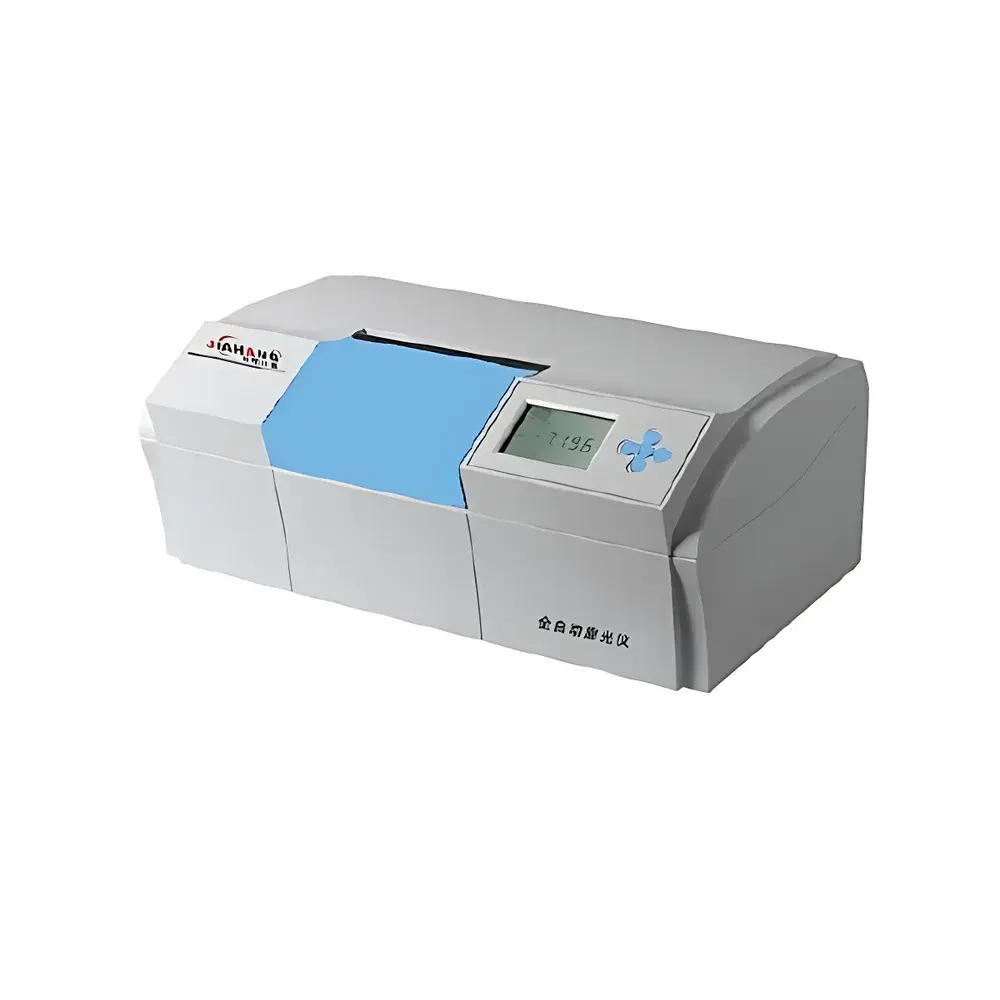
P100 Digital Automatic Polarimeter
| Origin | Shanghai, China |
|---|---|
| Manufacturer Type | Authorized Distributor |
| Origin Category | Domestic (PRC) |
| Model | P100 |
| Price Range | USD 1,400 – 7,000 |
| Product Type | Automatic Polarimeter |
| Temperature Control | Integrated Peltier-based Thermostatic Cell Holder (±0.1 °C stability) |
| Display | Backlit LCD with Real-time Dual-Parameter Readout |
| Light Source | Stable 589.3 nm LED (Na-D Line Equivalent) |
| Optical Rotation Range | ±45° |
| Sucrose Scale Range | ±120°Z |
| Accuracy | ±(0.01° + 0.05% of reading) for optical rotation |
| Minimum Resolution | 0.01° / 0.01°Z |
| Repeatability | ≤0.002° (optical rotation), ≤0.006°Z (sucrose scale) |
| Interface | RS-232C for Data Export and Remote Control |
Overview
The P100 Digital Automatic Polarimeter is a precision optical instrument engineered for the quantitative measurement of optical rotation — the angular deflection of plane-polarized light as it passes through chiral substances. Based on the fundamental principle of polarimetry, the P100 employs a high-stability 589.3 nm LED light source (spectrally aligned with the sodium D-line), a precision half-shade field analyzer, and a closed-loop servo-controlled rotating analyzer system. This architecture ensures robust angular resolution down to 0.01° and repeatability better than ±0.002° under controlled thermal conditions. Designed for routine and regulatory-compliant analysis, the instrument operates in accordance with established pharmacopoeial methods (e.g., USP , EP 2.2.7, ChP IV) and supports traceable calibration using certified quartz control plates and sucrose reference standards. Its integrated Peltier-regulated cell holder maintains sample temperature within ±0.1 °C, minimizing thermal drift and enabling temperature-dependent studies critical in pharmaceutical QC and sugar process monitoring.
Key Features
- Automated zero-point calibration and dynamic endpoint detection eliminate manual null adjustment, reducing operator dependency and inter-user variability.
- Dual-scale real-time display simultaneously shows optical rotation (°) and sucrose concentration (°Z), facilitating immediate interpretation for food, beverage, and fermentation applications.
- Peltier-based thermostatic cell holder (ambient to 40 °C) enables precise temperature control without external water baths — essential for method reproducibility per ISO 11348 and ASTM E1254.
- Backlit LCD interface with intuitive menu navigation supports standalone operation; all settings and results are retained during power cycling.
- Onboard data management stores up to three consecutive measurements per sample and automatically computes mean, standard deviation, and %RSD — compliant with GLP documentation requirements.
- RS-232C serial interface enables bidirectional communication with LIMS or custom QA software, supporting automated report generation and audit trail capture (compatible with FDA 21 CFR Part 11–ready systems when paired with validated host software).
Sample Compatibility & Compliance
The P100 accommodates standard 100 mm and 200 mm pathlength cells (including jacketed variants), with optional 50 mm micro-cells for limited-volume samples (≥0.5 mL). It is routinely deployed in environments requiring adherence to GMP, ISO/IEC 17025, and pharmacopoeial monographs. The instrument’s accuracy specification — ±(0.01° + 0.05% of reading) — meets or exceeds the performance criteria defined in USP General Chapter for chiral assay validation and EP 2.2.7 for optical rotation testing of active pharmaceutical ingredients (APIs). All factory calibrations are traceable to NIM (National Institute of Metrology, China) standards, with optional UKAS-accredited calibration certificates available upon request.
Software & Data Management
While the P100 operates autonomously via its embedded firmware, its RS-232C port allows integration into laboratory data ecosystems. Raw measurement logs (timestamp, temperature, rotation value, °Z equivalent, operator ID) can be streamed to CSV-compatible applications. When used with validated third-party data acquisition software, the system supports electronic signatures, user access levels, and full audit trails — satisfying 21 CFR Part 11 requirements for electronic records in regulated industries. No proprietary software installation is required for basic data export; terminal emulation (e.g., Tera Term, PuTTY) suffices for protocol-level interaction.
Applications
- Pharmaceutical QC: Enantiomeric purity assessment of chiral drugs (e.g., ibuprofen, levodopa, antibiotics) per ICH Q5C and USP monographs.
- Sugar industry: Brix and polarization-based sucrose quantification in raw juice, syrup, and refined sugar — aligned with ICUMSA Method GS4/3-15.
- Food & beverage: Verification of honey authenticity, maple syrup grading, and citrus juice adulteration screening.
- Academic research: Kinetic studies of enzymatic hydrolysis (e.g., invertase activity), polymer helicity characterization, and solvent effect investigations on chiral conformation.
- Chemical manufacturing: In-process monitoring of asymmetric synthesis batches and final product release testing.
FAQ
What wavelength does the P100 use, and is it compliant with pharmacopoeial standards?
The P100 utilizes a narrow-band 589.3 nm LED, spectrally equivalent to the sodium D-line — the mandated wavelength for optical rotation testing in USP, EP, JP, and ChP.
Can the P100 measure samples below room temperature?
No — the integrated Peltier module provides heating and stabilization up to 40 °C but does not support sub-ambient cooling. For low-temperature work, an external recirculating chiller-compatible cell holder is recommended.
Is calibration verification possible without sending the unit to a service center?
Yes — users may perform daily verification using NIST-traceable quartz control plates (available as accessories) or certified sucrose solutions, with pass/fail criteria defined in internal SOPs.
Does the P100 support 21 CFR Part 11 compliance out of the box?
The hardware includes secure data logging and RS-232 output, but full Part 11 compliance requires validated host software, electronic signature capability, and administrative controls — implemented at the laboratory information system level.
What cell pathlengths are supported, and is cell cleaning guidance provided?
Standard 100 mm and 200 mm cells are included; 50 mm micro-cells are optional. A detailed cleaning protocol — including solvent compatibility charts and lint-free wiping procedures — is supplied in the operator manual to prevent optical surface damage and residue-induced bias.




