


COMECAUSE IN-D4 Automatic Potentiometric Titrator
| Brand | COMECAUSE |
|---|---|
| Model | IN-D4 |
| Origin | Shandong, China |
| Manufacturer Type | Direct Manufacturer |
| Instrument Type | General-Purpose Automatic Potentiometric Titrator |
| Application Scope | Universal |
| Potential Measurement Range | −2000 to +2000 mV |
| Potential Resolution | 0.1 mV |
| Potential Accuracy | ±0.25 ‰ of full scale |
| Potential Stability | ±0.3 mV / 3 h |
| Titration Precision | ±5 µL (for 10 mL burette) |
| Titration Resolution | 0.1 mV |
| pH Range | 0–14 |
| pH Resolution | 0.01 |
| pH Accuracy | ±0.01 |
| Conductivity Range | 0.00 µS/cm – 2000 mS/cm |
| Conductivity Accuracy | ±1.0 % FS |
| Temperature Range | −5 °C to +105 °C |
| Temperature Resolution | 0.1 °C |
| Temperature Accuracy | ±0.2 °C |
| Display | 7-inch Android 10 touchscreen |
| Data Storage | 100,000 records |
| Connectivity | USB / Wi-Fi / Ethernet |
| Dimensions | 310 × 226 × 233 mm |
| Weight | 3.7 kg |
Overview
The COMECAUSE IN-D4 Automatic Potentiometric Titrator is an engineered solution for high-reproducibility quantitative chemical analysis based on potentiometric endpoint detection. It operates on the fundamental principle of monitoring the electromotive force (EMF) change across a galvanic cell composed of a reference electrode and an indicator electrode during titrant addition. As the reaction approaches stoichiometric equivalence, a sharp inflection in potential—corresponding to the titration endpoint—is detected algorithmically, eliminating subjective visual interpretation. Designed to meet JJG 814–2015 (Chinese National Verification Regulation for Automatic Potentiometric Titrators) Class 0.05 specifications, the IN-D4 delivers a maximum potential error of ±1.5% of full scale and repeatability ≤0.2%, ensuring compliance with routine QC/QA requirements in regulated laboratory environments.
Key Features
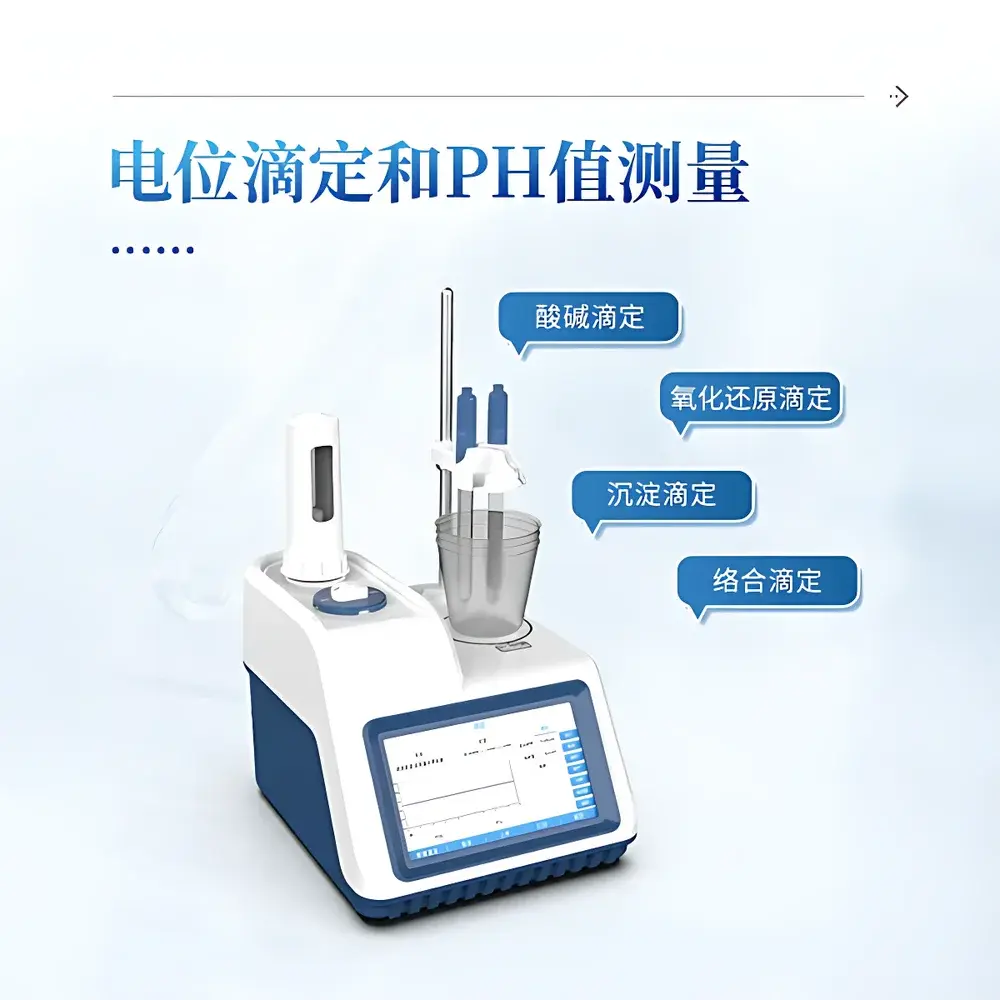
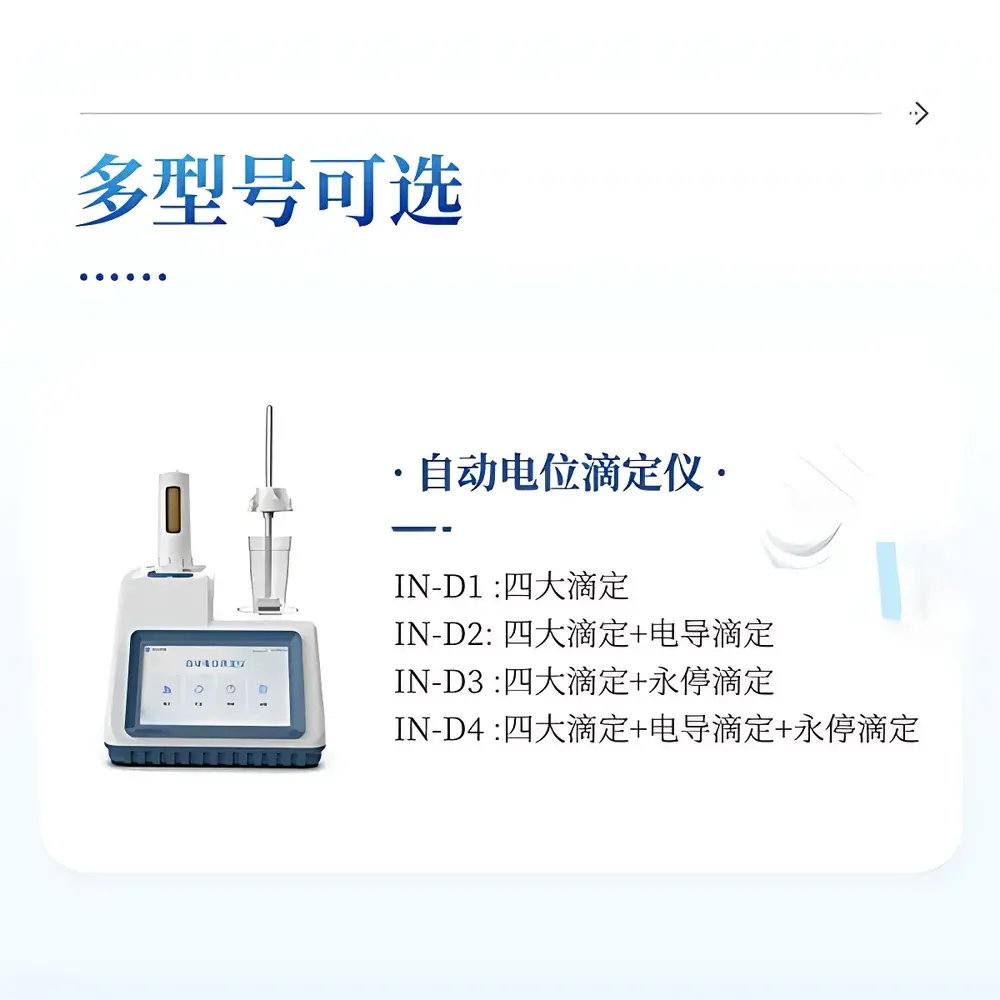
- Multi-mode titration capability: supports potentiometric titration, pH measurement, conductometric titration, and amperometric (dead-stop) titration via modular expansion—enabling acid-base, redox, precipitation, and complexometric analyses with appropriate electrode selection.
- Three programmable titration modes: dynamic titration (variable step size near endpoint), fixed-volume titration, and manual override—allowing method optimization for heterogeneous or low-signal samples.
- Automated fluid handling system: integrated peristaltic pump replaces conventional burettes; precision dosing accuracy of ±5 µL (10 mL burette) ensures traceable volumetric delivery aligned with ISO/IEC 17025 metrological traceability expectations.
- Integrated electrode conditioning utilities: “Purge” removes air bubbles from tubing; “Rinse” primes lines with minimal reagent volume to minimize carryover; “Drain” evacuates residual liquid into the burette post-analysis, reducing exposure risk and cross-contamination.
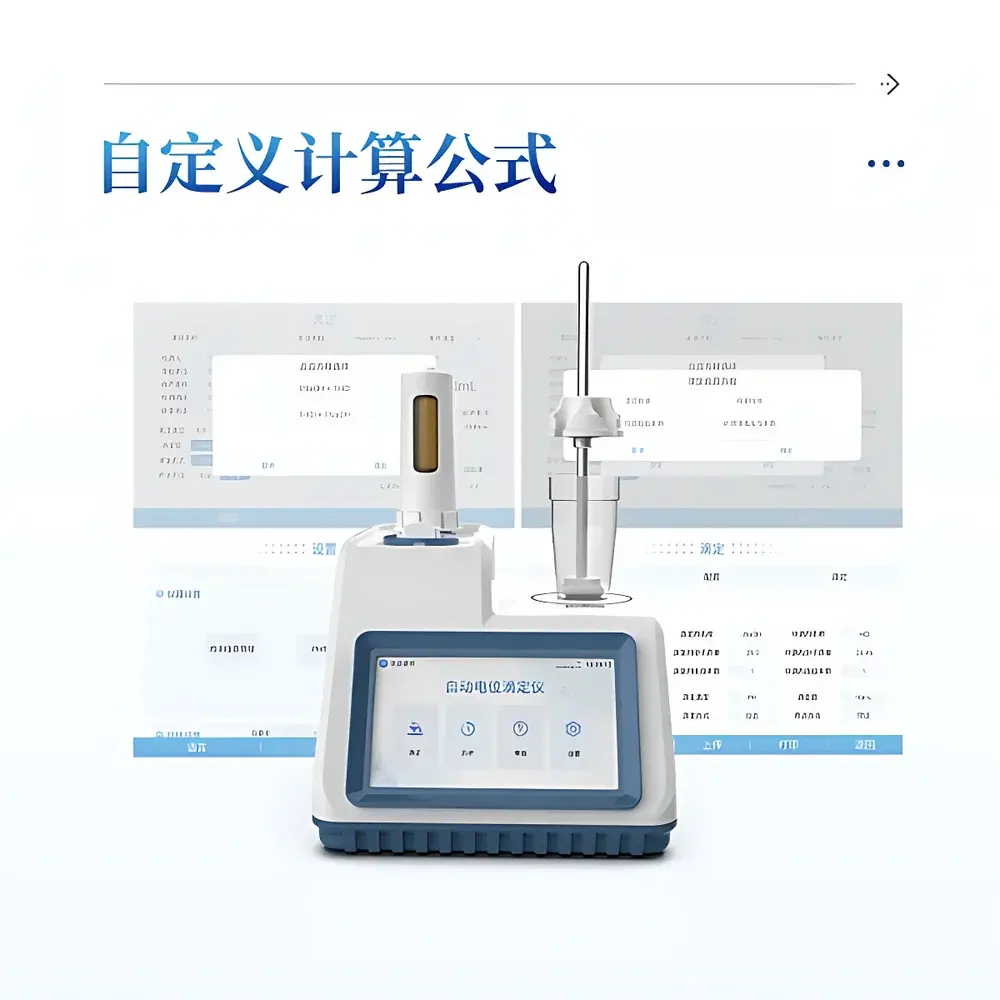
- Customizable calculation engine: users define stoichiometric formulas using standard chemical notation; results (e.g., mass %, molarity, ppm) are auto-computed and logged with raw potential vs. volume data.
- Method library management: stores ≥100 user-defined titration protocols—including electrode type, titrant concentration, stirring speed, endpoint criteria, and report templates—with timestamped version control.
- Dual-function operation: functions as both an automated titrator and a benchtop pH/conductivity meter, supporting GLP-compliant calibration logging and electrode diagnostics.
Sample Compatibility & Compliance
The IN-D4 accommodates aqueous and non-aqueous matrices across diverse sample viscosities and ionic strengths. Its wide potential range (−2000 to +2000 mV) and sub-millivolt resolution enable reliable detection of subtle endpoints in weak acid–weak base or multi-step redox systems. Electrode compatibility includes standard Ag/AgCl, calomel, glass pH, platinum, and double-junction reference electrodes. The instrument satisfies verification criteria per JJG 814–2015 and aligns with foundational principles referenced in ASTM E2087 (Standard Guide for Potentiometric Titration), ISO 8655-6 (Piston burettes), and USP <771> (Potentiometric Titrations). While not pre-certified for 21 CFR Part 11, its audit-trail-capable data storage (with user ID, timestamp, method ID, and raw sensor output) supports internal validation for GMP/GLP workflows.
Software & Data Management
Running Android 10 on a 7-inch capacitive touchscreen, the IN-D4 provides intuitive graphical workflow navigation without external PC dependency. All measurements—including real-time potential/pH/conductivity curves, derivative plots (dE/dV), and endpoint interpolation—are visualized and exportable in CSV format via USB, Wi-Fi, or Ethernet. Internal memory retains 100,000 complete titration records with metadata (operator, date/time, method name, electrode serial number, calibration history). Built-in thermal printing generates compliant hard-copy reports featuring sample ID, titrant lot number, environmental temperature, and statistical summary (mean, RSD, confidence interval where applicable).
Applications
The IN-D4 serves as a primary titration platform in quality control laboratories across food safety (e.g., titratable acidity in dairy, free fatty acids in oils), pharmaceutical manufacturing (assay of active ingredients per USP monographs), environmental testing (chloride in wastewater per APHA 4500-Cl⁻ B), petrochemical QA (TAN/TBN in lubricants), and academic research (kinetic studies requiring precise reagent addition). Its modular architecture allows adaptation to pharmacopeial methods including EP 2.2.20, JP 2.05, and Chinese Pharmacopoeia 2020 Edition IV.62.
FAQ
Does the IN-D4 support regulatory-compliant electronic signatures and audit trails?
It logs operator ID, method version, calibration events, and raw sensor data with timestamps—sufficient for internal GLP/GMP validation; however, formal 21 CFR Part 11 compliance requires site-specific configuration and procedural controls.
Can I use non-COMECAUSE electrodes with this titrator?
Yes—the IN-D4 accepts industry-standard BNC and DIN connectors; compatibility is confirmed by electrode output impedance and signal range alignment with the instrument’s input specifications.
What maintenance is required for long-term accuracy?
Daily rinsing of tubing and electrodes, quarterly verification of burette delivery accuracy per ISO 8655-6, and annual recalibration of analog front-end circuits using NIST-traceable mV standards are recommended.
Is method transfer possible between IN-D4 units?
Yes—methods, calibration profiles, and calculation templates are exportable/importable via USB drive in encrypted binary format, enabling consistent deployment across multi-instrument labs.
How does the system handle endpoint detection in turbid or colored samples?
Since potentiometric detection relies on interfacial potential—not optical properties—it remains unaffected by sample opacity or dye interference, unlike photometric or visual endpoints.





