
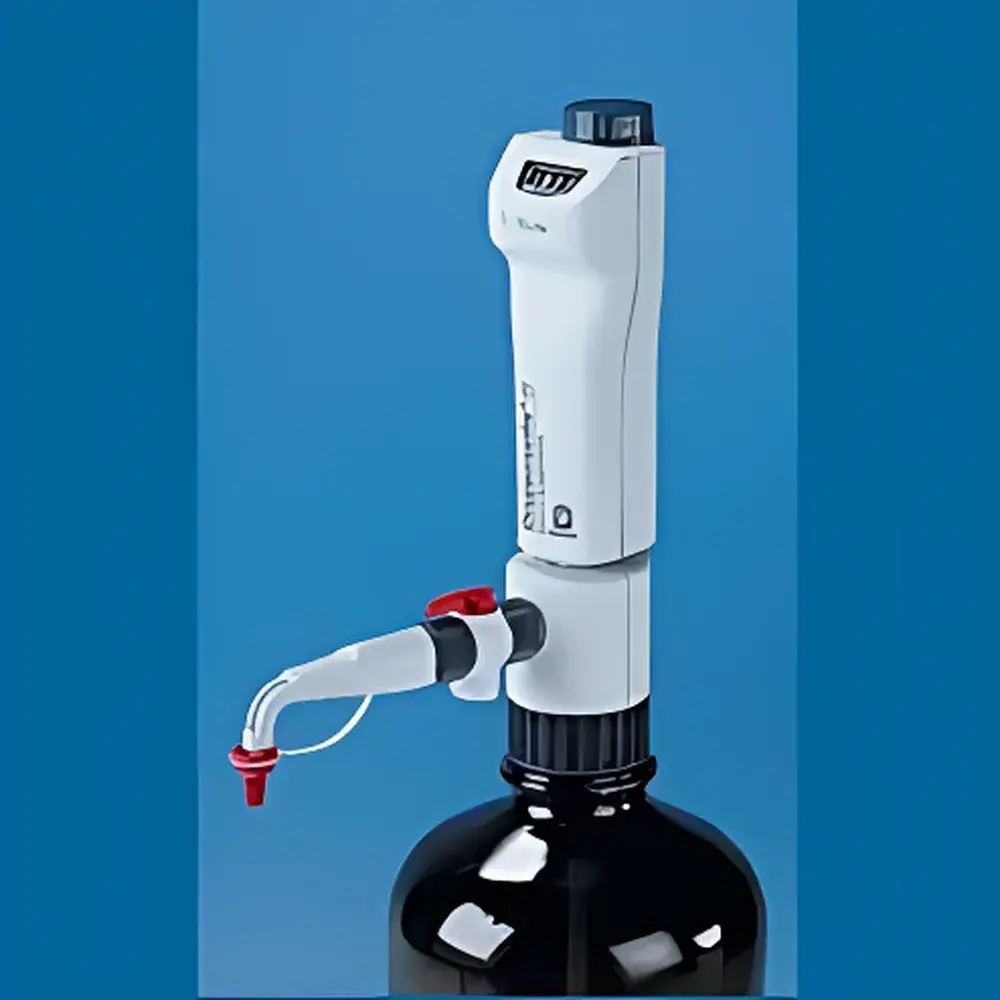
BRAND Dispensette® III Bottle-Top Dispenser – Precision Liquid Handling System for Laboratory Use
| Brand | BRAND® |
|---|---|
| Origin | Germany |
| Model | Dispensette® III |
| Type | Digital Bottle-Top Dispenser |
| Volume Range | 0.2–50 mL (model-dependent) |
| Minimum Increment | 0.01–0.2 mL (model-dependent) |
| Accuracy | ±0.1% |
| Precision (Repeatability) | ±0.1% |
| Max. Operating Pressure | 500 mbar |
| Max. Liquid Viscosity | 500 mm²/s |
| Max. Liquid Density | 2.2 g/cm³ |
| Max. Operating Temperature | 40 °C |
| Sterilization | Autoclavable at 121 °C for 20 min |
| Materials | Borosilicate glass, platinum-iridium piston, ETFE/EP/FA seals, polypropylene housing |
Overview
The BRAND Dispensette® III Bottle-Top Dispenser is a high-precision, manually operated liquid handling instrument engineered for reproducible, contamination-free dispensing of reagents directly from standard laboratory bottles. Based on positive displacement volumetric principle, it eliminates reliance on air displacement or syringe-based mechanisms—ensuring consistent delivery independent of liquid density, vapor pressure, or surface tension. Designed for routine and regulated laboratory environments—including QC/QA labs, pharmaceutical R&D, and analytical chemistry workflows—the Dispensette® III delivers traceable, GLP-compliant volume transfer without electronic components, making it inherently robust and maintenance-light. Its modular architecture supports rapid adaptation across diverse chemical classes via chemically resistant material variants (Standard, Organic, and Trace Analysis), each validated per ISO 8655-3 for volumetric accuracy and long-term stability.
Key Features
- Manual operation with intuitive up-and-down sleeve actuation—no batteries or software required.
- Full-system autoclavability (121 °C, 20 min) for sterility-critical applications in cell culture and molecular biology.
- Integrated safety valve enabling closed-loop bubble venting—prevents solution loss while maintaining volumetric integrity during priming.
- Fail-safe discharge system: prevents accidental liquid release if the discharge tube is not fully seated or secured.
- Adjustable immersion tube with depth-lock mechanism—compatible with bottle heights from 80 mm to 350 mm.
- 360° rotatable mounting head with adjustable discharge nozzle orientation—ensures label visibility and ergonomic positioning.
- Modular discharge tubing options, including 800 mm PTFE tube with integrated safety grip for remote or narrow-vessel dispensing.
- Chemical compatibility certified across three material configurations: Standard (for H3PO4, NaOH, KCl, etc.), Organic (for HCl, HNO3, TFA, THF), and TA-grade (ultra-pure, low-metallic leaching for ICP-MS and trace elemental analysis).
Sample Compatibility & Compliance
The Dispensette® III meets stringent international standards for volumetric performance and chemical resistance. All models comply with ISO 8655-3:2022 (volumetric dispensers) and are calibrated against NIST-traceable reference standards. Material certifications include USP Class VI biocompatibility testing (for organic and TA variants), FDA-compliant resin declarations (PP, ETFE, EP), and DIN EN ISO 10993-5 cytotoxicity validation. For regulated environments, the instrument supports full audit trails when used in conjunction with manual logbooks compliant with 21 CFR Part 11 requirements—particularly when paired with BRAND’s optional calibration certificate (certified to ±0.1% tolerance). It is routinely deployed in GMP laboratories performing dissolution testing, titrant preparation, and reference standard dilution under USP and Ph. Eur. 2.2.17 guidelines.
Software & Data Management
As a purely mechanical, non-electronic instrument, the Dispensette® III requires no firmware, drivers, or proprietary software. Volume settings are adjusted manually via digital dial or vernier scale (depending on model), with engraved markings ensuring permanent readability and resistance to solvent degradation. Calibration data—including date, operator ID, and measured deviation—is documented externally using standardized lab notebooks or LIMS-integrated forms. Optional BRAND-certified calibration services provide ISO/IEC 17025-accredited certificates traceable to national metrology institutes. For digital workflow integration, users may pair the dispenser with electronic balance interfaces or automated pipetting stations via custom SOPs aligned with ISO/IEC 17025 Clause 7.7 (measurement uncertainty estimation).
Applications
The Dispensette® III serves critical functions across multiple laboratory disciplines: precise acid/base titrant dispensing in wet chemistry; controlled addition of solvents in HPLC mobile phase preparation; repeatable reagent dosing in ELISA and PCR setup; high-purity standard solution dilution for ICP-OES/MS calibration curves; and safe handling of corrosive or volatile substances (e.g., concentrated mineral acids, halogenated solvents) where fume hood exposure must be minimized. Its ability to maintain accuracy across viscosity ranges up to 500 mm²/s makes it suitable for glycerol-based buffers, polymer solutions, and viscous catalyst formulations—common in materials science and formulation development labs.
FAQ
Is the Dispensette® III compatible with hydrofluoric acid (HF)?
No. HF attacks borosilicate glass and platinum-iridium components. For HF handling, consult BRAND’s specialized HF-resistant dispensers (e.g., Dispensette® HF series) featuring sapphire pistons and PFA-wetted parts.
Can the same Dispensette® III be used for both aqueous and organic solvents?
Only if configured as the Organic variant. The Standard variant is not recommended for prolonged use with chlorinated or aromatic hydrocarbons due to seal swelling risk.
What is the recalibration interval recommendation?
Per ISO 8655-3, annual verification is advised for routine use; semi-annual calibration is required in GxP environments or after any physical impact or chemical exposure event.
Does the safety valve require periodic replacement?
Yes. BRAND recommends replacing the safety valve assembly every 12 months or after 5000 actuation cycles—whichever occurs first—to ensure consistent bubble venting performance and pressure containment.
Are replacement parts available globally with documented traceability?
Yes. All consumables—including piston assemblies, seals, discharge tubes, and bottle adapters—are supplied with batch-specific CoA and material compliance documentation, supporting full supply chain transparency for regulatory audits.



