
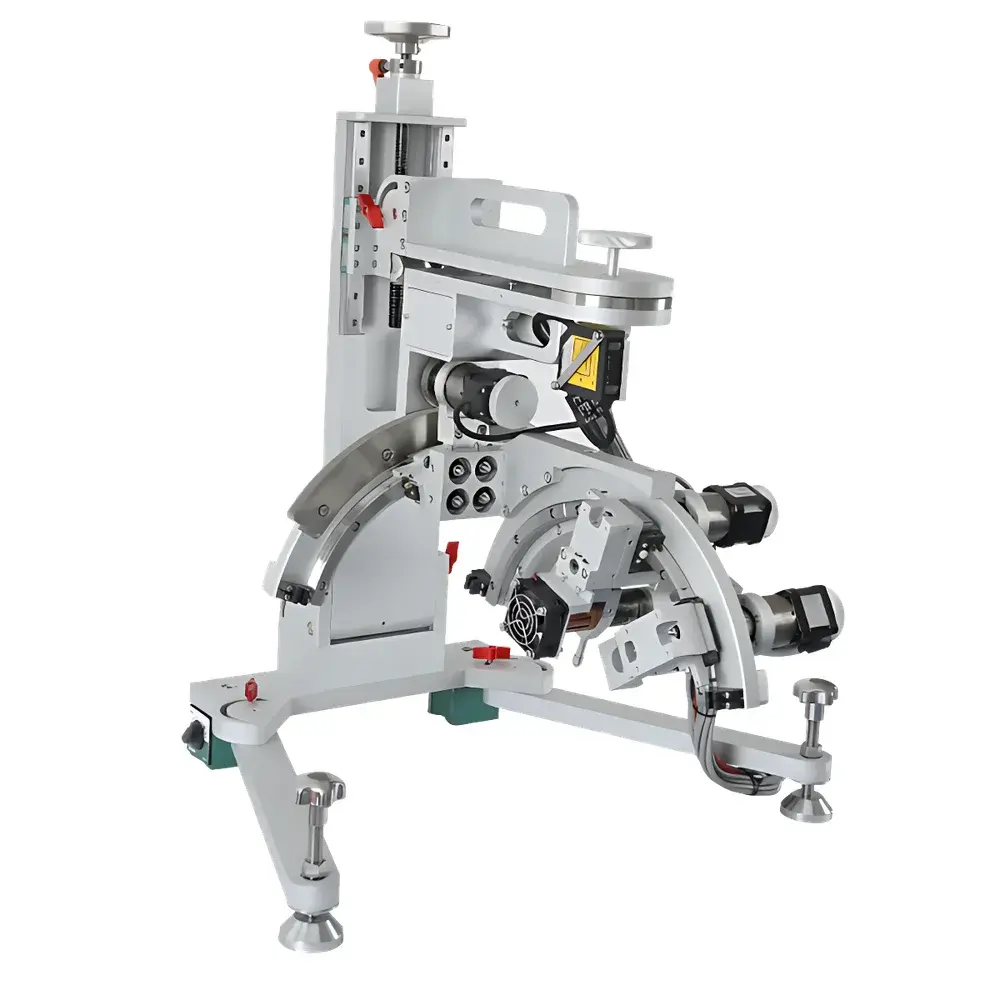
TDTC-150 X-Ray Residual Stress Analyzer
| Brand | Tongda |
|---|---|
| Origin | Liaoning, China |
| Manufacturer Type | Authorized Distributor |
| Country of Origin | China |
| Model | TDTC-150 |
| Price Range | USD 70,000 – 140,000 |
| X-ray Tube Power | 200 W |
| 2θ Angular Range | 45°–170° (continuously adjustable) |
| ψ Tilt Angle Range | 0° to ±45° |
| Anode Target Material | Chromium (Cr) |
| Measurement Methods | Sin²ψ, Side-Inclination, Tilt-and-Rotate |
| Stress Output | Principal Stresses (σ₁, σ₂, σ₃) and Shear Stress (τ) |
| Phase Analysis Mode | Four-Peak Method for Retained Austenite Quantification |
| Detector | Multi-channel Silicon Strip Linear Array Detector |
| Control System | PLC-based Modular Architecture |
| Operating System | Integrated Windows OS with Real-time Data Visualization |
| Sample Compatibility | Ferrous & Non-ferrous Metals, Titanium Alloys, Nickel-Based Superalloys, Glass, Composites |
Overview
The TDTC-150 X-Ray Residual Stress Analyzer is a benchtop-grade, laboratory- and field-deployable instrument engineered for non-destructive, quantitative evaluation of residual stress states in crystalline solid materials using monochromatic X-ray diffraction. It operates on the fundamental principle of lattice strain measurement: residual stress induces elastic distortion of atomic planes, resulting in measurable shifts in Bragg diffraction peak positions. By acquiring diffraction data across multiple sample orientations—specifically via controlled ψ-tilt and 2θ-scan sequences—the system calculates interplanar spacing variations and converts them into stress tensor components using the sin²ψ method and related formalisms (e.g., side-inclination and tilt-and-rotate variants). Designed for precision metrology in metallurgical QA/QC, aerospace component certification, and additive manufacturing process validation, the TDTC-150 delivers traceable, repeatable results compliant with ASTM E915, ISO 21942, and EN 15305 standards.
Key Features
- Chromium (Cr) anode X-ray tube with 200 W nominal power output, optimized for Kα radiation (λ = 2.2909 Å) — ideal for ferrous alloys, stainless steels, and nickel-based materials where high absorption contrast and strong diffraction intensity are required.
- Full-range angular positioning: continuously adjustable 2θ from 45° to 170° and ψ tilt from 0° to ±45°, enabling comprehensive stress state reconstruction including biaxial and triaxial components.
- Multi-channel silicon strip linear array detector providing high quantum efficiency, zero readout noise, and sub-second frame acquisition — significantly reducing measurement time without compromising signal-to-noise ratio.
- PLC-based modular control architecture with closed-loop vector servo drives ensures micron-level goniometer repeatability (< ±0.01° angular accuracy) and long-term mechanical stability under thermal or vibrational load.
- Integrated Windows-based software platform supporting automated sequence execution, real-time diffraction pattern visualization, and on-the-fly stress tensor calculation — eliminating manual post-processing delays.
- Lightweight structural design (≤ 85 kg) with integrated leveling feet and optional portable cart configuration — certified for on-site use in production floors, maintenance hangars, and field service environments.
Sample Compatibility & Compliance
The TDTC-150 accommodates flat, curved, and irregularly shaped specimens up to Ø120 mm × 30 mm thick. Its universal sample stage supports clamping of carbon steels, alloy steels, titanium alloys (e.g., Ti-6Al-4V), Inconel 718, cobalt-chrome, borosilicate glass, and fiber-reinforced polymer composites. All stress measurement protocols adhere to internationally recognized methodologies: ASTM E915-22 (Standard Test Method for Verifying the Alignment of X-Ray Diffraction Equipment for Residual Stress Measurement), ISO 21942:2019 (Non-destructive testing — X-ray diffraction methods for residual stress analysis), and EN 15305:2007 (Non-destructive testing — Test method for residual stress analysis by X-ray diffraction). The system supports GLP-compliant audit trails, user access levels, and electronic signature logging per FDA 21 CFR Part 11 requirements when configured with optional validation packages.
Software & Data Management
The embedded TDTC-Analysis Suite provides full workflow integration from instrument control to final report generation. Core modules include: (1) StressCalc Engine — implements matrix inversion and least-squares fitting for principal stress and shear stress derivation; (2) AusteniteQuant — applies the four-peak method (using (200), (220), (311), and (222) reflections) to quantify retained austenite volume fraction in martensitic steels; (3) PhaseID — performs qualitative/quantitative phase identification using ICDD PDF-4+ database integration; (4) GrainSize — estimates crystallite size via Scherrer equation and Williamson-Hall analysis. Raw data (intensity vs. 2θ) is stored in vendor-neutral .xy format; processed reports export to PDF, CSV, and XML with embedded metadata (operator ID, timestamp, calibration certificate ID, environmental conditions).
Applications
- Aerospace: Residual stress mapping of turbine blades, landing gear forgings, and welded joints pre- and post-shot peening or heat treatment.
- Automotive: Validation of surface integrity in crankshafts, camshafts, and gear teeth after grinding, turning, or roller burnishing.
- Additive Manufacturing: In-process and post-build stress assessment of Ti-6Al-4V and Inconel 718 laser powder bed fusion parts to inform support structure optimization and HIP cycle parameters.
- Nuclear Industry: Monitoring stress evolution in pressure vessel weld overlays and cladding layers subjected to neutron irradiation or thermal cycling.
- Academic Research: Correlating thermo-mechanical processing history (e.g., cold rolling reduction, annealing temperature) with near-surface stress gradients and phase transformations.
FAQ
What X-ray wavelength does the TDTC-150 use, and why is Cr target selected?
The system employs Cr Kα radiation (λ = 2.2909 Å), selected for optimal diffraction efficiency in iron-based and nickel-based alloys where Fe Kα would cause excessive background due to fluorescence. Cr provides strong, sharp peaks with minimal secondary radiation.
Can the TDTC-150 measure residual stress in coatings or thin films?
Yes — with appropriate incidence angle adjustment and penetration depth modeling, it supports near-surface stress profiling down to ~5–20 µm depth depending on material density and radiation energy.
Is the instrument suitable for ISO/IEC 17025 accredited laboratories?
When deployed with documented calibration certificates (X-ray tube output, goniometer angular accuracy, detector linearity), SOPs, and staff training records, the TDTC-150 meets technical requirements for inclusion in scope of accreditation.
Does the software support custom stress tensor reporting formats for OEM customers?
Yes — the API-enabled architecture allows third-party integration and customizable report templates compliant with internal quality management systems (e.g., SAP QM, ETQ Reliance).
What safety certifications does the instrument carry?
It complies with IEC 61010-1 (Safety Requirements for Electrical Equipment for Measurement, Control, and Laboratory Use) and includes interlocked shielding, beam-stop verification, and dose-rate monitoring per national radiation safety regulations (e.g., NRC 10 CFR 35, EU Directive 2013/59/Euratom).





