
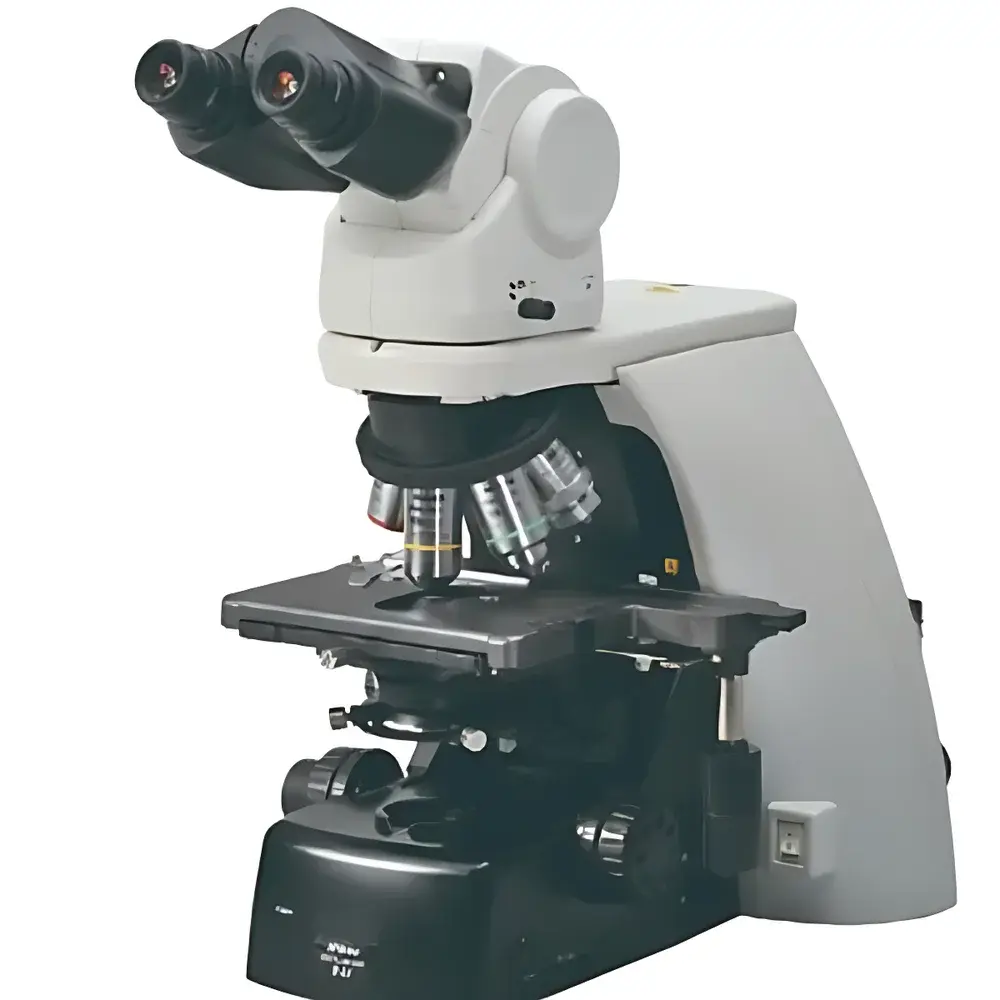
Nikon ECLIPSE Ni-U Research-Grade Upright Microscope
| Brand | Nikon |
|---|---|
| Origin | Japan |
| Model | ECLIPSE Ni-U |
| Optical System | CFI60 Infinity-Corrected |
| Focusing Mechanism | Motorized Stage & Nosepiece |
| Illumination | 12V 100W Halogen / High-CRI LED (50,000 hr lifetime) |
| Objective Turret Options | NI-N7-E (7-port motorized), NI-ND6-E (6-port DIC motorized), NI-N7-I (7-port smart) |
| Stage Travel | 78 × 54 mm (manual), 0.1 µm resolution (NI-S-E motorized) |
| Encoded Z-Focus | 0.025 µm resolution |
| Condenser | NI-CUD-E (NA 0.88, motorized universal dry) |
| Eyepiece FOV | 22 mm or 25 mm |
| Port Options | C-mount, F-mount, variable zoom (0.6×–2.0×), DSC ports with magnification adapters |
| Power Consumption | ≤211 W (max halogen + full motorization) |
| Weight | 18–32 kg (configuration-dependent) |
Overview
The Nikon ECLIPSE Ni-U is a modular, research-grade upright microscope engineered for high-precision life science applications requiring rigorous optical fidelity, ergonomic workflow integration, and long-term experimental reproducibility. Built upon Nikon’s CFI60 infinity-corrected optical architecture — optimized for minimal chromatic aberration, high transmission efficiency, and compatibility with both standard CFI60 and next-generation CFI75 objectives — the Ni-U serves as a foundational platform for brightfield, phase contrast, differential interference contrast (DIC), darkfield, and epifluorescence microscopy. Its dual-path focusing system enables precise Z-axis control via either motorized stage translation (±2 mm/±13 mm), motorized nosepiece movement (±13 mm/±2 mm), or manual coarse/fine focus with coaxial ergonomics. Integrated linear encoders deliver 0.025 µm positional resolution in Z, supporting quantitative time-lapse imaging, multi-layer z-stacking, and automated focus recovery protocols essential for longitudinal cell culture studies and tissue section analysis.
Key Features
- Modular optical design supporting CFI60 and CFI75 objective families, including high-NA oil-immersion, long-working-distance (LWD), and DIC-compatible optics
- Dual-motorized focusing architecture: independently controllable motorized stage (NI-S-E, 0.1 µm resolution) and motorized nosepiece (NI-N7-E or NI-ND6-E), enabling dynamic parfocal alignment across magnifications
- High-CRI LED illumination (50,000-hour rated lifetime) with integrated NCB11, ND8, ND32, and scattering filters; optional NI-ND-E electric ND filter for seamless intensity calibration
- Ergonomic flexibility: C-TE2 tilting binocular tube (10–30°), NI-TT2-E motorized quad-port turret (15–35° tilt), and multiple DSC port configurations (C-mount, F-mount, 0.55×, 0.7×, 2.5×, and motorized 0.6×–2.0× zoom)
- Encoded precision mechanics: linear encoder-equipped Z-drive, programmable auto-retract/re-focus sequences, and backlash-free coaxial coarse/fine focus
- Expandable platform: compatible with NI-CTLB control box for synchronized operation of motorized stages, turrets, condensers (NI-CUD-E), and illumination systems
Sample Compatibility & Compliance
The Ni-U accommodates standard glass slides (1–3 mm thickness), Petri dishes (via optional NI-SH-D dish holder), multi-well plates, and custom sample chambers up to 30 mm height. Its NI-CUD-E motorized universal condenser (NA 0.88) supports Köhler illumination for brightfield, phase contrast (with C-PH turret), DIC (with D-CUO or FN-C LWD condensers), and darkfield (C-DO/C-DD). The system meets ISO 10934-1 (microscope optical performance standards) and is designed to support GLP-compliant workflows when paired with Nikon NIS-Elements software featuring audit trail, user access control, and electronic signature capabilities per FDA 21 CFR Part 11 requirements. All CFI-series objectives comply with JIS B 7151 and DIN EN ISO 8578 specifications for numerical aperture, working distance, and parfocality tolerances.
Software & Data Management
The Ni-U integrates natively with Nikon NIS-Elements AR (Advanced Research) software, enabling hardware-synchronized acquisition, multi-channel fluorescence unmixing, deconvolution, and AI-assisted segmentation. Motorized components are fully scriptable via Python API or macro recorder, supporting automated acquisition routines for high-content screening (HCS) and time-series phenotyping. Image metadata — including objective ID, Z-position, exposure parameters, filter status, and illumination intensity — is embedded in TIFF/OME-TIFF format with EXIF-compliant tags. Raw data export supports FAIR principles (Findable, Accessible, Interoperable, Reusable), and NIS-Elements includes built-in DIC vector analysis, intensity profiling, and colocalization quantification modules validated against reference datasets from the NIH-supported BioImage Archive.
Applications
- Long-term live-cell imaging in incubator-integrated setups, leveraging thermal stability of CFI60 optics and low-heat LED illumination
- Quantitative histopathology: high-resolution scanning of H&E- and IHC-stained tissue sections using motorized XY stage and encoded Z-stack acquisition
- Neuroscience research: DIC-based visualization of unstained neuronal morphology combined with epifluorescent calcium indicator imaging
- Developmental biology: time-lapse observation of zebrafish or C. elegans embryos using phase contrast and transmitted-light DIC on temperature-controlled stages
- Microbial motility assays: high-speed brightfield tracking with synchronized shutter control and sub-pixel centroid detection
- GMP-aligned QC workflows: standardized SOP-driven imaging protocols with version-controlled acquisition settings and digital signature logging
FAQ
Does the Ni-U support automated multi-objective imaging without manual realignment?
Yes — the NI-N7-E motorized turret and NI-CUD-E condenser maintain precise parfocality and Köhler alignment across all configured objectives and illumination modes. Calibration is performed once per objective during initial setup and retained in system memory.
Can the Ni-U be integrated into a cleanroom or ISO Class 5 environment?
The Ni-U chassis meets IP20 ingress protection rating and operates within ambient temperature ranges of 15–30°C and humidity ≤70% RH non-condensing. Optional vibration-damping feet and ESD-safe ceramic-coated stages (e.g., NIE-CSRR2) facilitate deployment in controlled environments.
Is NIS-Elements software included with the base system?
NIS-Elements Basic is provided for hardware control and image capture. NIS-Elements AR (Advanced Research) and associated modules (deconvolution, HCS, 3D rendering) are available as licensed options compliant with institutional site-license agreements.
What maintenance intervals are recommended for the motorized components?
Nikon recommends biannual inspection of motorized stage belts and nosepiece gear trains by certified service engineers. Linear encoder calibration is verified annually as part of preventive maintenance, with traceable documentation provided per ISO/IEC 17025 guidelines.
How does the Ni-U ensure illumination consistency across long-duration experiments?
The high-CRI LED source exhibits <0.1% intensity drift over 8 hours at constant drive current, and real-time feedback from the internal photodiode enables closed-loop intensity stabilization when used with NI-CTLB control box and NIS-Elements scripting.
Related Products




