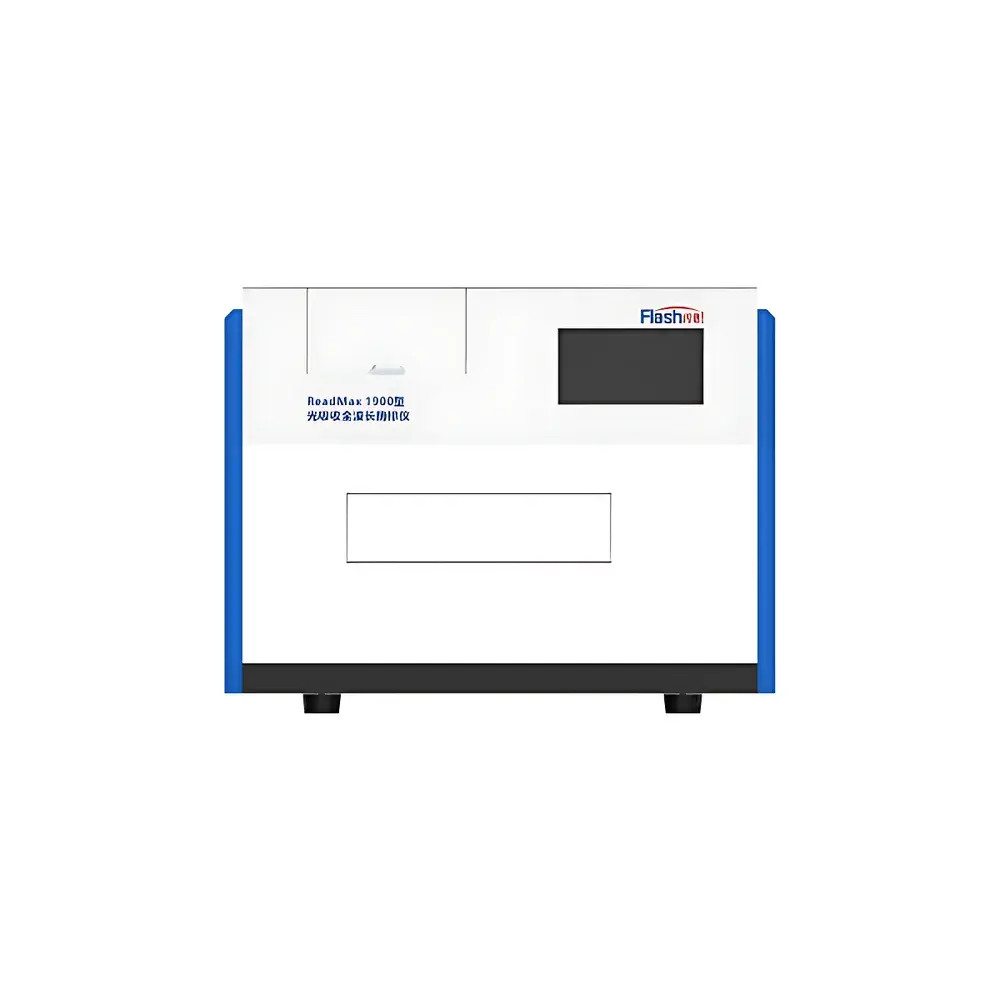
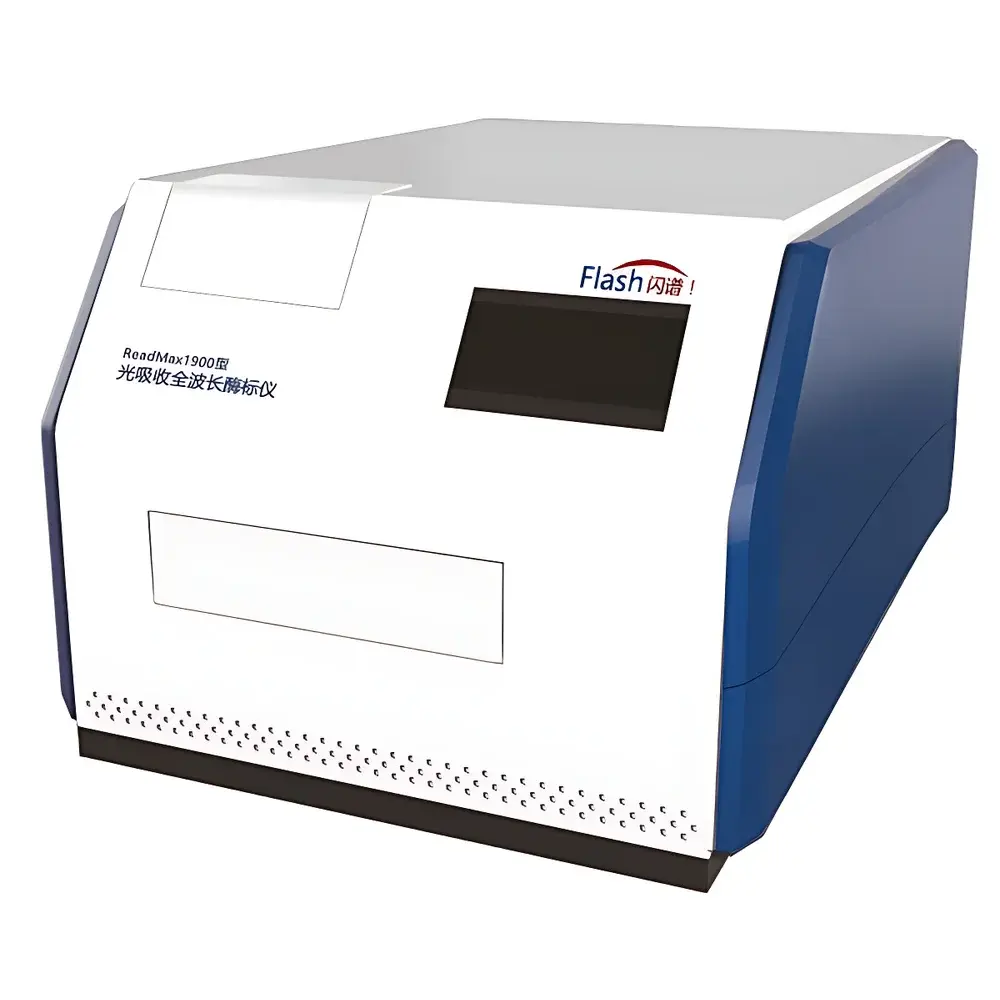
Flash Spectrum ReadMax 1900 UV-Vis Full-Range Absorbance Microplate Reader
| Brand | Flash Spectrum |
|---|---|
| Origin | Shanghai, China |
| Manufacturer Type | Authorized Distributor |
| Product Origin | Domestic (China) |
| Model | ReadMax 1900 |
| Price Range | USD 7,000–14,000 |
| Functionality | Absorbance-Only Microplate Reader |
| Automation Level | Fully Automated |
| Assay Modes | Endpoint, Kinetic, and Spectral Scan |
| Curve Fitting | Linear Regression Only |
| Detector Configuration | Dual-Detector System (Sample + Reference) |
| Wavelength Range | 190–1000 nm |
| Absorbance Range | 0–4.000 OD |
| Linearity Range | 0–4.0 Abs |
| Kinetic Measurement Speed | 6 sec per single wavelength |
| Wavelength Accuracy | ±1.0 nm |
| Wavelength Repeatability | <0.2 nm |
| Temperature Control Range | Ambient +2 °C to 65 °C |
| Plate Compatibility | Standard 96-well and UV-transparent 96-well microplates |
| Light Source | Pulsed Xenon Lamp |
| Cuvette Port | Integrated Single-Cell Optical Path for Standalone UV-Vis Spectrophotometry |
Overview
The Flash Spectrum ReadMax 1900 is a fully automated, monochromator-based absorbance microplate reader engineered for precision life science research in academic laboratories, biotech R&D centers, and pharmaceutical quality control environments. It employs a high-stability pulsed xenon lamp coupled with a precision Czerny-Turner grating monochromator to deliver continuous spectral coverage from 190 nm to 1000 nm—enabling quantitative analysis across nucleic acid quantification (260 nm), protein determination (280 nm, Bradford, Lowry), enzyme kinetics (NADH at 340 nm), endotoxin detection (LAL assay), and cell viability assays (MTT, XTT). Unlike filter-based systems, its grating architecture eliminates the need for physical filter wheels, ensuring seamless wavelength selection without mechanical latency or spectral discontinuity. The dual-detector design—comprising an independent sample and reference photodiode—compensates for source intensity drift and optical path variation in real time, supporting rigorous adherence to ASTM E275 and ISO 10993-12 validation principles for optical density measurement.
Key Features
- Integrated cuvette port enabling standalone UV-Vis spectrophotometry (1 cm pathlength), compliant with USP <85> and EP 2.2.25 for solution-phase absorbance verification.
- Temperature-controlled incubation chamber (ambient +2 °C to 65 °C) with PID-regulated heating and uniformity ≤±0.5 °C across plate surface—validated per CLSI EP23-A for thermal stability in kinetic ELISA and enzyme activity profiling.
- On-board orbital shaking (200–1,200 rpm, programmable amplitude) synchronized with measurement cycles to ensure homogeneous mixing without external shakers—critical for low-volume (<100 µL) assays and viscous biological matrices.
- Spectral scanning mode (1 nm resolution, 10 nm/sec scan speed) generating full 190–1000 nm spectra for spectral fingerprinting, peak identification, and interference assessment in complex media (e.g., serum-containing culture supernatants).
- Optimized optical train with quartz-coated optics and thermally stabilized detector housing to minimize thermal noise and maintain signal integrity over extended runtime (>8 hr continuous operation).
- Compliance-ready firmware architecture supporting audit trail logging, user access levels (admin/operator/guest), and electronic signature capability aligned with FDA 21 CFR Part 11 Annex 11 requirements when paired with S-Pro Microplate Analysis Workstation software.
Sample Compatibility & Compliance
The ReadMax 1900 accepts standard ANSI/SLAS-compliant 96-well microplates—including clear, white, black, and UV-transparent polystyrene variants—as well as custom-format plates via adjustable plate carrier positioning. Its optical path accommodates both bottom-read and top-read configurations with auto-detection of plate type and well geometry. For regulatory applications, the system supports IQ/OQ documentation packages traceable to NIST-calibrated standards (e.g., NIST SRM 930e neutral density filters). All absorbance measurements adhere to ISO 15195:2018 (clinical laboratory testing—requirements for reference measurement systems) and are validated against certified reference materials for DNA (λ DNA, 50 µg/mL), BSA (1 mg/mL), and NADH (100 µM). The integrated cuvette mode meets ICH Q5C stability-indicating method criteria for protein higher-order structure monitoring.
Software & Data Management
S-Pro Microplate Analysis Workstation is a Windows-based application delivering GLP-compliant data acquisition, processing, and reporting. It features built-in templates for common protocols (ELISA, IC50, LD50, growth curves), customizable curve-fitting algorithms (linear, quadratic, 4PL, 5PL), and automatic background subtraction using blank wells or reference wavelengths. Raw absorbance values are stored in vendor-neutral .CSV and .XML formats; metadata (user ID, timestamp, instrument serial, calibration log) is embedded in each export. Audit trail records all parameter changes, result edits, and export actions with immutable timestamps. Optional LIMS integration is supported via HL7 v2.5 and RESTful API endpoints for automated data ingestion into enterprise systems.
Applications
- Nucleic acid quantification and purity assessment (A260/A280, A260/A230) in genomic and transcriptomic workflows.
- Protein concentration determination using direct UV (280 nm), Bradford, Lowry, and BCA methods—with preloaded standard curves and inter-assay normalization tools.
- Kinetic enzyme assays (e.g., alkaline phosphatase, horseradish peroxidase, caspase-3) with configurable interval timing (1–300 sec) and slope calculation for Vmax/Km derivation.
- Cell-based assays including MTT, XTT, WST-1, and resazurin reduction for cytotoxicity, proliferation, and metabolic activity profiling under controlled thermal conditions.
- Endotoxin quantification via chromogenic LAL assay (405 nm detection) meeting USP <85> and EP 2.6.14 specifications.
- Microbial growth monitoring (OD600) in fermentation optimization and antibiotic susceptibility testing (AST) with plate-to-plate reproducibility CV <1.2% (n=12).
FAQ
Does the ReadMax 1900 support wavelength calibration verification?
Yes—using optional ND-10 certified neutral density reference plates and factory-provided calibration certificates traceable to NIST SRM 930e.
Can the instrument perform dual-wavelength ratio measurements (e.g., 450 nm/620 nm) for ELISA?
Yes—dual-wavelength endpoint and kinetic modes are fully implemented with independent gain adjustment per channel.
Is temperature uniformity validated across the entire 96-well footprint?
Yes—thermal mapping per CLSI EP23-A confirms ≤±0.5 °C deviation at 37 °C and 65 °C setpoints.
What data security protocols are implemented in S-Pro software?
Role-based access control, encrypted local database storage, electronic signatures, and tamper-evident audit logs compliant with 21 CFR Part 11 Subpart B.
Is the cuvette port compatible with standard 1 cm quartz or glass cells?
Yes—accepts standard 12.5 × 12.5 mm square cells with automatic pathlength recognition and auto-zero functionality.