
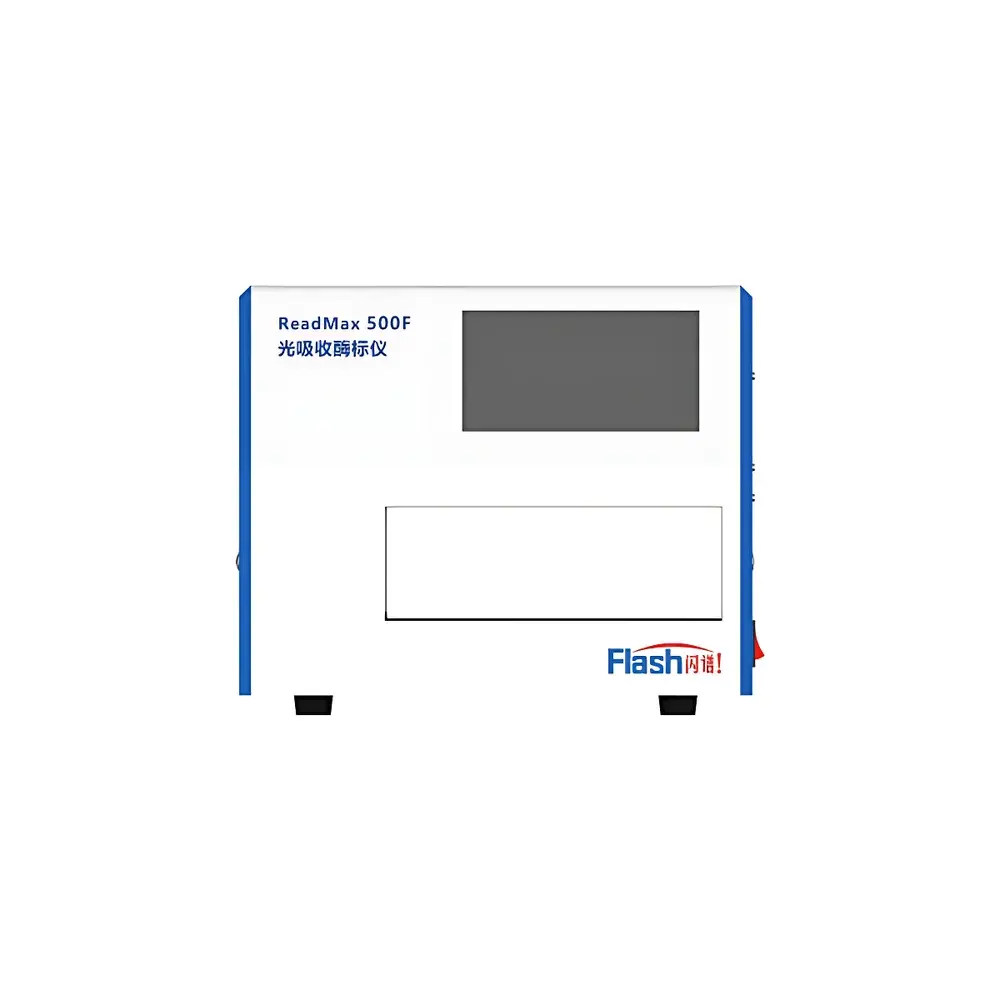
Flash Spectrum ReadMax 500F Absorbance Microplate Reader
| Brand | Flash Spectrum |
|---|---|
| Origin | Shanghai, China |
| Model | ReadMax 500F |
| Function Type | Absorbance-Only |
| Automation Level | Fully Automated |
| Assay Method | Endpoint |
| Calibration Curve Types | Single-Point & Linear Regression |
| Detector Type | Photodiode Array |
| Wavelength Range | 340–900 nm |
| Absorbance Range | 0–6 Abs |
| Linearity Range | 0–3 Abs (±2%) |
| Wavelength Switching Time | 6 s per filter |
| Precision | CV ≤ 0.2% (0–3 Abs) |
Overview
The Flash Spectrum ReadMax 500F is a fully automated, single-mode absorbance microplate reader engineered for precision endpoint quantification in life science and clinical research laboratories. It operates on the principle of Beer–Lambert law-based photometric measurement, utilizing a stable quartz-halogen light source and high-sensitivity photodiode detection to deliver reproducible optical density (OD) readings across the broad spectral range of 340–900 nm. Designed for rigorous adherence to assay protocols requiring high inter- and intra-run consistency—such as ELISA, protein quantification (Bradford, Lowry), cytotoxicity (MTT/XTT), enzyme kinetics (e.g., phosphatase or kinase activity), and endotoxin (LAL) testing—the ReadMax 500F supports standardized 96-well microplates exclusively. Its dual-reference architecture (blank reference + background reference) minimizes systematic error from plate heterogeneity or meniscus variation, while its 0.001 Abs resolution and certified linearity up to 3 Abs (±2%) meet routine QC requirements for GLP-compliant workflows.
Key Features
- Fully integrated 7-inch capacitive touchscreen interface—no external PC required for operation, method execution, or result review
- Internal filter wheel accommodating up to 16 interference filters; standard configuration includes 405 nm, 450 nm, and 620 nm filters optimized for common immunoassays and colorimetric assays
- Single-beam optical path with dual reference channels: dedicated blank reference well channel and independent background subtraction channel for enhanced baseline correction
- Two measurement modes: Fast Mode (6 s per 96-well plate) and Standard Mode (12 s), both supporting single- and dual-wavelength measurements
- Linear shaking module with three adjustable amplitude/speed settings to ensure homogeneous mixing prior to reading
- Optional incubation module (MF-10) available for temperature-controlled kinetic assays (25–45 °C, ±0.5 °C stability)
- LED light source upgrade option for extended operational lifetime (>20,000 h) and reduced thermal drift
- Onboard data management: stores up to 100 assay protocols and 100 full 96-well datasets with timestamped metadata
- Three USB 2.0 ports: one for PC connectivity (USB-to-serial emulation), one for USB flash drive export (CSV/Excel-compatible), and one for direct thermal printer output
Sample Compatibility & Compliance
The ReadMax 500F is validated for use with all ANSI/SBS-standard 96-well polystyrene, polypropylene, and UV-transparent microplates—including opaque, clear-bottom, and black-walled formats used in absorbance-coupled cell-based assays. It complies with ISO 15197:2013 (in vitro diagnostic devices — requirements for blood-glucose monitoring systems) for optical performance verification and supports traceable calibration using Flash Spectrum’s certified OD reference plates (NIST-traceable absorbance standards at 0.5, 1.0, 2.0, and 3.0 Abs). While not FDA 510(k)-cleared as an IVD device, its metrological specifications align with CLSI EP10-A3 guidelines for analytical measurement range verification and EP5-A3 for precision evaluation. Audit trail functionality is implemented via timestamped protocol logs and immutable result exports, facilitating internal GLP/GMP documentation practices.
Software & Data Management
The embedded firmware provides intuitive assay setup—including wavelength selection, plate mapping, reference well assignment, and kinetic interval definition—with real-time preview of raw OD values per well. All exported data files include embedded metadata: instrument ID, operator name (user-defined), date/time stamp, filter set used, measurement mode, and ambient temperature (monitored via onboard sensor). CSV outputs conform to MIAME-compliant column headers (Well ID, ODλ1, ODλ2, ΔOD, %CV, etc.) and are directly importable into GraphPad Prism, Microsoft Excel, or laboratory information management systems (LIMS). Firmware updates are delivered via USB drive and include version-controlled changelogs compliant with IEC 62304 Class B software safety requirements.
Applications
- Quantitative immunoassays: Endpoint ELISA/EIA for cytokines, hormones, and infectious disease markers (e.g., anti-HBsAg, HIV p24)
- Protein concentration determination using Bradford, Lowry, BCA, or biuret methods
- Cytotoxicity and proliferation assays: MTT, XTT, WST-1, and resazurin reduction kinetics
- Enzyme activity profiling: Alkaline phosphatase, horseradish peroxidase, β-galactosidase, and kinase-coupled ATPase assays
- Endotoxin quantification via Limulus Amebocyte Lysate (LAL) chromogenic endpoint assay
- Microbial growth monitoring: OD600 tracking in bacterial/fungal cultures
- Food safety screening: Nitrite, sulfite, and pesticide residue detection via colorimetric reaction chemistry
FAQ
What is the maximum number of filters supported, and how are they changed?
The ReadMax 500F accepts up to 16 interference filters mounted in its motorized filter wheel. Filter changes are fully automated and triggered by assay protocol selection—no manual intervention or tooling required.
Does the instrument support kinetic measurements?
Yes—single-well kinetic mode enables time-resolved absorbance acquisition at user-defined intervals (1–300 s), suitable for slow enzymatic reactions or cell viability monitoring over hours.
Is the system compatible with 384-well plates?
No. The optical path and plate carrier are mechanically and optically optimized exclusively for ANSI/SBS-compliant 96-well microplates.
How is photometric accuracy verified during routine use?
Users may perform daily verification using Flash Spectrum’s certified OD reference plates (Cat. No. RM-CAL-01), which provide NIST-traceable absorbance values at four wavelengths (405, 450, 570, and 630 nm) and three OD levels (0.5, 1.0, and 2.0 Abs).
Can measurement data be exported in compliance with 21 CFR Part 11?
While the ReadMax 500F does not implement electronic signatures or role-based access control natively, its immutable CSV exports, timestamped audit logs, and firmware update history support Part 11-aligned validation protocols when deployed within a validated LIMS or electronic lab notebook (ELN) environment.





