
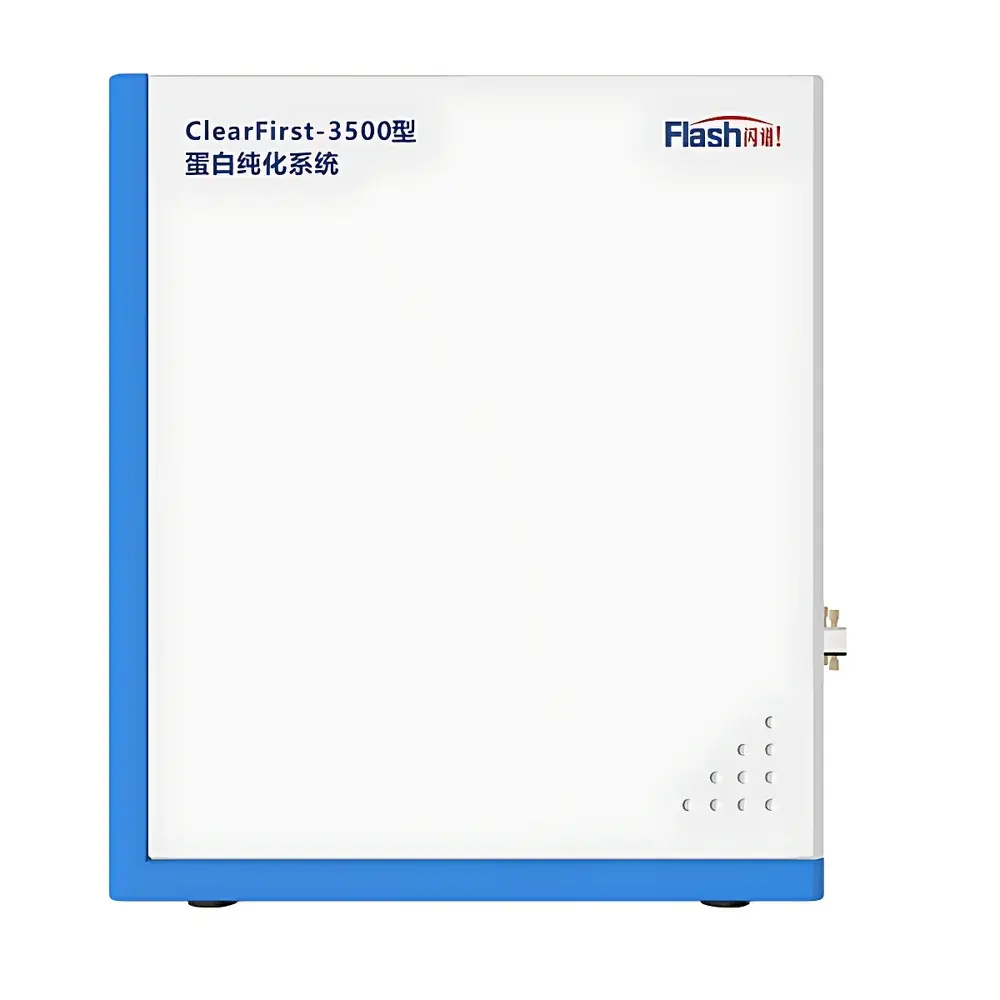
Flash Spectrum ClearFirst-3500 Protein Purification System
| Brand | Flash Spectrum |
|---|---|
| Origin | Shanghai, China |
| Model | ClearFirst-3500 |
| Flow Rate Range | 0.01–300 mL/min (optional up to 400 mL/min) |
| Pressure Range | 0–20 MPa (0–200 bar) at ≤50 mL/min |
| UV Wavelength Range | 190–850 nm |
| Detection Channels | Quad-wavelength simultaneous detection |
| Conductivity Range | 0–999.9 mS/cm |
| Conductivity Accuracy | ≤±0.01 mS/cm |
| Column Positions | 5 |
| Buffer Inlets | 4 (2 per pump) |
| Sample Inlets | 8 |
| Fraction Collection | X-Y matrix collector with 12 outlets (11 large-volume + waste), 18 mm tube rack (96-position), temperature-controlled |
| Gradient Formation | High-precision dual-pump gradient generation |
| System Compatibility | Aqueous biological buffers only |
| Software | ClearFirst-3500 Dedicated Workstation (Windows-based, GLP-compliant audit trail, method database, user management, instrument self-test) |
Overview
The Flash Spectrum ClearFirst-3500 Protein Purification System is a high-performance, fully automated preparative chromatography platform engineered for precision separation and purification of biomolecules—including recombinant proteins, monoclonal antibodies, nucleic acids, vaccines, and native proteins—under laboratory and pilot-scale conditions. Based on low-pulsation dual high-pressure piston pump architecture, the system implements true constant-flow delivery across its full operational range (0.01–300 mL/min, expandable to 400 mL/min), enabling seamless transition from analytical method development to process-scale optimization. Its modular fluidic design integrates bio-inert wetted materials (e.g., PEEK, titanium, sapphire, and fused silica) throughout all high-pressure zones, ensuring compatibility with aggressive aqueous buffers, chaotropic agents, and low-pH eluents commonly used in affinity, ion exchange, hydrophobic interaction, and size-exclusion chromatography. The system operates under programmable gradient control with real-time pressure monitoring at column inlet and outlet, supporting robust column lifetime management and reproducible retention time alignment across repeated runs.
Key Features
- Dual high-pressure piston pumps with four pump heads and independent degassing valves—minimizing flow pulsation and delivering baseline stability superior to peristaltic systems.
- Quad-wavelength UV-Vis detector (190–850 nm) with ±1 nm wavelength accuracy and selectable optical path lengths (2 mm standard; 5 mm and 10 mm optional) for flexible sensitivity tuning across concentration ranges.
- High-accuracy conductivity detector (0–999.9 mS/cm, ≤±0.01 mS/cm) featuring integrated temperature sensing and automatic temperature compensation using NIST-traceable calibration algorithms.
- Optional pH detector with active temperature correction, exceeding typical OEM specifications in resolution and drift stability.
- Automated high-pressure sample injection valve enabling precise, air-free switching between load, inject, and wash states—critical for reproducible loading of viscous or particulate-containing samples.
- Four-buffer inlet selection valve per pump (8 total buffer ports), supporting complex multi-step gradients and rapid mobile-phase reconfiguration without manual intervention.
- Integrated bypass and reverse-flush modules for rapid system equilibration, column regeneration, and removal of precipitated contaminants.
- X-Y matrix fraction collector with 12 independently controllable outlets (11 large-volume collection channels + waste), operating at ambient or temperature-controlled conditions (4–25 °C); compatible with 18×150 mm test tubes, 15 mL conical centrifuge tubes, and 96-well plates via interchangeable racks.
- Comprehensive pressure monitoring: dedicated transducers installed pre-column, post-column, and post-pump for real-time system diagnostics and overpressure protection.
- Modular expansion support: optional autosampler, bubble sensors (up to four locations), refrigerated cabinet integration, and pH/conductivity co-detection for multi-parameter process monitoring.
Sample Compatibility & Compliance
The ClearFirst-3500 is validated for use with aqueous-based biological buffers only—including Tris-HCl, phosphate, acetate, citrate, imidazole, guanidine HCl, and sodium chloride solutions—across pH 2.0–12.0 and conductivity up to 999.9 mS/cm. All fluid-contact surfaces comply with USP Class VI biocompatibility standards and meet ISO 10993-5 cytotoxicity requirements. The system supports Good Laboratory Practice (GLP) and Good Manufacturing Practice (GMP)-aligned workflows through built-in electronic signatures, user access levels (administrator/operator/analyst), method versioning, and full audit trail logging per FDA 21 CFR Part 11 guidelines. It accommodates columns up to 50 mm internal diameter and supports up to five column positions for serial or parallel configuration—enabling tandem purification strategies such as capture-polish-polish or orthogonal clean-up steps.
Software & Data Management
The ClearFirst-3500 Dedicated Workstation is a Windows-based application offering intuitive graphical method programming, real-time chromatogram visualization, and synchronized multi-detector data acquisition. The software includes a secure method database with encrypted storage, allowing users to store, retrieve, and execute pre-validated protocols with one-click activation. Instrument self-diagnostic routines verify pump performance, valve actuation, detector lamp status, and sensor calibration prior to run initiation. All raw data—including UV absorbance, conductivity, pH (if equipped), pressure, and fraction trigger events—are saved in vendor-neutral ASCII format (.csv) alongside proprietary binary files for long-term archival and third-party analysis. Audit trails record timestamped actions by user ID, including method edits, parameter changes, and fraction collection decisions—ensuring full traceability required for regulatory submissions.
Applications
The ClearFirst-3500 serves as a versatile platform for both discovery-stage protein characterization and scalable downstream processing development. Typical applications include: purification of His-tagged and GST-fusion proteins via immobilized metal affinity chromatography (IMAC); isolation of monoclonal antibodies using Protein A/G/L resins; polishing steps via cation/anion exchange or hydrophobic interaction chromatography (HIC); desalting and buffer exchange via size-exclusion chromatography (SEC); removal of endotoxins or host-cell proteins (HCPs); and preparative isolation of plasmid DNA or mRNA intermediates. Its wide flow range and pressure capability support column formats from analytical (4.6 mm ID) to semi-preparative (21.2 mm ID), making it suitable for early-stage screening, purity assessment, and gram-scale purification—all within a single, unified hardware and software environment.
FAQ
What types of chromatographic techniques does the ClearFirst-3500 support?
It supports affinity, ion exchange, hydrophobic interaction, size-exclusion, and mixed-mode chromatography—compatible with most commercially available resins and columns rated for ≤20 MPa.
Can the system be integrated into a cold room or chromatography refrigerator?
Yes—the compact footprint and front-accessible service points allow direct installation into standard 4 °C layer chromatography cabinets; optional temperature-controlled fraction collection maintains sample integrity during extended runs.
Is remote operation or network deployment supported?
The workstation supports local area network (LAN) connectivity for remote monitoring and method transfer; however, full remote control requires additional firewall configuration and IT validation per organizational cybersecurity policies.
How is calibration traceability maintained for detectors and sensors?
UV wavelength accuracy is verified using holmium oxide and didymium filters; conductivity calibration follows ASTM D1125 and ISO 7888 protocols using certified KCl standards; all calibration events are logged with operator ID and timestamp.
Does the system comply with FDA 21 CFR Part 11 requirements?
Yes—electronic records and signatures meet Part 11 criteria when deployed with enabled audit trail, role-based access control, and secure password policies as configured during initial setup.



