
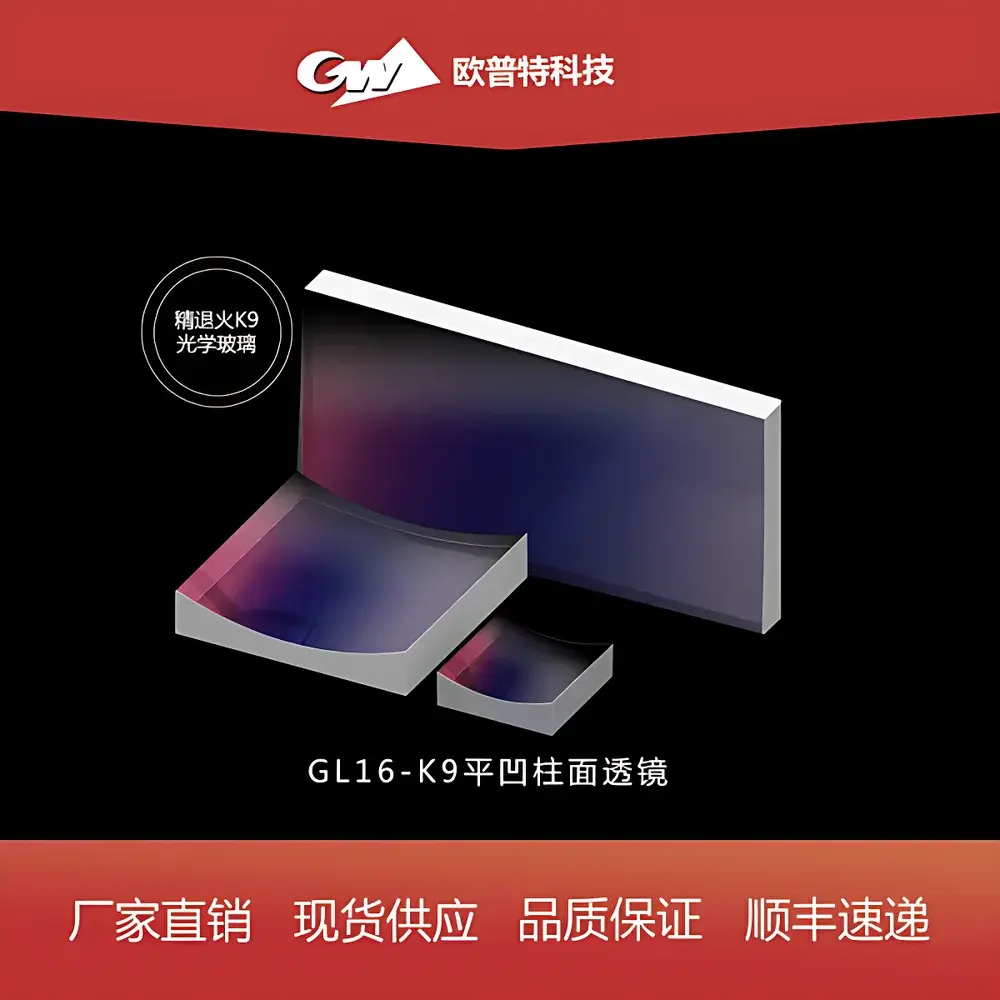
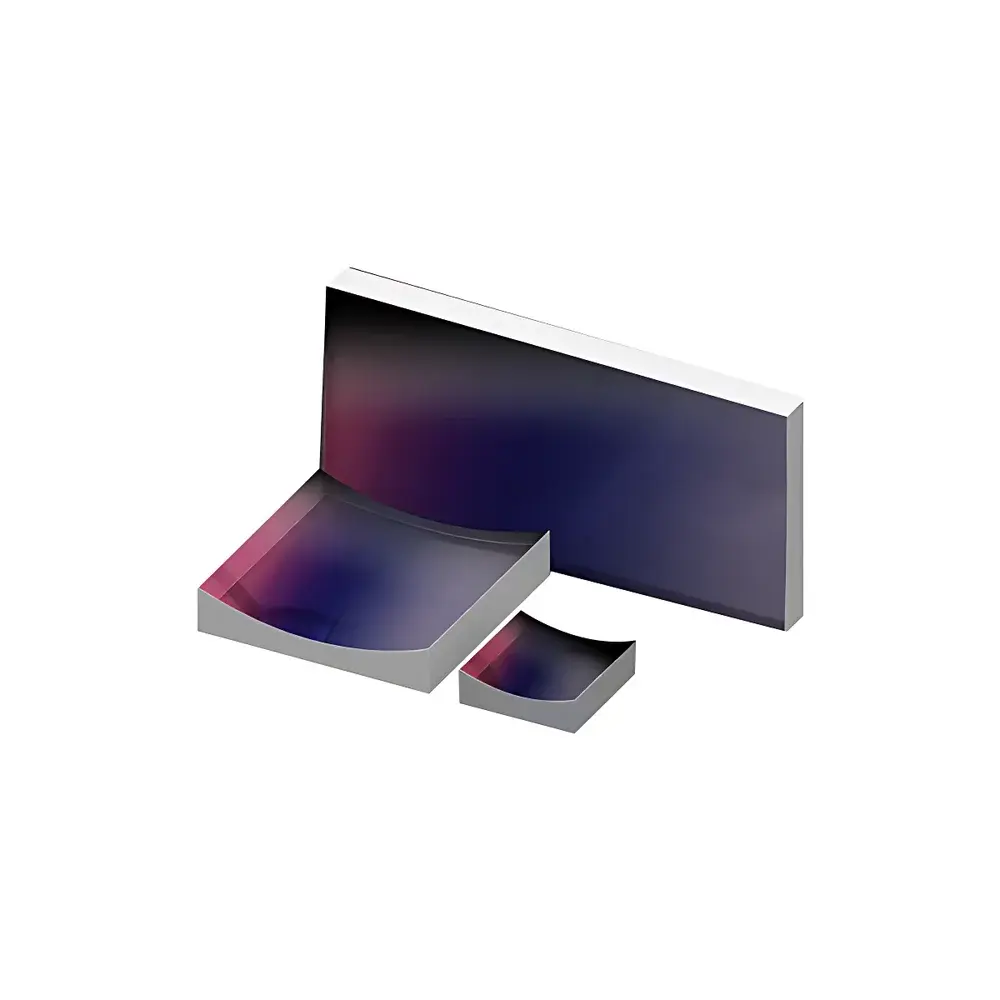
GL16-K9 Plano-Concave Cylindrical Lens with Visible-Band Anti-Reflection Coating
| Origin | Beijing |
|---|---|
| Manufacturer Type | Authorized Distributor |
| Regional Origin | China |
| Model | GL16-VIS |
| Price Range | USD 0.15–75.00 (per piece, volume-dependent) |
| Component Category | Optical Element |
| Coating Specification | Broadband AR, 650–1050 nm |
| Substrate Material | N-BK7 (Schott equivalent) |
| Surface Quality | 40-20 scratch-dig |
| Clear Aperture | ≥90% of nominal dimension |
| Focal Length Tolerance | ±1% |
| Centration Error | ≤3 arcmin |
| Wavefront Distortion | λ/4 @ 633 nm |
Overview
The GL16-K9 Plano-Concave Cylindrical Lens is a precision optical component engineered for beam shaping, line generation, anamorphic correction, and astigmatic focusing in visible-light optical systems. Unlike spherical lenses, cylindrical lenses possess curvature along only one axis—enabling controlled divergence or convergence in a single plane while preserving collimation in the orthogonal direction. This GL16 series employs high-homogeneity N-BK7 optical glass (compliant with ISO 10110-2 and MIL-O-13830 standards), optimized for low wavefront error and minimal birefringence. Each lens features a plano surface on one side and a concave cylindrical surface on the other, with radius of curvature precisely matched to the specified effective focal length (EFL). The broadband anti-reflection (BBAR) coating deposited via ion-assisted e-beam evaporation achieves 99% per surface) and reduced ghosting in multi-element assemblies such as laser line projectors, spectroscopic slit illuminators, and optical coherence tomography (OCT) reference arms.
Key Features
- Strict conformance to ISO 10110-1 dimensional tolerances: EFL ±1%, center thickness ±0.1 mm, radius tolerance ±0.2%
- Surface quality rated at 40-20 scratch-dig per MIL-PRF-13830B, verified by interferometric inspection
- Coating durability validated to ISO 9211-4 Class 2 (adhesion, humidity, abrasion)
- Available in 21 standard dimensions (rectangular clear apertures from 8.0×4.0 mm to 53.0×50.8 mm) and 17 discrete focal lengths ranging from –4.0 mm to –1000 mm
- Dual product coding: GL16-XXX-VIS denotes visible-band AR; NIR and SWIR variants (e.g., GL16-XXX-NIR) are offered separately with tailored coatings
- Back focal length (BFL) and radius of curvature (R₁) provided for each configuration to support paraxial ray tracing and Zemax/OpticStudio modeling
Sample Compatibility & Compliance
These lenses are compatible with standard optomechanical mounts (e.g., Thorlabs SM1-threaded lens tubes, Kinematic mounts with adjustable tilt) and integrate seamlessly into OEM laser diode modules, confocal microscopy scan optics, and industrial machine vision lighting engines. All GL16-K9 lenses comply with RoHS 2015/863/EU and REACH SVHC regulations. The N-BK7 substrate meets ASTM F2301-18 specifications for optical crown glass, including refractive index uniformity (Δn ≤ 5×10⁻⁶), stress birefringence (<5 nm/cm), and bubble/inclusion limits per ISO 10110-3. No hazardous substances are introduced during coating or edge finishing. Documentation includes traceable metrology reports (interferometric surface figure, spectral transmittance curves, and coating adhesion test records) upon request for GMP/GLP environments.
Software & Data Management
Each lens variant is supported by downloadable optical design files (.zmx, .sdp, .fco) compatible with Zemax OpticStudio, Synopsys CODE V, and Oslo EDU. A comprehensive parametric datasheet—structured in CSV and Excel formats—includes all geometrical parameters (X×Y clear aperture, EFL, BFL, R₁, center thickness, edge thickness), coating performance graphs (R% vs. wavelength), and mechanical drawings with GD&T callouts. For integration into automated optical alignment workflows, the GL16 series supports standardized part numbering (e.g., GL16-40×20-250-VIS) enabling direct import into ERP/MES systems (SAP, Oracle) and digital twin libraries. Traceability is maintained through batch-specific serial tags embedded in packaging labels (ISO/IEC 15420 compliant).
Applications
- Laser line generation in structured light 3D scanning systems (e.g., triangulation sensors operating at 635 nm or 785 nm)
- Anamorphic beam expansion for diode-pumped solid-state (DPSS) lasers requiring circularization of elliptical output
- Optical pumping cavity design where asymmetric focusing improves absorption uniformity in gain media
- Fluorescence microscopy illumination optics—shaping excitation light into thin sheets for light-sheet (LSFM) configurations
- Industrial sorting systems using line-scan cameras, where uniform line intensity profile minimizes shading artifacts
- Interferometric calibration setups requiring known cylindrical wavefront divergence for null testing
FAQ
What is the damage threshold for these lenses under CW laser illumination?
For continuous-wave operation at 532 nm, the coated N-BK7 surface exhibits a laser-induced damage threshold (LIDT) of ≥5 J/cm² (1064 nm, 10 ns, 10 Hz), per ISO 21254-1 testing. Actual LIDT depends on beam diameter, spatial profile, and thermal management.
Can custom focal lengths or non-standard dimensions be manufactured?
Yes—custom geometries, alternate substrates (e.g., fused silica for UV or high-power applications), and specialized coatings (e.g., 0° AOI V-coating at 780 nm) are available under NRE-supported engineering programs with lead times of 6–10 weeks.
Is mounting hardware included with purchase?
No—mounting solutions (e.g., kinematic lens holders, SM1-threaded retaining rings) are sold separately to allow system-specific mechanical integration.
How is centration error measured and guaranteed?
Centration is verified using a precision autocollimator and rotary stage per ISO 10110-5; reported values reflect maximum deviation between optical and mechanical axes, with standard units guaranteed ≤3 arcmin (≤0.05°).
Are Zemax-compatible non-sequential models available for stray light analysis?
Yes—scatter models incorporating surface roughness PSD data and coating layer stack interference effects are provided for advanced stray light simulation upon execution of a simple NDA.




