
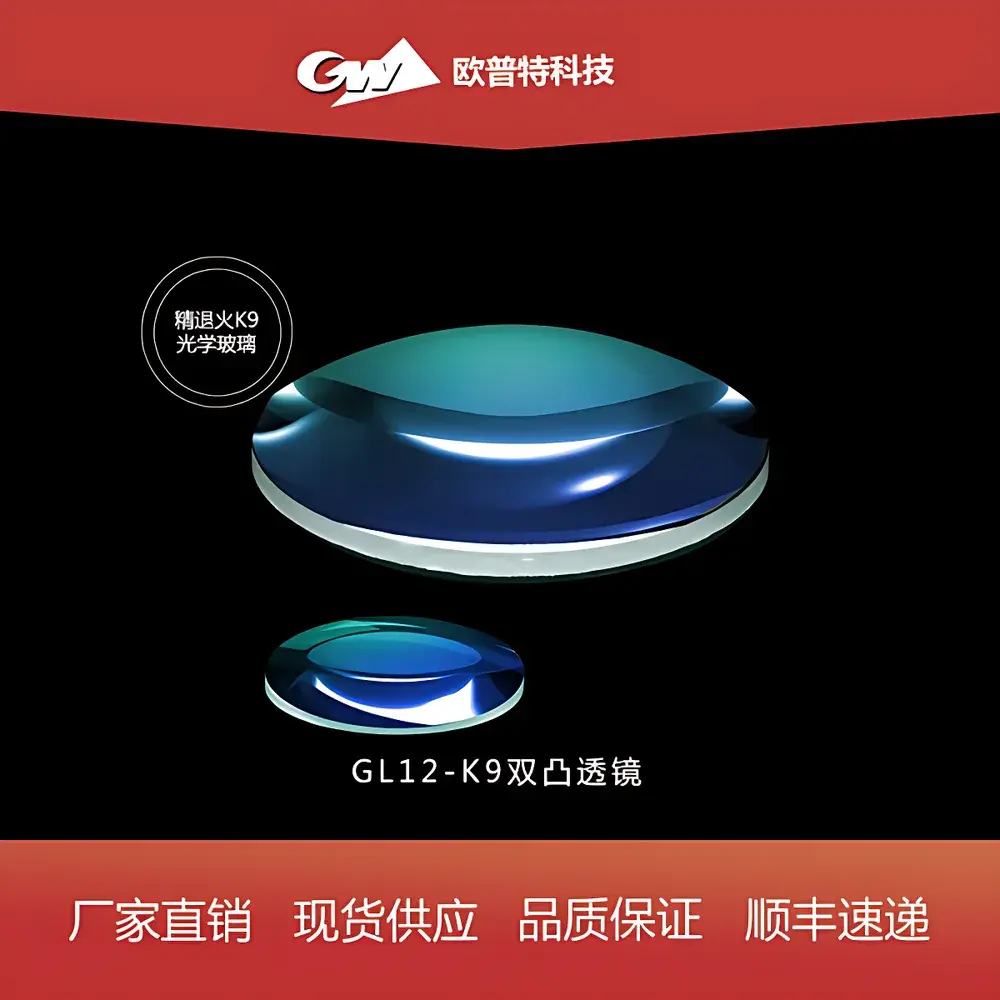
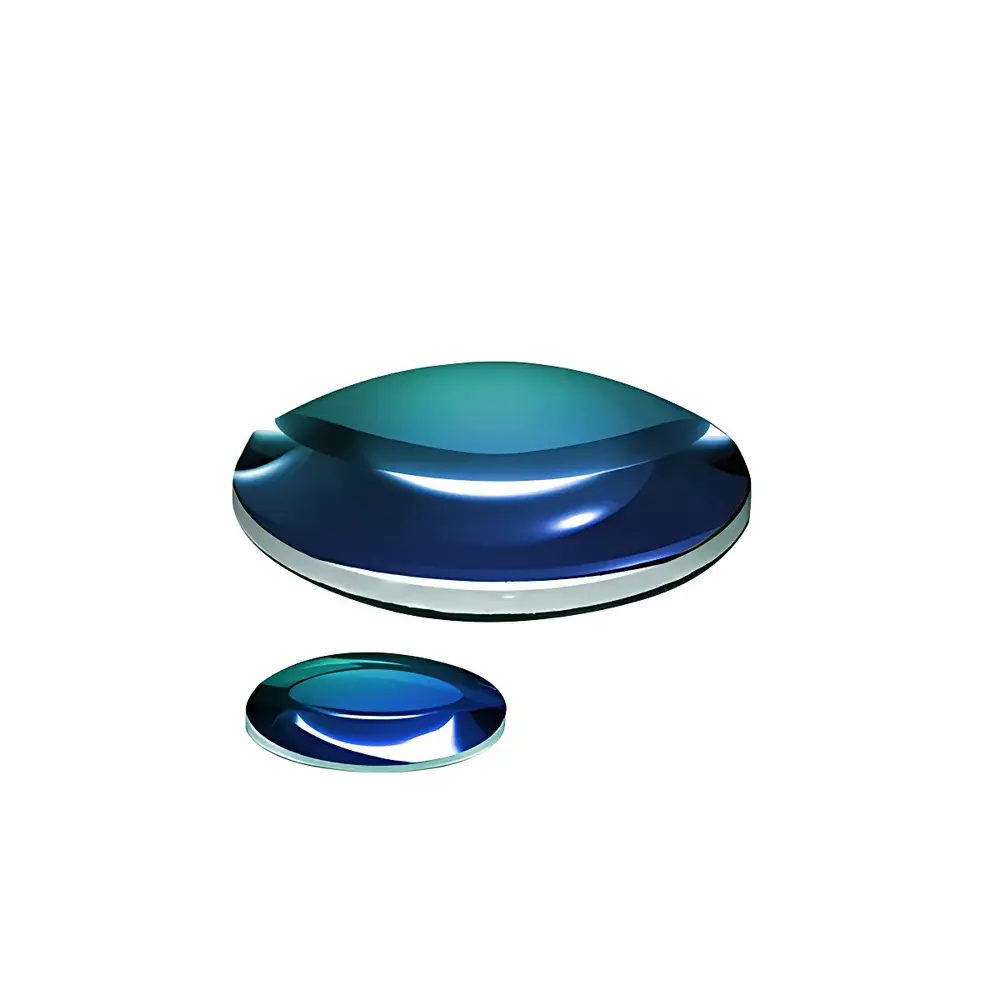
GL12-NIR K9 Double-Convex Lens with Broadband Anti-Reflection Coating for Near-Infrared (650–1050 nm), Diameter 2–100 mm
| Origin | Beijing, China |
|---|---|
| Manufacturer Type | Distributor |
| Regional Origin | Domestic (China) |
| Model | GL12-NIR |
| Price Range | USD 0.15–75.00 (per piece, volume-dependent) |
| Component Category | Optical Element |
| Material | Precision-Annealed K9 Optical Glass |
| Design Wavelength | 587.6 nm |
| Diameter Tolerance | +0.0 / −0.1 mm |
| Center Thickness Tolerance | ±0.2 mm |
| Surface Irregularity | λ/4 @ 632.8 nm |
| EFL Tolerance | ±2% |
| Centration Error | 3 arcmin |
| Surface Quality | 3–4 scratch-dig |
| Edge Treatment | 0.2 mm × 45° chamfer |
| Coating | Broadband AR for NIR (650–1050 nm) |
Overview
The GL12-NIR is a precision-engineered double-convex lens fabricated from homogenously annealed K9 borosilicate crown glass—a material widely specified in optical design for its excellent transmission across the visible and near-infrared (NIR) spectrum (400–1050 nm), low bubble/inclusion content, and predictable thermal and mechanical stability. Designed to operate at a primary design wavelength of 587.6 nm (the helium d-line), this lens adheres to ISO 10110-3 standards for surface form and irregularity (λ/4 @ 632.8 nm HeNe wavelength). Its symmetric biconvex geometry provides positive focal power ideal for collimation of point sources, focusing of collimated beams, and use in relay or imaging systems where minimal spherical aberration is required at moderate conjugate ratios. The broadband anti-reflection coating (AR@650–1050 nm) reduces average reflectance to <0.5% per surface over the NIR band, significantly enhancing throughput in spectrometers, laser diode coupling assemblies, NIR spectroscopy modules, and machine vision illumination paths operating beyond 650 nm.
Key Features
- Precision-annealed K9 optical glass substrate with certified homogeneity (Δn ≤ 5×10⁻⁶) and stress birefringence < 5 nm/cm, ensuring consistent wavefront fidelity.
- Broadband NIR anti-reflection coating deposited via ion-assisted e-beam evaporation—meets MIL-C-48497A spectral durability requirements and withstands standard cleaning protocols (ISO 10110-7 compliant).
- Tight mechanical tolerances: diameter tolerance +0.0/−0.1 mm; center thickness ±0.2 mm; centration error ≤3 arcminutes—enabling direct integration into kinematic mounts and SM-threaded lens tubes without iterative alignment.
- Surface quality rated 3–4 scratch-dig per ISO 10110-7, verified under 50× dark-field inspection; surface irregularity λ/4 peak-to-valley @ 632.8 nm measured interferometrically.
- Edge treatment: 0.2 mm × 45° protective chamfer applied to both peripheries to mitigate chipping during handling and mounting.
- Available in diameters from 2 mm to 100 mm, with corresponding effective focal lengths (EFL) scalable from sub-millimeter to >500 mm—custom focal lengths and aspheric variants available upon request under OEM agreements.
Sample Compatibility & Compliance
The GL12-NIR lens is compatible with industry-standard optomechanical interfaces including SM-series threaded mounts (e.g., SM1, SM2), cage systems (e.g., Thorlabs 30 mm and 60 mm), and custom machined lens cells. It meets RoHS Directive 2011/65/EU and REACH Annex XVII compliance for restricted substances. While not individually certified to ISO 9001, all batches undergo incoming material certification per ISO 10110-2 (material specification) and outgoing inspection per ISO 10110-5 (surface quality and dimensional verification). For regulated applications—including medical optical subsystems (IEC 60601-2-57) or aerospace avionics (AS9100 traceability)—full lot traceability documentation (including interferometric test reports and coating spectral scans) is provided upon order confirmation.
Software & Data Management
No embedded firmware or software is associated with this passive optical component. However, full technical data—including measured transmission spectra (200–1600 nm), coating performance curves, interferograms, and Zemax-compatible .ZBF/.DAT surface profile files—is supplied digitally in PDF and ASCII formats upon shipment. All metrology data conforms to NIST-traceable calibration practices. For integration into automated optical assembly lines, dimensional and coating specifications are exportable to MRP/ERP systems via CSV or XML schema aligned with IPC-2581 standards.
Applications
- NIR spectral analysis: Coupling light into fiber-optic probes and FTIR sample compartments (e.g., in pharmaceutical raw material ID per USP ).
- Laser diode beam shaping: Collimating 780 nm, 808 nm, 850 nm, and 980 nm pump diodes in solid-state laser cavities and fiber amplifier stages.
- Machine vision illumination: Homogenizing NIR LED arrays for semiconductor wafer inspection and agricultural sorting systems.
- Thermal imaging pre-optics: Focusing SWIR radiation (up to 1050 nm) onto InGaAs detector arrays in industrial process monitoring.
- Educational optics labs: Demonstrating Gaussian beam propagation, ABCD matrix modeling, and aberration theory using calibrated focal length sets (e.g., GL12-NIR-003, -010, -025 series).
FAQ
Is the NIR coating optimized for 650–1050 nm only, or does it provide incidental suppression in the visible range?
The coating design prioritizes minimum reflectance across 650–1050 nm; residual reflectance in the visible band (400–650 nm) remains uncontrolled and typically exceeds 1.5% per surface.
Can these lenses be used in vacuum or high-humidity environments?
Yes—the K9 substrate and oxide-based AR coating are stable under 10⁻⁵ Torr vacuum and 95% RH at 40°C per ASTM E1014 accelerated aging tests; outgassing rates comply with ECSS-Q-ST-70-02C Class B limits.
Do you supply interferometric test reports for individual lenses?
Standard orders include batch-level interferograms; individual-lens certification (with serial-numbered report) is available as a value-added service at +12% cost premium.
What is the maximum permissible power density for continuous-wave NIR lasers?
For uncoated K9, damage threshold is ~15 J/cm² at 1064 nm, 10 ns pulse; for CW operation at 808 nm, conservative derating yields 500 W/cm² with active cooling—contact engineering support for application-specific LIDT validation.
Are custom diameters or focal lengths available with the same NIR coating?
Yes—custom geometries (including non-standard EFLs, aspheres, and hybrid profiles) are supported under NRE-based prototyping contracts with lead times from 4–6 weeks.





