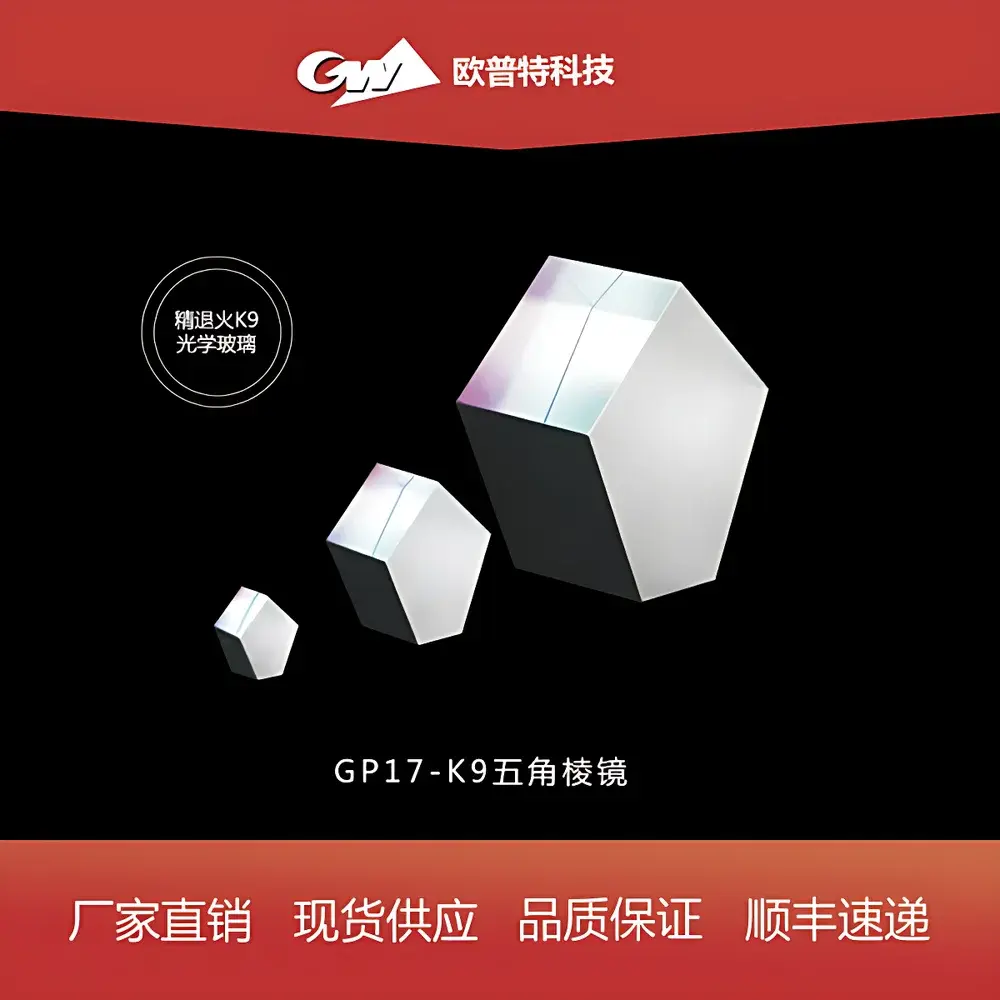
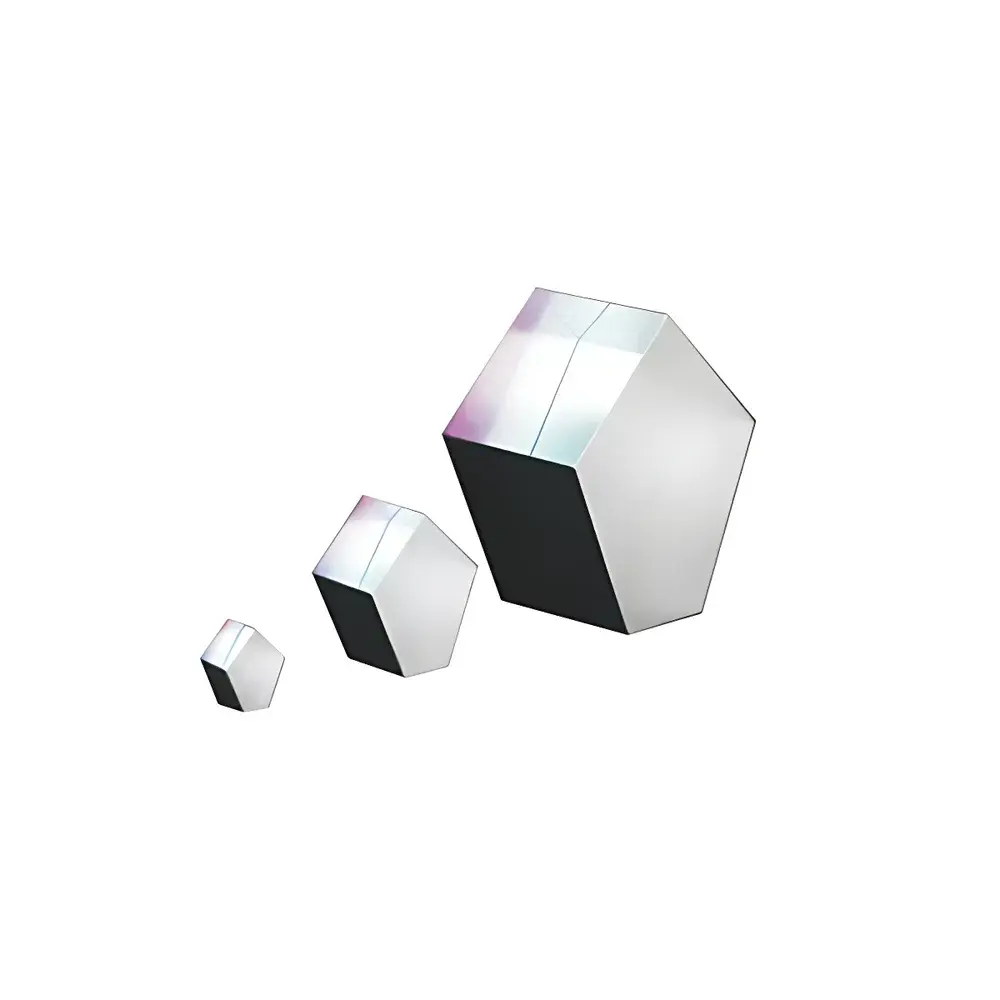
GP17–K9 Pentaprism

| Material | K9 optical glass (precision annealed) |
|---|---|
| Dimensional tolerance | +0.0 / −0.2 mm |
| Beam deviation angle | 90° ± 3′ (GP17-005-01) or 90° ± 30″ (other variants) |
| Surface flatness | λ/10 @ 632.8 nm |
| Surface quality | 3–4 scratch-dig |
| Edge chamfer | < 0.25 mm × 45° |
| Coating | Aluminum reflective coating with black paint protection on reflecting faces |
| Component category | Optical element |
Ask about pricing, availability and specifications.
Overview
The GP17–K9 Pentaprism is a precision optical component engineered for stable, fixed-angle beam deviation in alignment, metrology, and optical system integration applications. Unlike conventional right-angle prisms requiring precise angular orientation, the pentaprism inherently deviates incident light by exactly 90° through two internal reflections—regardless of minor rotational or translational misalignments. This mechanical insensitivity arises from its five-face geometry and total internal reflection (TIR)-free design: light enters one face, reflects off two orthogonal mirrored surfaces, and exits perpendicularly to the input direction. Constructed from precision-annealed K9 borosilicate crown glass, the GP17 series ensures low birefringence, high homogeneity, and thermal stability suitable for laboratory-grade instrumentation and OEM optical assemblies.
Key Features
- Stable 90° beam deviation with angular tolerance of ±3′ (for GP17-005-01) or ±30″ (for GP17-010 through GP17-040), verified at 632.8 nm He–Ne wavelength
- Optical surface flatness maintained at λ/10 RMS over the clear aperture, supporting interferometric and collimation-critical setups
- Surface quality rated to 3–4 scratch-dig per MIL-PRF-13830B, ensuring minimal scatter in high-sensitivity imaging and laser delivery paths
- Aluminum reflective coating (R > 88% @ 400–700 nm) applied to two internal reflecting faces, protected by matte black paint to suppress stray light and reduce ghost reflections
- Single-layer magnesium fluoride (MgF₂) anti-reflection coating on entrance and exit faces (R < 1.5% average per surface, 400–700 nm), minimizing Fresnel losses and residual etalon effects
- Controlled edge chamfer (< 0.25 mm × 45°) prevents chipping during handling and mounting while preserving functional clear aperture integrity
Sample Compatibility & Compliance
The GP17–K9 Pentaprism is compatible with standard optomechanical mounts including kinematic mirror mounts, prism tables, and cage-system adapters (e.g., Thorlabs SM1, Ø1″ post holders). Its K9 substrate meets ISO 10110-3:2019 specifications for optical glass homogeneity and stress birefringence (≤ 5 nm/cm). The aluminum/MgF₂ coating stack complies with ISO 9211-4:2021 for durability under standard environmental conditions (Class 1 abrasion resistance, humidity cycling per MIL-C-48497A). No hazardous substances are used in manufacturing; RoHS 3 and REACH SVHC declarations are available upon request for traceability in regulated instrumentation supply chains.
Software & Data Management
As a passive optical component, the GP17–K9 Pentaprism requires no embedded firmware, drivers, or software interfaces. However, it is fully compatible with industry-standard optical design and tolerancing workflows—including Zemax OpticStudio, CODE V, and FRED—where its exact geometric parameters (face angles, refractive index dispersion n(λ), coating spectral reflectance/transmittance data) can be imported via manufacturer-provided .ZMX or .DAT files. Calibration certificates (including interferometric surface map reports and spectral reflectance scans) are supplied with each unit for GLP-compliant documentation and traceable system-level verification.
Applications
- Laser alignment systems in semiconductor lithography tooling and industrial laser processing workstations
- Reference optics in autocollimators, theodolites, and coordinate measuring machine (CMM) vision subsystems
- Beam folding in compact spectrometers, OCT interferometers, and confocal microscope scan engines
- Teaching labs for wavefront analysis, polarization-independent path reversal, and ray-tracing validation exercises
- OEM integration into medical endoscopic illumination channels and aerospace attitude reference sensors where mechanical drift immunity is critical
FAQ
What is the maximum recommended power density for continuous-wave laser use?
For uncooled operation with 1064 nm CW lasers, the damage threshold is ≥ 500 W/cm² (tested per ISO 21254-1 with 10.6 µm CO₂ reference calibration). For UV or pulsed lasers, consult the coating-specific LIDT report included with shipment.
Can this pentaprism be used in vacuum environments?
Yes—K9 glass and MgF₂/Al coatings exhibit negligible outgassing (per ASTM E595: TML < 0.5%, CVCM < 0.1%). Vacuum-compatible mounting hardware is recommended for differential thermal expansion management.
Is custom size or coating available?
Standard GP17 dimensions are offered as listed; custom apertures, tighter angular tolerances (±5″), or broadband dielectric HR coatings (e.g., 532/1064 nm dual-band) are available under NRE-supported OEM agreements.
How is surface flatness verified?
Each unit undergoes full-aperture phase-shifting interferometry using a Zygo Verifire™ HD system referenced to NIST-traceable standards; raw interferograms and PV/RMS data are archived and provided upon request.
Does the black paint affect thermal stability?
The matte black epoxy-based paint has CTE matched to K9 (≈ 7.1 × 10⁻⁶ /°C) and passes thermal shock testing from −40°C to +85°C per MIL-STD-810G Method 503.5.