
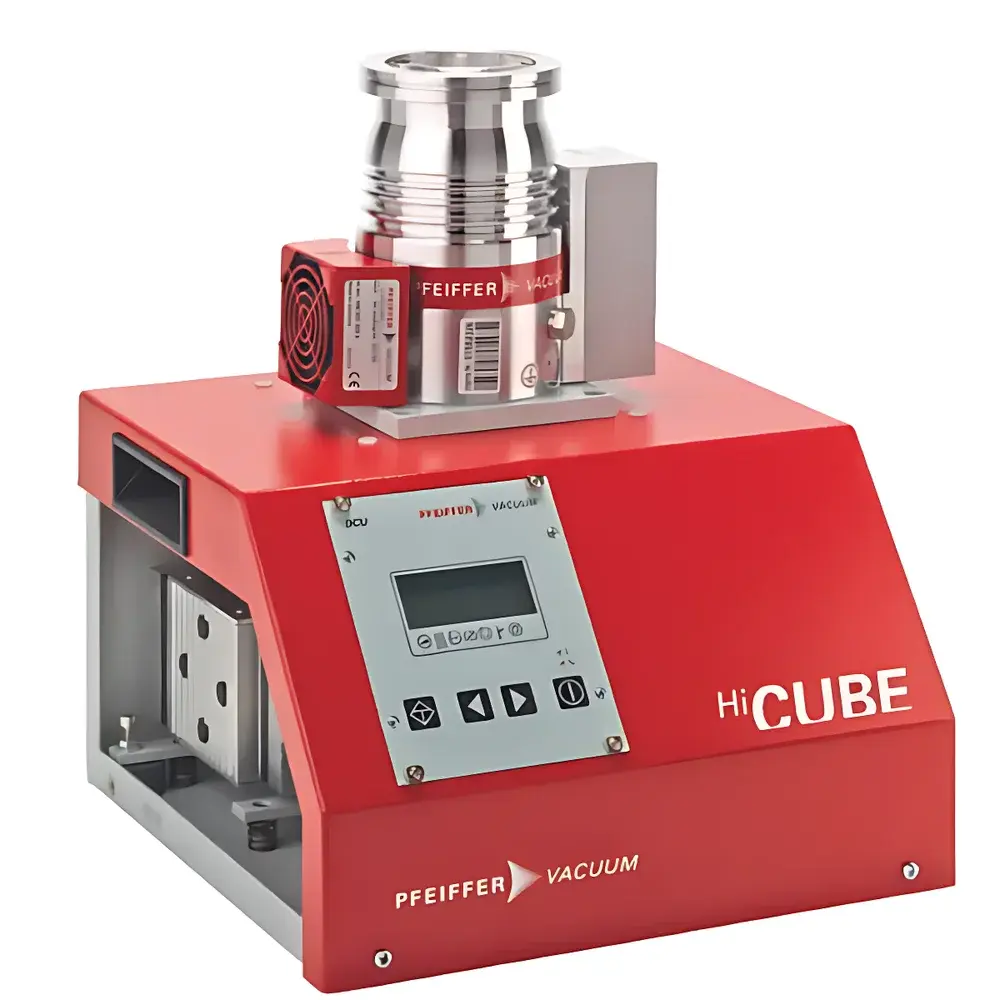
Pfeiffer Vacuum HiCube 80 Eco Turbo-Molecular Pump System
| Brand | Pfeiffer Vacuum |
|---|---|
| Origin | Germany |
| Model | HiCube 80 Eco |
| Pump Type | Oil-Free Turbo-Molecular Pump System |
| Ultimate Pressure | <1×10⁻⁸ Pa (without gas ballast) |
| Pumping Speed (N₂) | 67 L/s at DN 63 CF-F inlet |
| Pre-vacuum Pump | MVP 015-2 multi-stage diaphragm pump |
| Forepump Speed | 1 m³/h (16.67 L/min, N₂) |
| Ultimate Forepressure | <1×10⁻² Pa |
| Cooling | Convection-cooled (standard) |
| Power Supply | 100–240 V AC, 50/60 Hz |
| Max. Power Consumption | 170 W |
| Sound Pressure Level | ≤50 dB(A) |
| Inlet Flange | DN 63 CF-F |
| Outlet Flange | G 1/8" |
| Dimensions (W×D×H) | 352 × 301 × 302 mm |
| Weight | 13.5 kg |
| Compliance | CE, RoHS, ISO 9001 certified |
| Control Interface | Integrated digital controller with status LEDs and RS-232/USB option |
Overview
The Pfeiffer Vacuum HiCube 80 Eco is a fully integrated, oil-free turbo-molecular pump system engineered for reliable, high-performance vacuum generation in demanding laboratory and R&D environments. Combining the HiPace 80 turbomolecular pump with the MVP 015-2 dry multi-stage diaphragm forepump, this compact unit delivers stable ultra-high vacuum (UHV) conditions down to <1×10⁻⁸ Pa—without oil contamination or hydrocarbon backstreaming. Its convection-cooled design eliminates the need for external water cooling or forced-air systems, reducing infrastructure dependencies while maintaining thermal stability during extended operation. The system operates on universal AC input (100–240 V, 50/60 Hz), making it suitable for global deployment across university cleanrooms, surface science labs, mass spectrometry platforms, and thin-film deposition setups requiring reproducible base pressures and rapid pump-down cycles.
Key Features
- Fully integrated, plug-and-play architecture with pre-aligned turbomolecular and backing pump stages
- Eco-mode operation reduces energy consumption by up to 90% during idle or low-load process intervals
- Oil-free, hydrocarbon-free pumping path ensures sample integrity for sensitive applications including electron microscopy, XPS, and residual gas analysis
- DN 63 CF-F inlet flange enables direct integration into UHV-compatible stainless-steel systems per ISO-KF/CF standards
- Intelligent digital controller with real-time status indicators (pump speed, temperature, error codes) and optional RS-232/USB communication for remote monitoring and automation
- Low acoustic signature (≤50 dB(A)) suitable for shared laboratory spaces and noise-sensitive instrumentation suites
- Robust mechanical design compliant with CE, RoHS, and ISO 9001 manufacturing protocols
Sample Compatibility & Compliance
The HiCube 80 Eco is compatible with inert, reactive, and mildly corrosive gases—including N₂, Ar, O₂, and H₂—within standard operating parameters. It is not intended for condensable vapors, solvent-laden streams, or highly aggressive halogenated compounds without additional gas handling safeguards. All internal wetted materials conform to ultra-high purity requirements: rotor blades are made from high-strength aluminum alloy with precision-balanced dynamic geometry; stator components utilize vacuum-grade stainless steel and ceramic insulators. The system meets electromagnetic compatibility (EMC) Directive 2014/30/EU and Low Voltage Directive 2014/35/EU. Documentation supports GLP-compliant validation workflows, including traceable calibration records and factory test reports aligned with ISO 27025 principles.
Software & Data Management
While the HiCube 80 Eco operates autonomously via its embedded controller, optional PC connectivity enables integration into centralized vacuum management platforms. The included software suite (via USB or RS-232) provides time-stamped operational logs—including rotational speed history, temperature profiles, start/stop timestamps, and fault event codes—supporting audit-ready data retention for ISO/IEC 17025 or FDA 21 CFR Part 11–aligned quality systems. Export formats include CSV and XML, facilitating import into LIMS or ELN environments. No proprietary runtime or license activation is required; firmware updates are delivered as signed binary packages with SHA-256 verification.
Applications
- Surface analysis instruments: Auger electron spectroscopy (AES), X-ray photoelectron spectroscopy (XPS), and secondary ion mass spectrometry (SIMS)
- Electron microscopy: Transmission (TEM) and scanning (SEM) systems requiring stable <1×10⁻⁷ Pa base pressure
- Thin-film deposition: Physical vapor deposition (PVD), molecular beam epitaxy (MBE), and sputtering chambers
- Research-scale mass spectrometry: Time-of-flight (TOF), quadrupole, and ion trap configurations
- Accelerator and particle detector test benches where hydrocarbon-free vacuum is mandatory
- Calibration laboratories performing vacuum gauge intercomparisons per ISO 3567 and ASTM E1953
FAQ
What is the recommended maintenance interval for the HiCube 80 Eco?
Pfeiffer Vacuum specifies a 12-month or 4,000-hour operational interval for routine inspection—primarily visual verification of inlet filter integrity, cable connections, and mounting hardware. No scheduled lubrication or rotor servicing is required due to magnetic bearing design.
Can the HiCube 80 Eco be operated vertically or inverted?
No. The unit must be installed in its designated orientation (as shipped) to ensure proper convection cooling and rotor dynamics. Deviation may impair thermal dissipation and trigger overtemperature shutdown.
Is the MVP 015-2 forepump chemically resistant?
The MVP 015-2 features PTFE-coated diaphragms and EPDM elastomers, offering resistance to common laboratory gases and mild acids. For chlorine, fluorine, or ammonia service, consult Pfeiffer’s chemical compatibility matrix and consider optional Viton® sealing kits.
Does the system support automated venting or pressure regulation?
Not natively. Integration with external pneumatic valves and pressure controllers (e.g., VAT or MKS series) is required for programmable venting or active pressure stabilization. The HiCube controller provides TTL-level interlock outputs for synchronization.
How does Eco-mode affect pump-down time?
Eco-mode reduces rotor speed during non-critical phases but does not engage during initial roughing or high-throughput evacuation. Full-speed operation resumes automatically upon detection of rising chamber pressure or user-initiated “turbo boost” command.



