
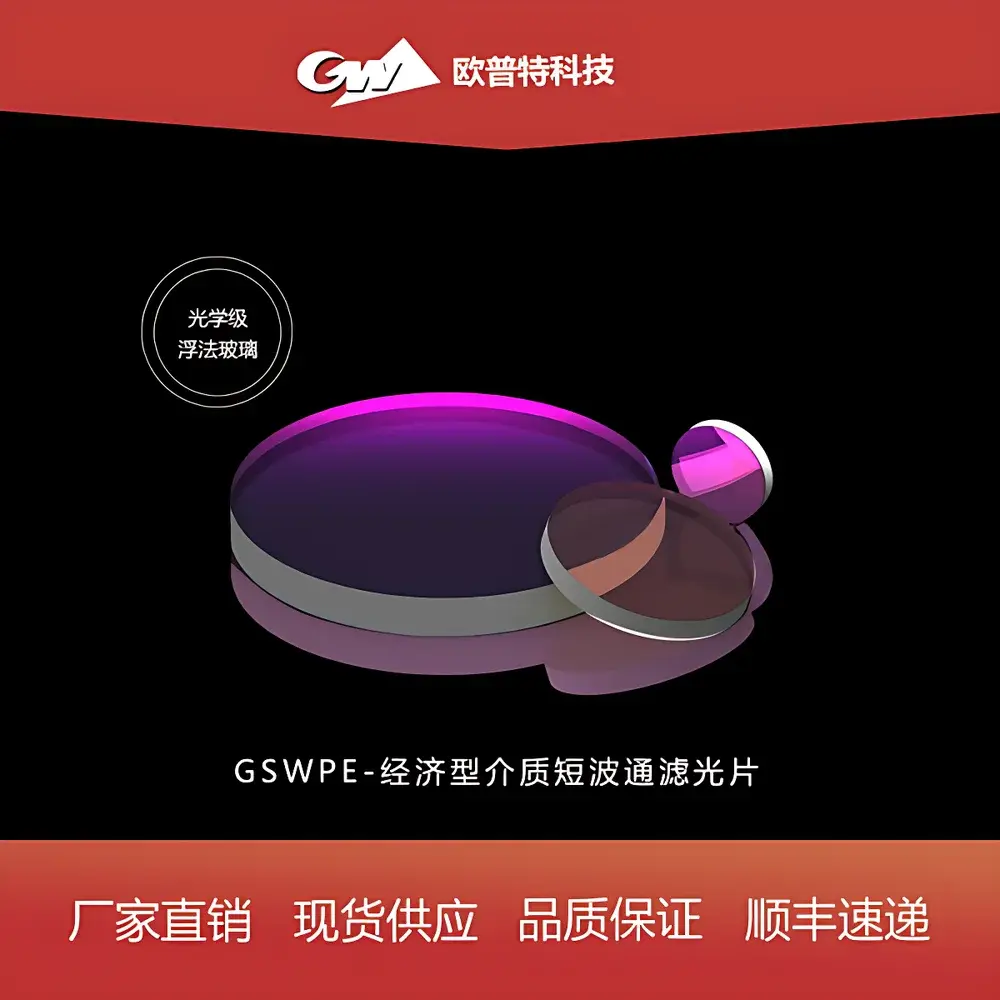
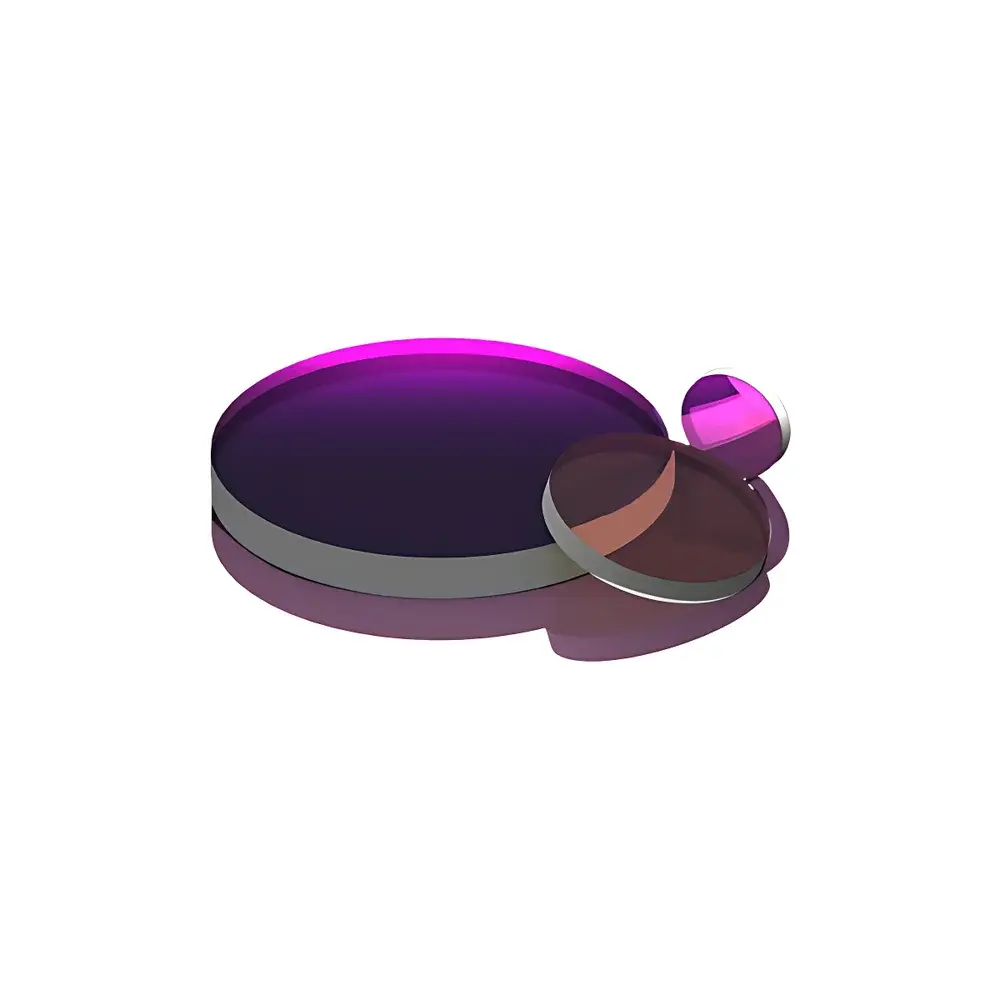
GSWPE Economical Short-Wave Pass Optical Filter
| Origin | Beijing |
|---|---|
| Manufacturer Type | Distributor |
| Origin Category | Domestic |
| Model | GSWPE |
| Price Range | USD 0.15–75.00 |
| Component Category | Optical Element |
| Available Diameters | Φ12.5 mm, Φ25 mm, Φ50 mm |
| Center Wavelengths (CWL) | 400–1100 nm (in 50 nm increments) |
| Transmission Band | e.g., 250–385 nm @ CWL 400 nm |
| Blocking Band | e.g., 420–485 nm @ CWL 400 nm |
| Substrate Material | Optical-grade fused silica or BK7 (standard) |
| Surface Quality | 60-40 scratch-dig |
| Parallelism | <1 arcmin |
| Thickness Tolerance | ±0.1 mm |
| Coating Type | Hard-dielectric multilayer interference coating |
| Damage Threshold | >5 J/cm² @ 1064 nm, 10 ns, 10 Hz (typ.) |
Overview
The GSWPE Economical Short-Wave Pass Optical Filter is a precision interference-based spectral filtering component engineered for reliable wavelength selection in UV–VIS–NIR optical systems. It operates on the principle of thin-film dielectric interference, where alternating high- and low-refractive-index layers are deposited onto optically polished substrates to produce sharp spectral transitions between transmission and blocking bands. Unlike absorptive filters, the GSWPE series achieves high transmission (>90% avg.) within its designated passband while maintaining optical density (OD ≥4) across defined blocking regions—enabling effective suppression of out-of-band radiation without thermal load accumulation. Designed for integration into spectroscopic setups, fluorescence instrumentation, laser safety systems, and environmental monitoring sensors, these filters support stable performance under ambient laboratory conditions and moderate illumination intensities.
Key Features
- Discrete center wavelength options from 400 nm to 1100 nm in 50 nm steps, each with precisely defined transmission and cutoff bands
- Standard diameters: Φ12.5 mm (GSWPE-CWL-D12), Φ25 mm (GSWPE-CWL-D25), and Φ50 mm (GSWPE-CWL-D50), all with centering tolerance ≤±0.1 mm
- Hard-dielectric multilayer coatings deposited via ion-assisted e-beam evaporation, ensuring environmental stability and resistance to humidity and mild cleaning agents
- Optical-grade fused silica or BK7 substrates—selected based on spectral range and transmission requirements—with surface quality rated at 60-40 scratch-dig per MIL-PRF-13830B
- Parallelism controlled to <1 arcminute and thickness tolerance held to ±0.1 mm for minimal wavefront distortion in collimated beam paths
- Consistent batch-to-batch spectral performance verified by calibrated spectrophotometry (PerkinElmer Lambda 950 or equivalent) with NIST-traceable reference standards
Sample Compatibility & Compliance
The GSWPE filter is compatible with standard optical mounts (e.g., SM1-threaded lens tubes, kinematic filter holders) and integrates seamlessly into OEM instruments requiring spectral pre-selection prior to detection. It complies with ISO 10110-7:2019 for surface imperfections and meets RoHS Directive 2011/65/EU for hazardous substance restrictions. While not certified to IEC 61000-4-x or FDA 21 CFR Part 11 (as a passive optical component), its performance data supports traceability in GLP-compliant analytical workflows when used within validated instrument configurations. No laser safety certification (e.g., EN 207) is claimed; users must validate suitability for Class 3B/4 laser applications per system-level hazard analysis.
Software & Data Management
As a passive optical component, the GSWPE filter does not incorporate embedded electronics or firmware. Spectral characterization data—including measured transmittance curves, blocking band OD profiles, and angular sensitivity plots—is supplied in ASCII-compatible CSV format upon request. These datasets are compatible with common optical design and analysis platforms such as Zemax OpticStudio, FRED, CODE V, and MATLAB-based spectral modeling tools. For integration into automated test benches, mechanical mounting dimensions and alignment fiducials are provided in STEP and DXF formats compliant with ASME Y14.41-2019 digital product definition standards.
Applications
- UV-excited fluorescence microscopy: isolating excitation light while rejecting emission bleed-through
- Multi-spectral imaging systems: enabling sequential band acquisition using rotating filter wheels
- Environmental photometer calibration: serving as reference spectral selectors for irradiance sensor validation
- Laser line cleanup: suppressing ASE and pump leakage in DPSS laser cavities operating near harmonic wavelengths
- Educational optics labs: demonstrating interference-based filtering principles with measurable edge steepness and rejection ratios
- Machine vision inspection: enhancing contrast in semiconductor wafer defect detection under narrowband illumination
FAQ
What is the typical transmission efficiency within the passband?
Average transmission exceeds 90% across the specified passband for most models; peak values reach 95% at central wavelengths under normal incidence. Angular dependence reduces transmission by ~2% per 5° deviation beyond ±5°.
Can the GSWPE filter be used at non-normal incidence?
Yes, but spectral shift occurs: center wavelength blue-shifts approximately 0.5 nm per degree of angle increase. System-level angular calibration is recommended for quantitative applications.
Is custom diameter or substrate material available?
Custom diameters (Φ6–Φ75 mm) and substrates (CaF₂, sapphire, or UV-fused silica) are available under OEM agreements with minimum order quantities and extended lead times.
How is spectral performance verified before shipment?
Each production lot undergoes full-spectrum measurement (200–1200 nm) using a double-monochromator UV-VIS-NIR spectrophotometer referenced to NIST-traceable standards; individual filter certificates list measured OD₄ points and edge steepness (10–90% transition width).
Does the filter require cleaning, and if so, what method is recommended?
Cleaning is discouraged unless contamination affects performance. When necessary, use spectroscopic-grade acetone followed by methanol on lint-free optical tissue; avoid ultrasonic baths or abrasive solvents.




