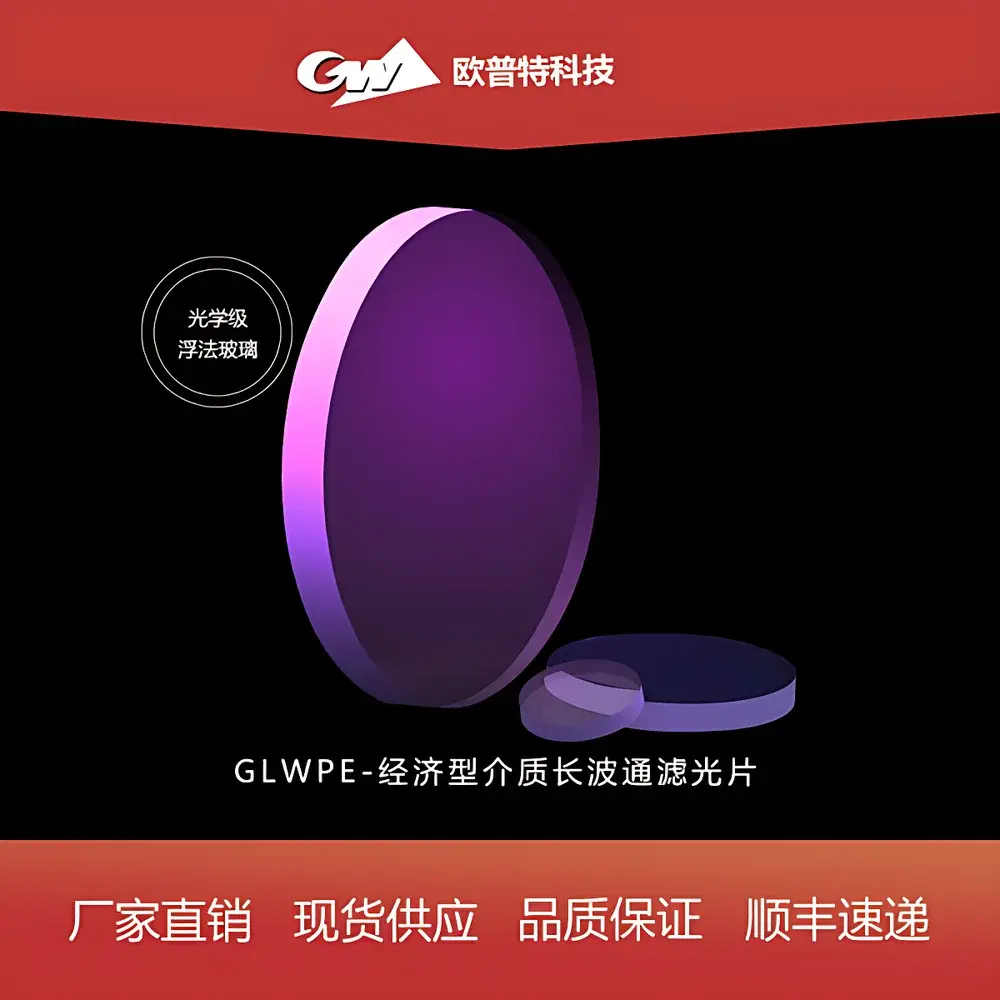
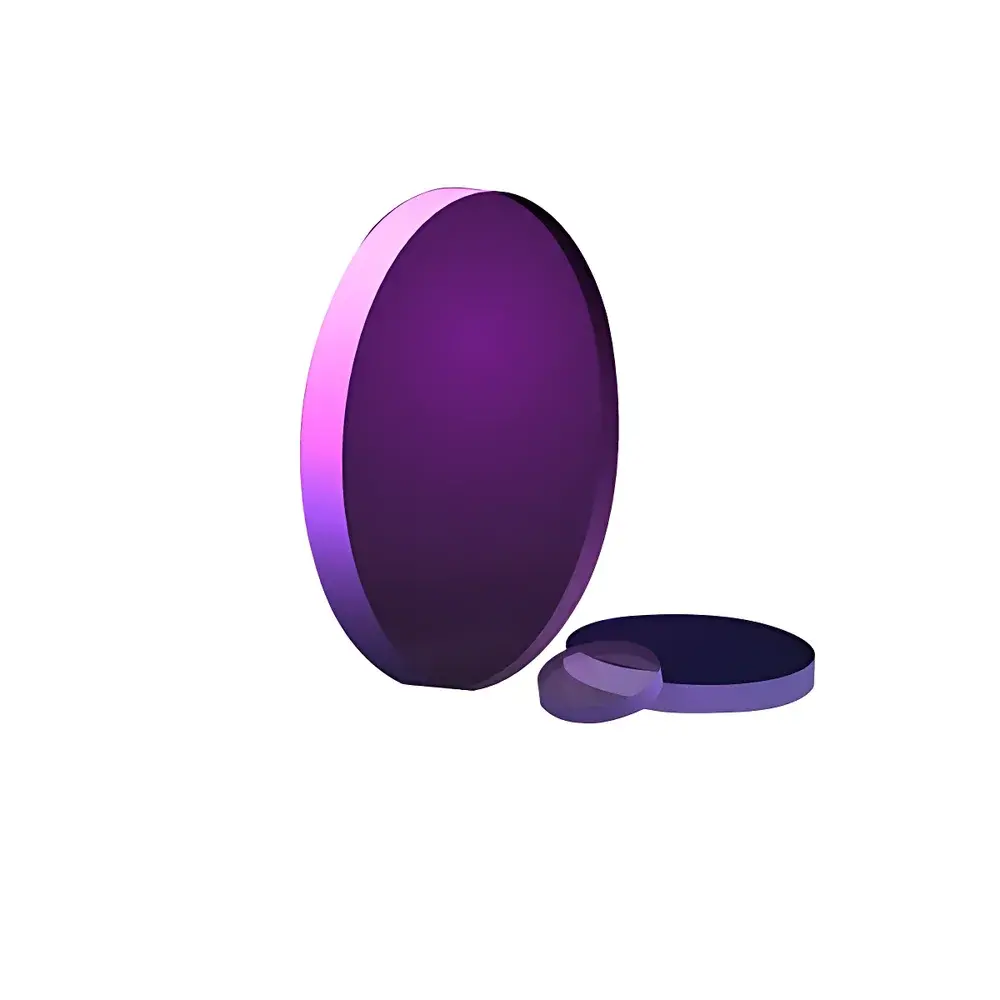
GLWPE Economical Long-Wave Pass Optical Filter
| Origin | Beijing, China |
|---|---|
| Manufacturer Type | Distributor |
| Regional Origin | Domestic (China) |
| Model | GLWPE |
| Price Range | USD 0.15–75.00 (per unit, volume-dependent) |
| Component Category | Optical Element |
| Available Diameters | 12.5 mm, 25 mm, 50 mm |
| Transmission Band | λ₀ + 20 nm to 2000 nm |
| Blocking Band | UV–λ₀ − 15 nm (typ.) |
| Center Wavelength Options | 400–1500 nm (in 50 nm increments) |
| Substrate Material | Optical-grade fused silica or BK7 (standard) |
| Surface Quality | 60-40 scratch-dig |
| Parallelism | < 3 arcmin |
| Thickness Tolerance | ±0.1 mm |
| Coating Type | Hard-dielectric multilayer interference coating |
| Operating Temperature | −20 °C to +70 °C |
| Damage Threshold | > 500 mW/cm² (CW, 532 nm), > 0.5 J/cm² (10 ns, 1064 nm) |
Overview
The GLWPE Economical Long-Wave Pass Optical Filter is a precision thin-film interference filter engineered for spectral separation in visible and near-infrared (VIS–NIR) optical systems. It operates on the principle of constructive and destructive interference within a multilayer dielectric stack deposited onto optically polished substrates (fused silica or BK7). Unlike absorptive filters, the GLWPE series achieves high transmission (>90% avg. across passband) and deep blocking (OD ≥ 4.0 from UV to λc−15 nm) through wavelength-selective reflection—enabling minimal thermal load and superior long-term stability under continuous illumination. Designed for integration into fluorescence microscopy, spectroscopic instrumentation, laser safety setups, and machine vision systems, each GLWPE filter is specified by its nominal center wavelength (λc), defined as the 50% transmission point between cutoff and onset. The standard spectral architecture delivers a sharp transition edge (typ. Δλedge ≤ 25 nm at 10%–90% transmission), with passbands extending uniformly from λc + 20 nm up to 2000 nm—ensuring compatibility with broadband detectors including Si, InGaAs, and extended-range CCD/CMOS sensors.
Key Features
- Precision hard-dielectric coating optimized for durability, environmental stability, and high laser damage threshold (LDT)
- Multiple standard center wavelengths from 400 nm to 1500 nm in 50 nm increments—covering key excitation/emission bands in biomedical and industrial sensing
- Three standard clear apertures: Ø12.5 mm, Ø25 mm, and Ø50 mm—each with part-numbered variants (e.g., GLWPE-700-D25) for unambiguous procurement and traceability
- Low wavefront distortion (< λ/4 @ 633 nm) and tight parallelism (< 3 arcmin) to preserve beam collimation in imaging and interferometric applications
- Compliant with ISO 10110-7 surface quality standards (60–40 scratch-dig) and RoHS Directive 2011/65/EU for restricted substances
- Optimized for ambient operation (−20 °C to +70 °C); no performance degradation observed after 500 thermal cycles (−40 °C ↔ +85 °C, 30 min dwell)
Sample Compatibility & Compliance
The GLWPE filter is compatible with standard optical mounts (SM1, SM2, C-mount adapters) and integrates seamlessly into OEM modules requiring spectral band selection without active electronics. Its fused silica substrate variant supports deep-UV transmission down to 185 nm (for alignment reference), while the BK7 version offers cost-optimized performance for λc ≥ 500 nm. All units undergo 100% spectral verification using NIST-traceable UV-VIS-NIR spectrophotometry (PerkinElmer Lambda 1050+ with 150 mm integrating sphere). Certificates of Conformance include measured transmission curves, blocking OD values at critical wavelengths (e.g., 355 nm, 532 nm, 1064 nm), and substrate refractive index verification per ISO 7944. The product line conforms to ISO 9001:2015 manufacturing controls and supports GLP-compliant documentation packages upon request—including batch-specific test reports and material declarations per REACH Annex XIV.
Software & Data Management
While the GLWPE is a passive optical component, its spectral specifications are fully integrated into common optical design platforms. Zemax OpticStudio (v23+) and CODE V (v12.10+) libraries include native GLWPE model files with measured dispersion data and angle-of-incidence (AOI) shift coefficients (0°–10°). Spectral transmission datasets (.csv, .txt) are provided with every order, formatted for direct import into MATLAB, Python (NumPy/Pandas), or LabVIEW for calibration correction and system-level modeling. For regulated environments, raw spectral data logs are archived with time-stamped acquisition metadata (instrument ID, operator, ambient conditions), supporting audit readiness under FDA 21 CFR Part 11 when paired with validated LIMS or ELN systems.
Applications
- Fluorescence lifetime imaging (FLIM) and confocal microscopy—used as emission filters to isolate Stokes-shifted signals while rejecting excitation leakage
- NIR spectroscopy (800–1700 nm) for agricultural phenotyping, pharmaceutical tablet analysis, and polymer identification
- Laser line cleanup in DPSS and diode-pumped systems—blocking residual pump wavelengths (e.g., 808 nm) while transmitting lasing output (e.g., 1064 nm)
- Thermal imaging pre-filters for uncooled microbolometers, attenuating ambient visible light without affecting MWIR responsivity
- Educational optics kits—demonstrating spectral filtering principles, edge steepness trade-offs, and substrate dispersion effects
- Machine vision inspection systems operating under mixed-illumination conditions (e.g., white LED + NIR LED co-illumination)
FAQ
What is the typical transition width (10%–90% transmission) for GLWPE filters?
Transition width ranges from 18 nm to 32 nm depending on center wavelength and substrate choice; values are documented in the supplied spectral report.
Can GLWPE filters be used at non-normal incidence?
Yes—performance shifts predictably with AOI; angular tuning data (Δλc/degree) is included in the technical datasheet for each λc variant.
Is custom diameter or coating specification available?
Custom diameters (Ø3–Ø100 mm) and non-standard λc values (±5 nm tolerance) are available under OEM agreements with minimum order quantities.
Do GLWPE filters require cleaning before installation?
Each unit is cleaned and inspected per ISO 14644-1 Class 5 cleanroom protocols; additional cleaning is unnecessary unless exposed to contaminants post-packaging.
How is lot-to-lot consistency ensured during manufacturing?
Coating runs are monitored in real time using in-situ quartz crystal microbalance and optical monitoring at 3 wavelengths; final spectral validation is performed on ≥5% of each production lot.