
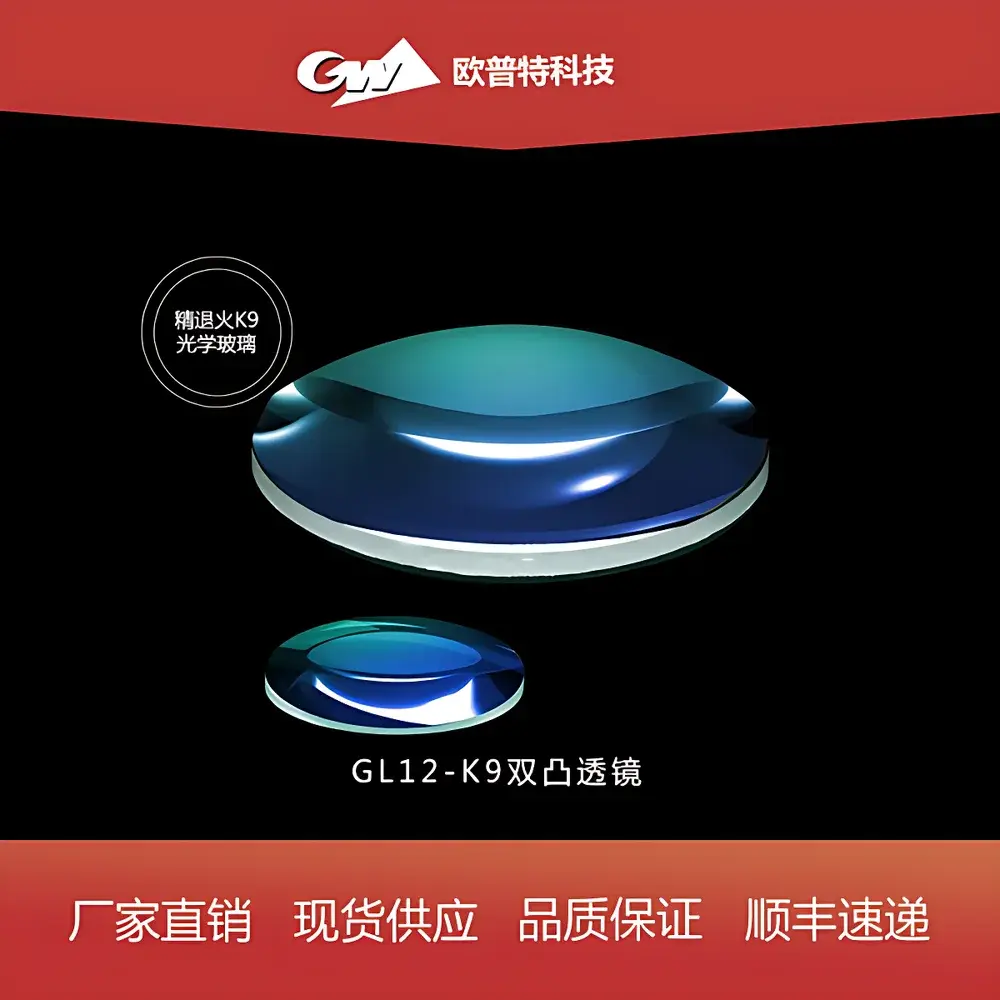
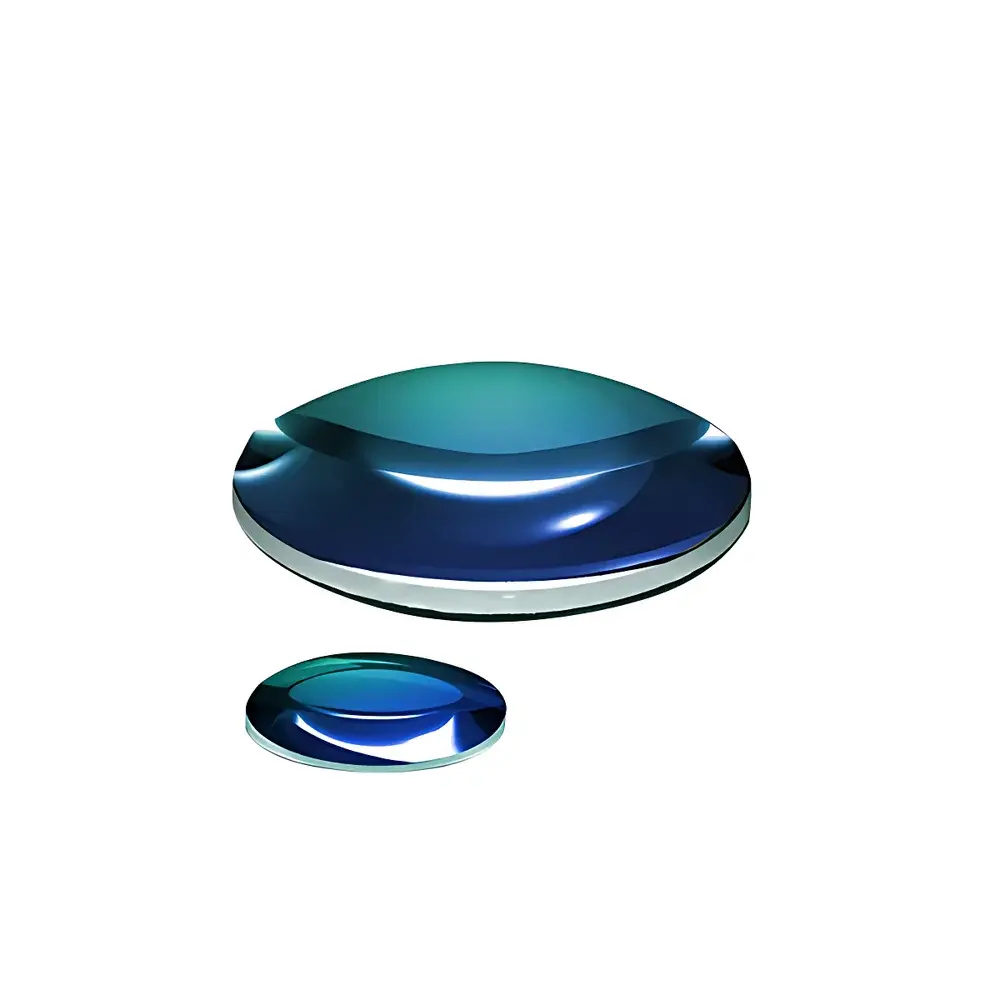
GL12-SWIR K9 Double-Convex Lens with Broadband Anti-Reflection Coating for Short-Wave Infrared (SWIR)
| Origin | Beijing, China |
|---|---|
| Manufacturer Type | Distributor |
| Origin Category | Domestic |
| Model | GL12-SWIR |
| Price Range | USD 0.15–75.00 (per unit) |
| Component Type | Optical Element |
| Material | Precision-Annealed K9 Optical Glass |
| Design Wavelength | 587.6 nm |
| Diameter Tolerance | +0.0 / −0.1 mm |
| Center Thickness Tolerance | ±0.2 mm |
| Surface Irregularity | λ/4 @ 632.8 nm |
| EFL Tolerance | ±2% |
| Centration Error | 3 arcminutes |
| Surface Quality | 3–4 scratch-dig |
| Edge Treatment | 0.2 mm × 45° chamfer |
| Coating | Broadband AR for SWIR (1000–1650 nm) |
Overview
The GL12-SWIR is a precision-engineered double-convex (DCX) lens fabricated from optically homogeneous, precision-annealed K9 borosilicate crown glass. Designed specifically for short-wave infrared (SWIR) applications spanning 1000–1650 nm, this lens features a broadband anti-reflection (AR) coating optimized for minimal reflectance across the entire SWIR band. Its positive focal length enables collimated beam focusing and point-source collimation—core functions in optical train design, spectroscopic instrumentation, laser delivery systems, and SWIR imaging modules. The lens adheres to ISO 10110-1 and ISO 10110-3 standards for surface form, irregularity, and surface quality, ensuring compatibility with high-fidelity alignment and integration into OEM optical assemblies.
Key Features
- Precision-annealed K9 glass substrate with low bubble/inclusion content per MIL-O-13830A and ISO 10110-2
- Broadband AR coating deposited via ion-assisted e-beam evaporation; average R < 0.5% per surface over 1000–1650 nm
- Surface irregularity controlled to λ/4 at HeNe wavelength (632.8 nm), verified by interferometric testing
- Diameter tolerance of +0.0 / −0.1 mm ensures repeatable mounting in standard SM-threaded lens cells (e.g., Thorlabs SM1, Newport 5.0 mm bore)
- Centration error ≤ 3 arcminutes supports alignment-critical applications such as fiber coupling and multi-element relay systems
- Edge treatment: 0.2 mm × 45° chamfer minimizes chipping risk during handling and mechanical mounting
- Available in diameters from 2 mm to 100 mm; custom EFLs configurable within standard manufacturing lead times
Sample Compatibility & Compliance
The GL12-SWIR lens is compatible with standard optomechanical mounts including kinematic lens holders, adjustable focus tubes, and threaded retaining rings (e.g., SM1 series). Its K9 substrate exhibits thermal expansion coefficient α ≈ 7.1 × 10⁻⁶ /°C and transmission > 90% (uncoated bulk) across 350–2000 nm—making it suitable for ambient-temperature laboratory use and stable under moderate thermal cycling. The AR coating meets MIL-C-48497A specifications for environmental durability (humidity, abrasion, adhesion). While not certified to ISO 9001 or IATF 16949 at component level, lenses are traceably packaged with individual test reports documenting surface quality, centration, and transmitted wavefront error (TWE) measurements.
Software & Data Management
No embedded firmware or software is associated with this passive optical component. However, lens specifications—including measured EFL, radius of curvature (R₁/R₂), center thickness, and coating spectral data—are supplied in standardized CSV and PDF format upon request. These files conform to the ISO 10110-12 metadata schema for optical element documentation and are compatible with Zemax OpticStudio, CODE V, and FRED optical design platforms via import scripts. Traceability records include batch ID, annealing lot number, and interferogram timestamps for GLP-aligned calibration workflows.
Applications
- SWIR spectrometer fore-optics and detector-side focusing elements
- Laser beam shaping in 1064 nm, 1310 nm, and 1550 nm telecom and sensing systems
- Thermal imaging relay optics for uncooled InGaAs focal plane arrays
- Optical coherence tomography (OCT) reference arms requiring low dispersion and high SWIR transmission
- Educational optics kits for teaching paraxial ray tracing, aberration analysis, and coating performance evaluation
- OEM integration into gas analyzers (e.g., CH₄, CO₂ detection at 1650 nm) and process monitoring sensors
FAQ
Is the AR coating optimized for both SWIR and NIR bands simultaneously?
No—the GL12-SWIR variant is specifically coated for 1000–1650 nm. A separate NIR-optimized version (GL12-NIR) covers 650–1050 nm, and a VIS version (GL12-VIS) targets 400–700 nm. Coating cross-band performance is not guaranteed.
Can this lens be used in vacuum environments?
Yes, provided outgassing is mitigated: K9 glass has negligible volatile content, and the AR coating passes ASTM E595 TML < 1.0% and CVCM < 0.10%. Bake-out at 80°C for 24 h is recommended prior to vacuum insertion.
What mounting options are recommended for 2 mm and 50 mm diameter variants?
For Ø2 mm: use epoxy-compatible micro-mounts (e.g., Thorlabs AD11F) with UV-curable adhesive; for Ø50 mm and larger: precision-machined aluminum lens cells with spring-loaded retaining rings to accommodate thermal expansion differentials.
Do you provide interferometric test reports for each lens?
Yes—standard delivery includes a certificate of conformance with interferometric surface figure data (Zernike coefficients up to n=6) and measured centration error. Full raw interferograms are available upon request for QA audits.
Is the lens suitable for high-power CW laser applications?
It is rated for continuous-wave irradiance up to 500 W/cm² at 1550 nm (measured at 10.6 µm spot size, 10 s exposure) without coating damage or thermal lensing. LIDT certification per ISO 21254-1 is available for specific configurations.




