
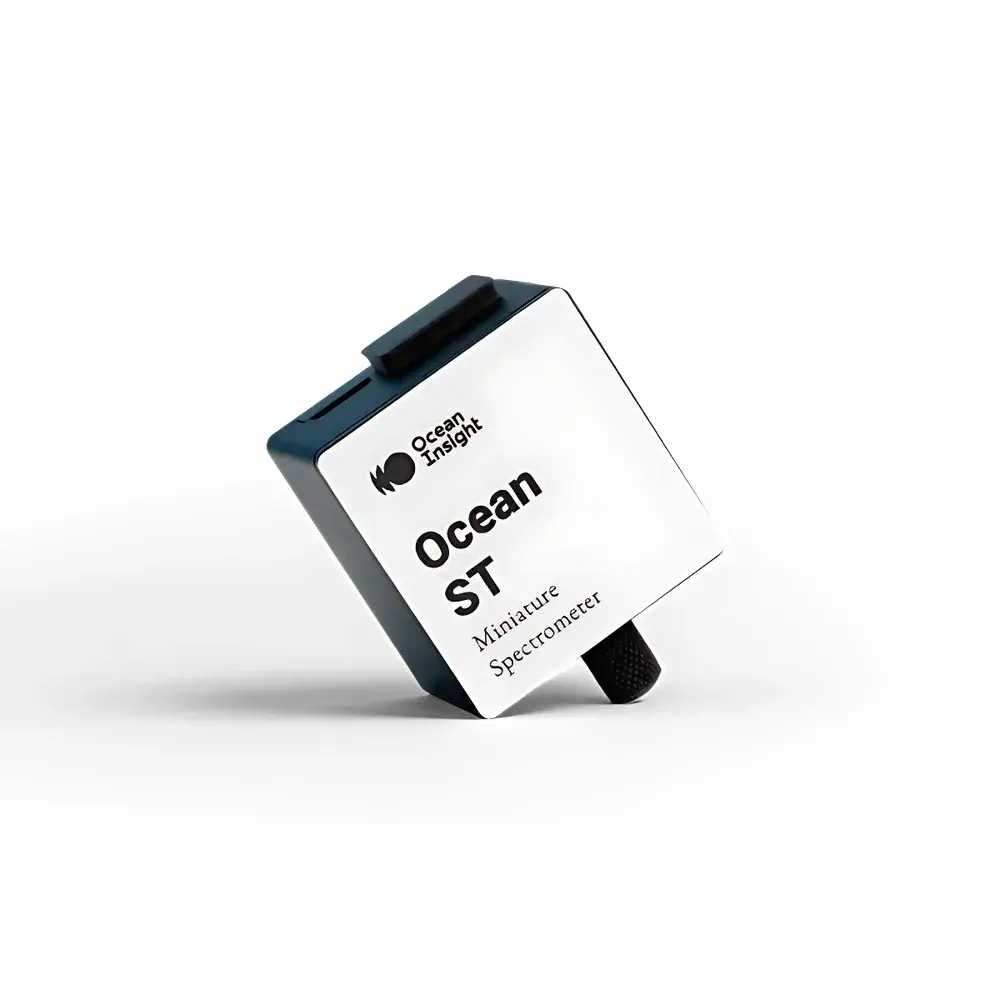
Ocean Optics Ocean ST Fiber Optic Spectrometer
| Brand | Ocean Optics |
|---|---|
| Origin | USA |
| Model | Ocean ST |
| Spectral Range | 185–650 nm (UV-Vis) |
| Optical Resolution | 2.2 nm FWHM (configuration-dependent) |
| Signal-to-Noise Ratio | >250:1 (full well, typical) |
| Dynamic Range | 1000:1 (single-scan) |
| Stray Light | <0.2% at 600 nm |
| Detector | Back-thinned CMOS linear array |
Overview
The Ocean Optics Ocean ST Fiber Optic Spectrometer is a high-performance, miniature spectrometer engineered for precision spectral measurement in space-constrained and integration-critical environments. Based on Czerny-Turner optical architecture with a fixed grating and back-thinned CMOS linear detector array, the Ocean ST delivers robust UV-Vis and Vis-NIR spectral acquisition with exceptional thermal stability and low inter-unit variability (<±0.3 nm wavelength shift over 0–40 °C). Its compact form factor (93 × 60 × 34.5 mm) and low mass (<200 g) make it suitable for embedded OEM applications—including inline process monitoring, portable analytical devices, and handheld instrumentation—without compromising spectroscopic fidelity. Designed for laboratory-grade accuracy in field-deployable hardware, the Ocean ST supports trace-level absorbance quantification, reflectance calibration, and real-time spectral trending under variable ambient conditions.
Key Features
- Three interchangeable spectral configurations: UV-Vis (185–650 nm), Vis-NIR (350–810 nm), and NIR (645–1085 nm), enabling application-specific optimization
- Fixed 2.2 nm FWHM optical resolution (typical), achieved via precision-aligned optics and slit-limited diffraction; optional slit widths (10 µm, 25 µm, 50 µm, 100 µm) allow trade-off adjustment between resolution and throughput
- Back-thinned CMOS detector with >90% quantum efficiency in UV region (200–350 nm), critical for DNA quantification, protein assay, and low-light fluorescence applications
- Thermally stabilized housing with passive thermal management, ensuring wavelength repeatability ≤ ±0.1 nm over 8-hour continuous operation
- USB 2.0 interface with 16-bit ADC and onboard memory buffer for jitter-free trigger-synchronized acquisition at up to 1000 spectra/second (with minimal integration time)
- Robust mechanical design compliant with IEC 60068-2 environmental test standards for shock (50 g, 11 ms half-sine) and vibration (5–500 Hz, 0.15 mm displacement)
Sample Compatibility & Compliance
The Ocean ST interfaces seamlessly with standard SMA 905 fiber-optic cables (core diameters 50–600 µm), enabling compatibility with Ocean Insight’s full suite of calibrated light sources (deuterium-halogen, LED, pulsed xenon), cuvette holders, integrating spheres, and probe accessories. It supports ASTM E308-15 (standard practice for computing color coordinates), ISO 11664-4 (CIE colorimetry), and USP (spectrophotometric absorbance verification protocols). Data integrity meets GLP/GMP requirements through timestamped spectral metadata, hardware-level integration time locking, and non-volatile configuration storage. While not inherently 21 CFR Part 11 compliant, audit trails and electronic signature readiness can be implemented via validated third-party software layers integrated with OceanDirect SDK.
Software & Data Management
Every Ocean ST ships with OceanDirect—a cross-platform SDK supporting Windows, macOS, and Linux, with native bindings for Python, MATLAB, LabVIEW, C#, and C++. The API provides low-level access to all instrument parameters: integration time (1 ms – 10 s), scan averaging, boxcar smoothing, dark reference acquisition, and nonlinearity correction coefficients. Spectral data is output in IEEE 754-compliant float32 arrays with calibrated wavelength vectors (nm) and intensity units (counts or µW/nm). OceanDirect includes built-in support for HDF5 and CSV export, real-time plotting, and batch processing pipelines. For regulated environments, developers may implement FDA-aligned audit trails by logging parameter changes and acquisition events to encrypted SQLite databases with SHA-256 hashing.
Applications
- Quantitative nucleic acid and protein analysis (A260/A280 ratio, dsDNA concentration per Beer-Lambert law)
- Colorimetric quality control in paints, textiles, and display manufacturing (CIELAB ΔE*ab, spectral reflectance mapping)
- In-line monitoring of chemical reactions and catalyst performance in flow reactors
- UV curing dose validation in photopolymerization processes
- LED binning and phosphor characterization using absolute irradiance calibration
- Environmental sensing: nitrate/nitrite detection in water via UV absorption peaks at 220 nm and 302 nm
FAQ
What spectral calibration options are available for the Ocean ST?
Factory calibration includes NIST-traceable wavelength (Hg/Ar emission lines) and radiometric (tungsten halogen lamp) calibration. Custom calibrations (e.g., deuterium lamp for deep-UV linearity) are available upon request.
Can the Ocean ST operate in triggered or external sync mode?
Yes—hardware TTL triggers (rising/falling edge) are supported via dedicated GPIO pin; synchronization latency is <1 µs RMS jitter.
Is temperature compensation enabled by default?
Yes—real-time pixel-wise wavelength correction is applied using internal thermistor readings and factory-derived polynomial coefficients.
How does slit selection affect system throughput and resolution?
A 10 µm slit yields ~2.2 nm FWHM resolution and ~3× lower throughput than a 100 µm slit; optimal slit choice depends on source brightness and required spectral discrimination.
Does OceanDirect support multi-device synchronization?
Yes—up to 8 Ocean ST units can be synchronized via shared TTL clock signal with sub-millisecond timing alignment across devices.





