
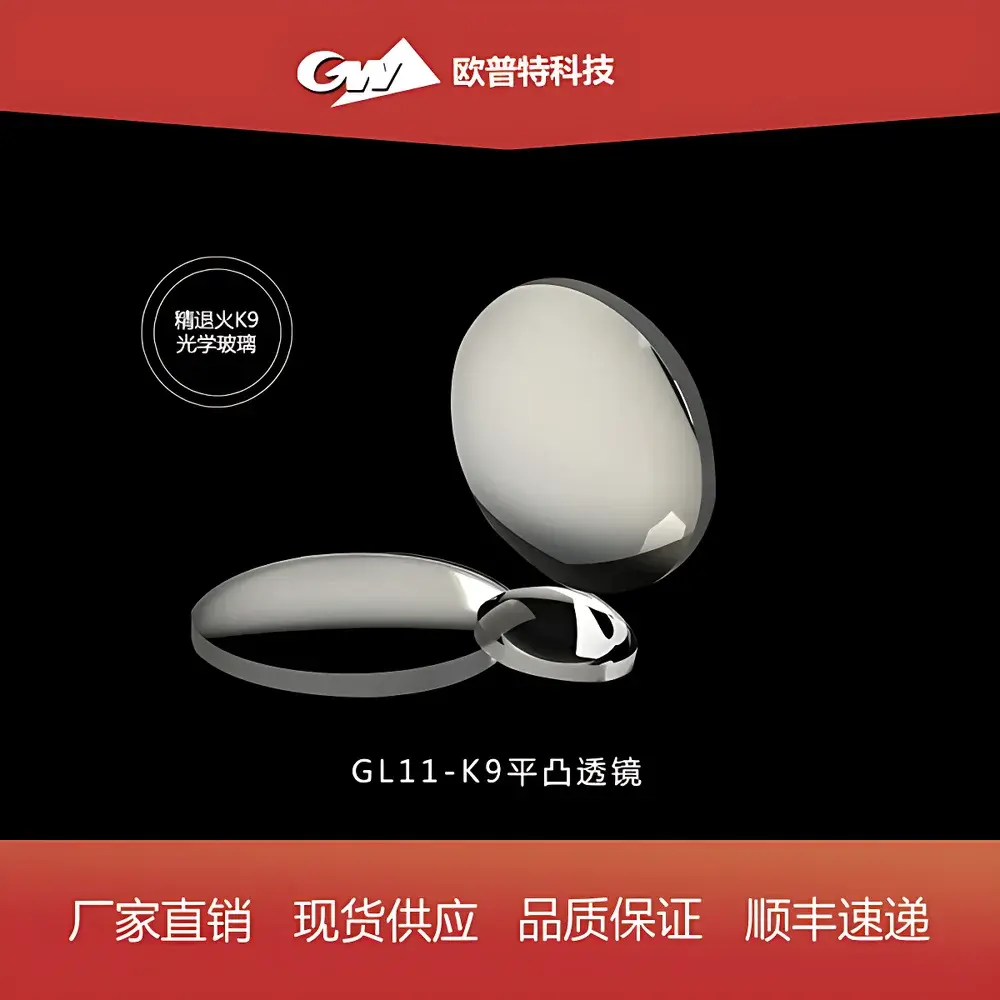
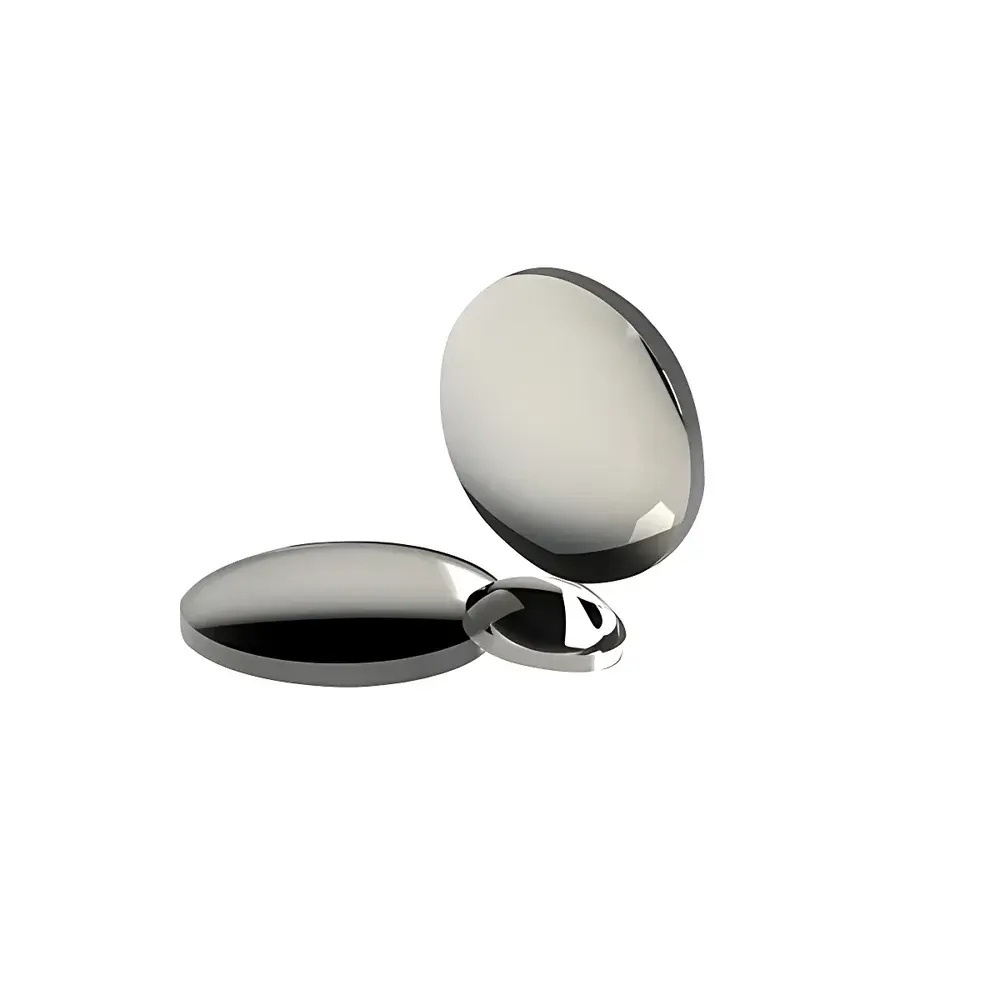
OptoSigma GL11-K9 Plano-Convex Lens (Uncoated), 3–100 mm Diameter
| Material | Precision-Annealed K9 Optical Glass |
|---|---|
| Design Wavelength | 587.6 nm |
| Diameter Tolerance | +0.0 / −0.1 mm |
| Center Thickness Tolerance | ±0.2 mm |
| Surface Irregularity | λ/4 @ 632.8 nm |
| Effective Focal Length (EFL) Tolerance | ±2% |
| Lens Centration Error | 3 arcmin |
| Surface Quality | 3–4 scratch-dig |
| Edge Treatment | 0.2 mm × 45° chamfer |
| Coating | Uncoated (optional AR coatings: UV, VIS, NIR, SWIR) |
| Substrate Applicability | K9 standard |
Overview
The OptoSigma GL11-K9 Plano-Convex Lens is a precision-manufactured optical component engineered for fundamental beam manipulation in laboratory and industrial optical systems. Constructed from high-homogeneity, precision-annealed K9 borosilicate crown glass, this uncoated lens operates with minimal internal stress and excellent transmission across the visible spectrum (400–700 nm). Its plano-convex geometry—featuring one flat surface and one spherical convex surface—provides a positive effective focal length (EFL), making it suitable for collimation, focusing, imaging, and beam expansion tasks. The lens is designed to the helium d-line wavelength (587.6 nm), ensuring consistent refractive index alignment with standard optical design conventions. Surface irregularity is controlled to λ/4 at 632.8 nm (HeNe laser wavelength), enabling diffraction-limited performance in low-aberration applications when used under appropriate conjugate conditions.
Key Features
- Precision-annealed K9 optical glass substrate with certified homogeneity and low bubble/inclusion content per ISO 10110-2
- Strict dimensional tolerances: diameter tolerance of +0.0 / −0.1 mm and center thickness tolerance of ±0.2 mm ensure mechanical interchangeability in kinematic mounts and lens holders
- Surface quality rated 3–4 scratch-dig per MIL-PRF-13830B, supporting high-power visible-light applications without localized damage risk
- Centration error limited to ≤3 arcminutes, minimizing beam deviation and enabling use in multi-element alignment-critical assemblies
- λ/4 surface irregularity (measured at 632.8 nm) validated via interferometric testing, supporting wavefront fidelity in coherent optical paths
- Standard 0.2 mm × 45° protective edge chamfer applied to both surfaces to mitigate chipping during handling and mounting
- Uncoated baseline configuration offers maximum flexibility for custom coating integration or vacuum-compatible environments where outgassing must be minimized
Sample Compatibility & Compliance
The GL11 series is manufactured in full compliance with ISO 10110 optical fabrication standards for surface form, irregularity, and surface quality. All lenses undergo 100% visual inspection under controlled illumination and are verified using phase-shifting interferometry for surface figure accuracy. While the base K9 material is not compliant with MIL-C-48497A for military-grade environmental durability, it meets ASTM F1357-21 requirements for general-purpose laboratory optics. For regulated environments—including ISO 13485-certified medical device R&D labs or GLP-compliant optical test facilities—the lens can be supplied with traceable calibration documentation (including interferogram reports and dimensional metrology certificates) upon request. RoHS-compliant manufacturing processes are employed throughout production.
Software & Data Management
As a passive optical component, the GL11-K9 lens does not incorporate embedded electronics or firmware. However, OptoSigma provides comprehensive digital asset support including Zemax-compatible .ZAR and CODE V .LEN files for all standard focal lengths (3 mm through 1000 mm), enabling accurate system-level modeling of aberrations, spot diagrams, and MTF performance. Lens specifications are integrated into OptoSigma’s online optical component database (accessible via API), allowing automated BOM validation and tolerance stack-up analysis in enterprise PLM environments. For customers requiring audit-ready documentation, optional electronic records—including interferometric test reports, surface roughness data (measured via white-light scanning interferometry), and batch-specific material certification—are archived for ≥10 years per ISO 9001:2015 clause 8.5.2.
Applications
- Collimation of point-source emitters (e.g., laser diodes, LEDs) — incident beam directed onto the plano surface to minimize spherical aberration
- Focusing of collimated beams (e.g., from spatial filters or fiber outputs) — incident beam directed onto the convex surface to optimize wavefront convergence
- Beam expansion and reduction in Galilean or Keplerian telescope configurations
- Objective elements in low-magnification inspection systems and machine vision illumination trains
- Reference optics in interferometric alignment setups and autocollimation tests
- Substrate platform for customer-specified thin-film deposition (e.g., broadband AR, HR, or dichroic coatings)
FAQ
What is the refractive index of K9 glass at 587.6 nm?
The nominal refractive index (nd) of precision-annealed K9 glass at the helium d-line (587.6 nm) is 1.51630 ± 0.00010, as certified per Schott N-BK7 specification equivalence.
Can this lens be used in UV or IR spectral regions?
The standard K9 substrate exhibits strong absorption below 350 nm and above 2.2 µm; for UV applications, fused silica variants (GL11-FS) are available; for NIR/SWIR, Ge, Si, or ZnSe alternatives are offered under the same mechanical form factor.
Is centration error measured per ISO 10110-5?
Yes — centration is quantified as the angular deviation between the mechanical axis (defined by outer diameter) and optical axis (defined by surface vertex normals), measured via autocollimation and reported in arcminutes per ISO 10110-5 Annex A.
Do you provide mounting recommendations for small-diameter lenses (e.g., Ø3 mm)?
For lenses with diameters ≤5 mm, we recommend kinematic lens mounts with spring-loaded retaining rings and alignment screws; contact our optical engineering team for custom cell drawings compatible with Thorlabs SM-series or Newport KM-series platforms.
Are batch-specific test reports available for GMP-regulated optical assembly lines?
Yes — full traceability packages including interferometric surface maps, dimensional CMM reports, and material lot certifications can be delivered with each shipment under controlled document revision protocols aligned with FDA 21 CFR Part 11 requirements.




