
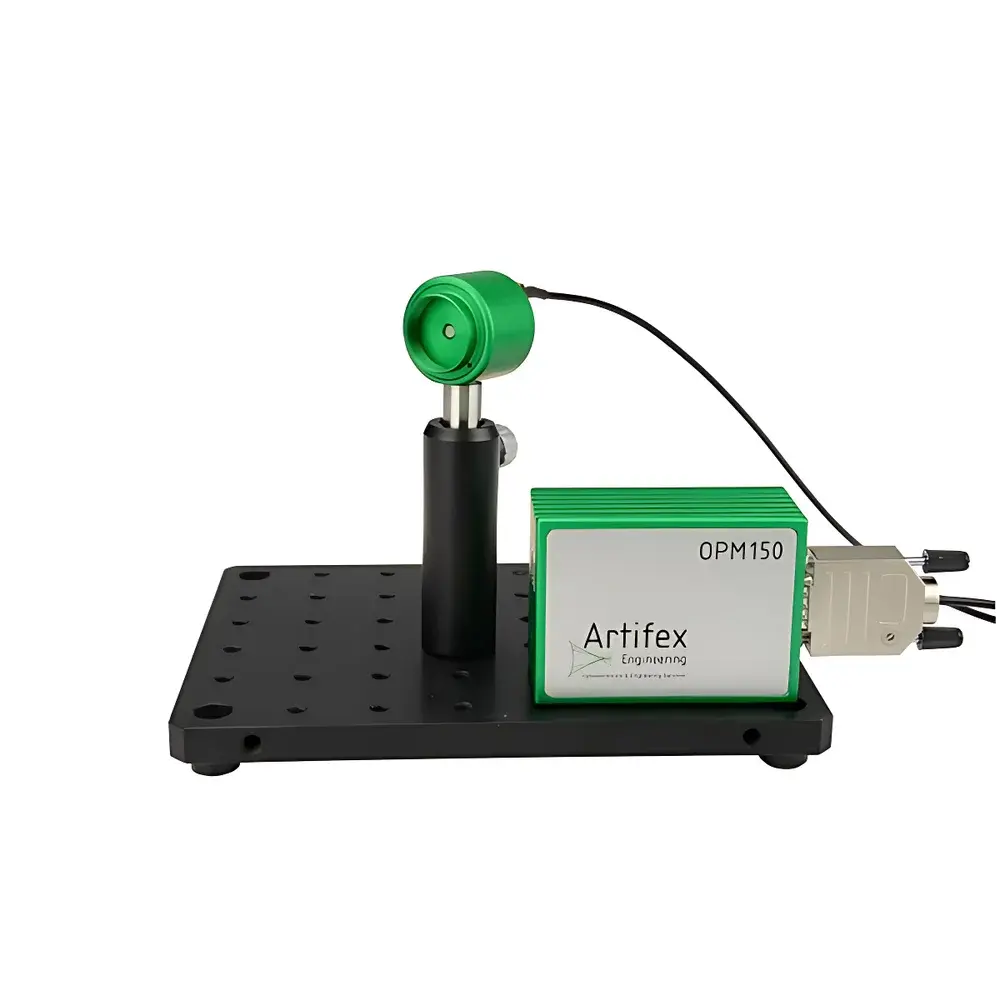
Artifex OPM150 High-Speed Laser Power Measurement System
| Brand | Artifex |
|---|---|
| Origin | Germany |
| Model | OPM150 |
| Detection Principle | Thermopile-based Absolute Power Measurement |
| Wavelength Range | 650 nm – 20 µm |
| Max. Incident Power Density | 5000 W/cm² |
| Cooling | Water-Cooled Gold-Coated Integrating Sphere |
| Interface | USB 2.0 |
| Software Mode | Real-Time Streaming, Transient Capture, Statistical Trending |
| Compliance | ISO 11554 (Laser Beam Parameter Measurements), EN 60825-1 (Laser Safety), Traceable to PTB Calibration Standards |
Overview
The Artifex OPM150 High-Speed Laser Power Measurement System is an industrial-grade, thermopile-based optical power monitoring solution engineered for real-time quantification of continuous-wave (CW) and transient laser output in high-power industrial and R&D environments. Unlike photodiode-based sensors limited by saturation and wavelength-dependent responsivity, the OPM150 employs a water-cooled, gold-coated integrating sphere coupled with a calibrated thermopile detector — enabling absolute, wavelength-independent power measurement across the broad spectral range from visible (650 nm) to far-infrared (20 µm). Its architecture supports high dynamic range operation up to 5 kW incident power while maintaining thermal stability under sustained irradiation at power densities exceeding 5000 W/cm². Designed for integration into laser manufacturing lines, QC test benches, and laser source qualification labs, the system delivers sub-second response time (<100 ms rise time) and statistical repeatability better than ±0.8% (k=2) over 8-hour operational cycles.
Key Features
- Water-cooled integrating sphere with electropolished, high-reflectivity (>98% @ 1–10 µm) gold coating — optimized for thermal dissipation and spatial uniformity in high-flux laser beam capture
- Real-time power acquisition at 1 kHz sampling rate, supporting both continuous streaming and triggered transient capture (e.g., turn-on overshoot, mode instability, or pulse-to-pulse drift)
- USB 2.0 interface with vendor-provided Windows-compatible software offering dual-mode display: analog-style needle gauge for intuitive CW monitoring and digital waveform view with adjustable timebase (10 ms to 60 s/div)
- Integrated statistical engine calculating RMS fluctuation, peak deviation, mean drift, and 3σ variation over user-defined windows — essential for ISO/IEC 17025-compliant calibration reporting
- Modular mechanical design: sphere aperture configurable for fiber-coupled (FC/PC, SMA905) or free-space beam input; optional beam dump and alignment port available
Sample Compatibility & Compliance
The OPM150 is validated for use with CO₂ lasers (10.6 µm), fiber lasers (1.06–1.08 µm), disk lasers (e.g., 5 kW Yb:YAG systems), diode stacks, and quantum cascade lasers. It meets the optical safety and metrological requirements of EN 60825-1:2014 for Class 4 laser measurement instrumentation and conforms to ISO 11554 Annex B for beam power measurement uncertainty estimation. All factory calibrations are traceable to Physikalisch-Technische Bundesanstalt (PTB), Germany, and include full uncertainty budgets per GUM (JCGM 100:2008). The system supports GLP/GMP audit trails when operated with optional software license enabling electronic signatures, version-controlled configuration files, and FDA 21 CFR Part 11–compliant data archiving.
Software & Data Management
The OPM150 Control Suite provides native support for CSV export with timestamped metadata (UTC sync via system clock), automatic gain scaling, and auto-zero compensation during idle periods. Raw binary data streams are stored in HDF5 format for compatibility with MATLAB, Python (h5py), and LabVIEW. Batch analysis modules allow comparative trending across multiple laser units, including pass/fail thresholds based on user-defined stability criteria (e.g., “<1.5% RMS fluctuation over 30 min at 2500 W”). Firmware updates are delivered via signed .hex packages with SHA-256 verification, ensuring integrity in regulated environments.
Applications
- Stability validation of multi-kilowatt industrial laser sources during qualification and preventive maintenance
- Monitoring of short-term power droop during extended duty cycles (e.g., >10 min at rated power)
- Characterization of transient behavior during laser startup, modulation, or feedback-loop engagement
- Verification of OEM laser parameter settings against actual output — critical for automotive battery welding and aerospace cladding process validation
- Supporting ISO 13694 and ISO 11146 beam parameter measurements by providing reference power normalization
FAQ
What is the maximum average power the OPM150 can measure without damage or calibration drift?
The water-cooled integrating sphere is rated for continuous exposure up to 5 kW at power densities ≤5000 W/cm²; sustained operation above this limit requires active flow-rate monitoring and inlet temperature control (recommended: 18–22°C coolant, ≥4 L/min flow).
Does the system support calibration traceability documentation?
Yes — each unit ships with a PTB-traceable calibration certificate listing correction factors per wavelength band (650–1100 nm, 1–3 µm, 8–12 µm), expanded uncertainty (k=2), and environmental conditions during calibration.
Can the OPM150 be integrated into automated test systems using LabVIEW or Python?
Yes — a documented DLL API (Windows x64/x86) and Python wrapper (PyOPM) are provided, supporting remote control of acquisition start/stop, gain selection, zeroing, and real-time data polling.
Is the gold coating susceptible to oxidation or contamination in industrial environments?
The gold layer is deposited via vacuum e-beam evaporation and protected by an inert ambient seal; routine cleaning uses only spectroscopic-grade isopropanol and nitrogen purge — no abrasive or acidic agents permitted.
How does the system handle beam alignment errors or partial sphere illumination?
The integrating sphere’s Lambertian geometry and high internal reflectivity ensure <±0.3% spatial nonuniformity error even with off-axis incidence up to ±15°; however, optimal accuracy requires centered beam entry within the specified aperture tolerance (±1 mm).




