
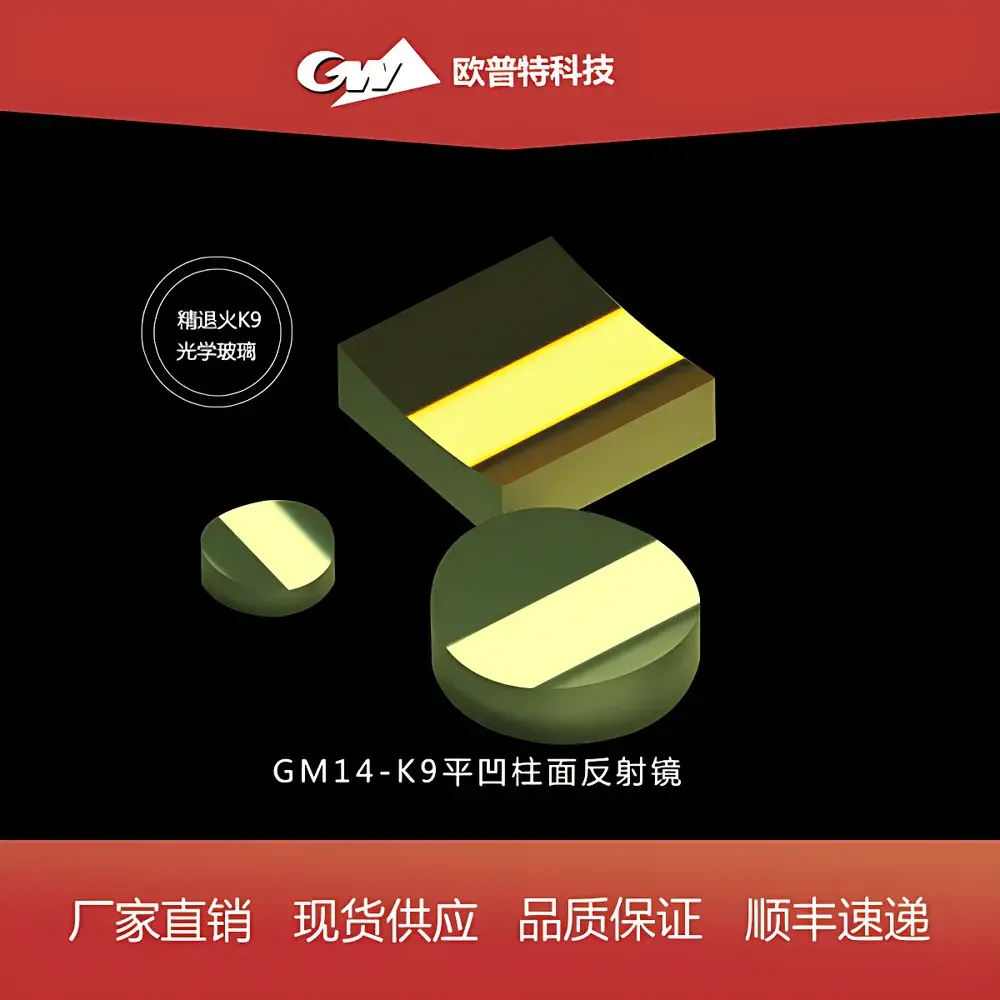
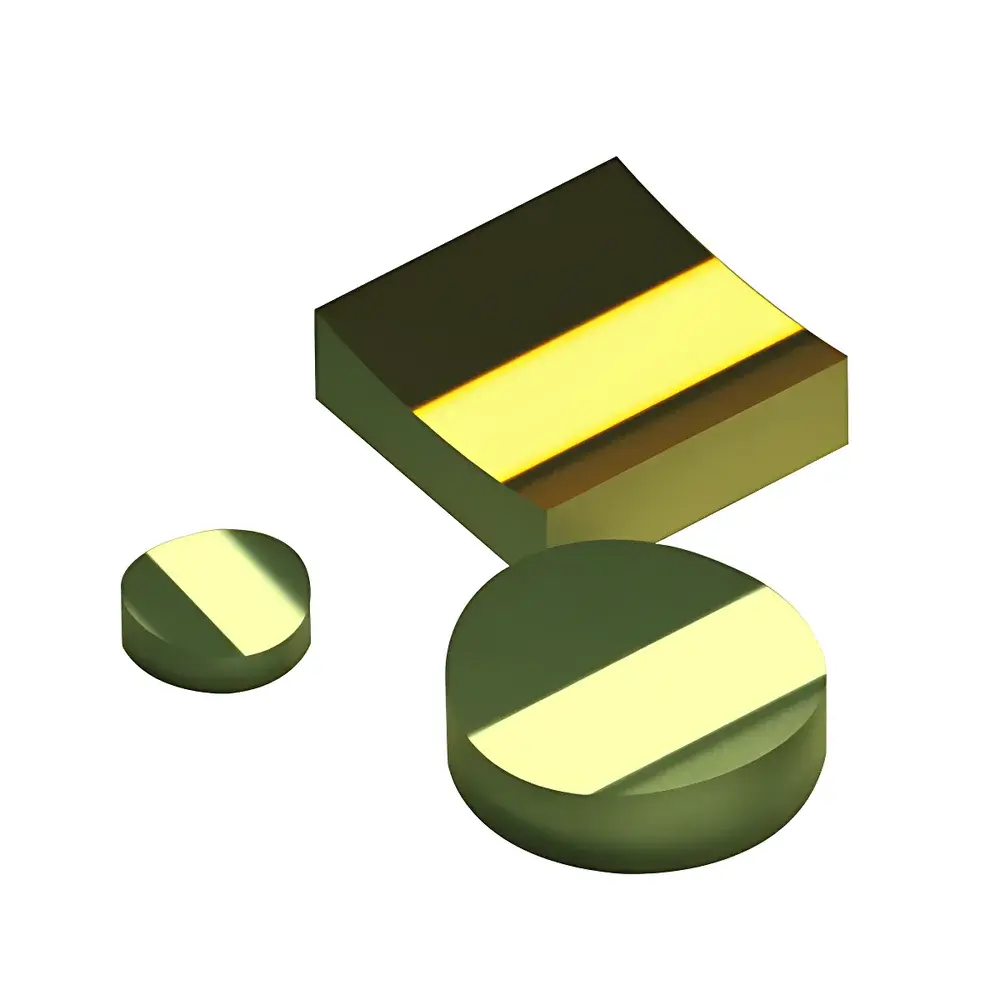
GM14-K9 Plano-Concave Cylindrical Mirror
| Origin | Beijing, China |
|---|---|
| Manufacturer Type | Authorized Distributor |
| Product Origin | Domestic (China) |
| Model | GM14 |
| Price Range | USD 0.15–75.00 (per unit, depending on coating and configuration) |
| Component Category | Optical Element |
| Substrate Material | Precision Annealed K9 Optical Glass |
| Surface Irregularity | λ/1 @ 633 nm |
| Centration Error | < 3 arcminutes |
| Reflected Surface Scratch-Dig | 60–40 (ISO 10110-7) |
| Back Surface Finish | Fine Ground or Inspection Polish |
| Diameter/Width Tolerance | +0.0 / −0.1 mm |
| Thickness Tolerance | ±0.2 mm |
| Focal Length Tolerance | ±2% |
| Edge Treatment | Protective 45° Chamfer, 0.2–0.5 mm |
| Coating Options | Bare Substrate, Protected Aluminum (AL), UV-Enhanced Aluminum (UVAL), Protected Silver (AG), Protected Gold (AU) |
Overview
The GM14-K9 Plano-Concave Cylindrical Mirror is a precision optical component engineered for controlled one-dimensional beam shaping and focusing in laser systems, spectroscopic instrumentation, and optical alignment setups. Unlike spherical or flat mirrors, cylindrical optics introduce curvature along a single axis—enabling astigmatic correction, line generation, anamorphic beam expansion, or asymmetric collimation. This mirror features a plano surface on one side and a concave cylindrical surface on the other, yielding a negative focal length in the curved axis and no optical power in the orthogonal direction. Its design adheres to fundamental principles of paraxial geometric optics, where the focal length (f) relates directly to the radius of curvature (R) via f = R/2 for the cylindrical surface. Constructed from precision-annealed K9 borosilicate crown glass—a material with high homogeneity, low bubble/inclusion content, and excellent transmission across 350–2000 nm—the GM14 series ensures minimal wavefront distortion and high thermal stability under moderate environmental fluctuations.
Key Features
- Precision-annealed K9 optical glass substrate with certified refractive index uniformity (nd = 1.5163 ± 0.0002) and low stress birefringence (< 5 nm/cm)
- Surface irregularity specified at λ/1 @ 633 nm (HeNe wavelength), verified by interferometric testing per ISO 10110-5
- Centration error maintained below 3 arcminutes, ensuring predictable beam deviation in multi-element mounts
- Reflected surface polished to ISO 10110-7 scratch-dig specification 60–40 (equivalent to MIL-PRF-13830B Grade 3–4), minimizing scatter-induced noise in sensitive detection paths
- Consistent edge protection: 45° chamfer of 0.2–0.5 mm depth applied to all perimeters to prevent chipping during handling and mounting
- Multiple standard geometries available—including round (Φ12.5 mm, Φ25.0 mm) and square (12.5 × 12.5 mm, 25.0 × 25.0 mm) apertures—with focal lengths spanning 12.5 mm to 250 mm
- Coating options optimized for spectral performance: protected aluminum (300–2000 nm), UV-enhanced aluminum (250–2000 nm), protected silver (450–2000 nm), and protected gold (700–16000 nm)
Sample Compatibility & Compliance
The GM14 mirrors are compatible with standard kinematic mirror mounts (e.g., Thorlabs KM100, Newport UMB1), lens tubes, and optomechanical breadboards using M4 or 8-32 threaded adapters. All substrates meet RoHS Directive 2011/65/EU requirements for restricted hazardous substances. Surface quality and dimensional tolerances conform to ISO 10110 standards for optical element specification and verification. While not individually certified to ISO 9001 or ISO 13485, the manufacturing and inspection processes employed by the original Chinese OEM follow documented quality control protocols aligned with GLP-compliant optical fabrication practices. No FDA or CE marking is applicable, as these are passive optical components—not medical devices or electrical equipment.
Software & Data Management
As a passive optical component, the GM14 mirror requires no embedded firmware, drivers, or software integration. However, its specifications are fully compatible with industry-standard optical design platforms including Zemax OpticStudio (version 22+), Synopsys CODE V, and Lambda Research TracePro. Each product variant is assigned a unique part number encoding aperture shape, focal length, and coating type (e.g., GM14-025-100-UVAL denotes a Φ25 mm mirror with 100 mm focal length and UV-enhanced aluminum coating). Technical datasheets—including measured surface figure maps, reflectance curves, and coating durability test reports—are available upon request in PDF format and can be imported into PLM systems such as Siemens Teamcenter or PTC Windchill for traceability in regulated R&D environments.
Applications
- Laser cavity design: introducing controlled astigmatism for mode matching or compensating thermal lensing in DPSS lasers
- Line-generation optics: transforming Gaussian beams into uniform line profiles for machine vision illumination or structured light scanning
- Anamorphic beam correction: pairing with plano-convex cylindrical lenses to correct ellipticity in diode laser outputs
- Spectrometer slit illumination: collimating light along one axis while preserving divergence in the orthogonal plane for improved spectral resolution
- Interferometric alignment: serving as reference surfaces in Twyman–Green or Mach–Zehnder configurations requiring cylindrical reference wavefronts
- Optical metrology fixtures: integrating into custom goniometers or autocollimators for angular calibration of rotational stages
FAQ
What is the damage threshold for the protected aluminum coating under continuous-wave (CW) laser irradiation?
Typical LIDT for protected aluminum on K9 at 1064 nm, 10.6 µm spot size, and 1 s exposure is ≥ 500 kW/cm². For pulsed operation (10 ns, 10 Hz), it is ≥ 0.5 J/cm². Actual values depend on beam profile, cleanliness, and local thermal management.
Can these mirrors be used in vacuum environments?
Yes—K9 glass and all standard coatings (AL, UVAL, AG, AU) are vacuum-compatible up to 10⁻⁶ Torr when properly cleaned and outgassed. Avoid prolonged exposure to high-humidity storage prior to vacuum insertion.
Is custom focal length or substrate material available?
Standard offerings cover discrete focal lengths; custom radii require minimum order quantities and extended lead times. Alternative substrates (e.g., fused silica, CaF₂) are available under OEM agreement but not part of the GM14 catalog.
How is centration error measured and verified?
Centration is evaluated using a commercial optical axis finder (e.g., Trioptics OptiCentric) with automated image analysis, reporting deviation between mechanical and optical axes in arcminutes per ISO 10110-1 Annex D.
Do you provide certification of conformance (CoC) or test reports?
A CoC listing nominal specifications and batch identification is included with each shipment. Full interferometric test reports (with Zernike coefficients and PV/RMS wavefront error) are available upon request at additional cost.




