
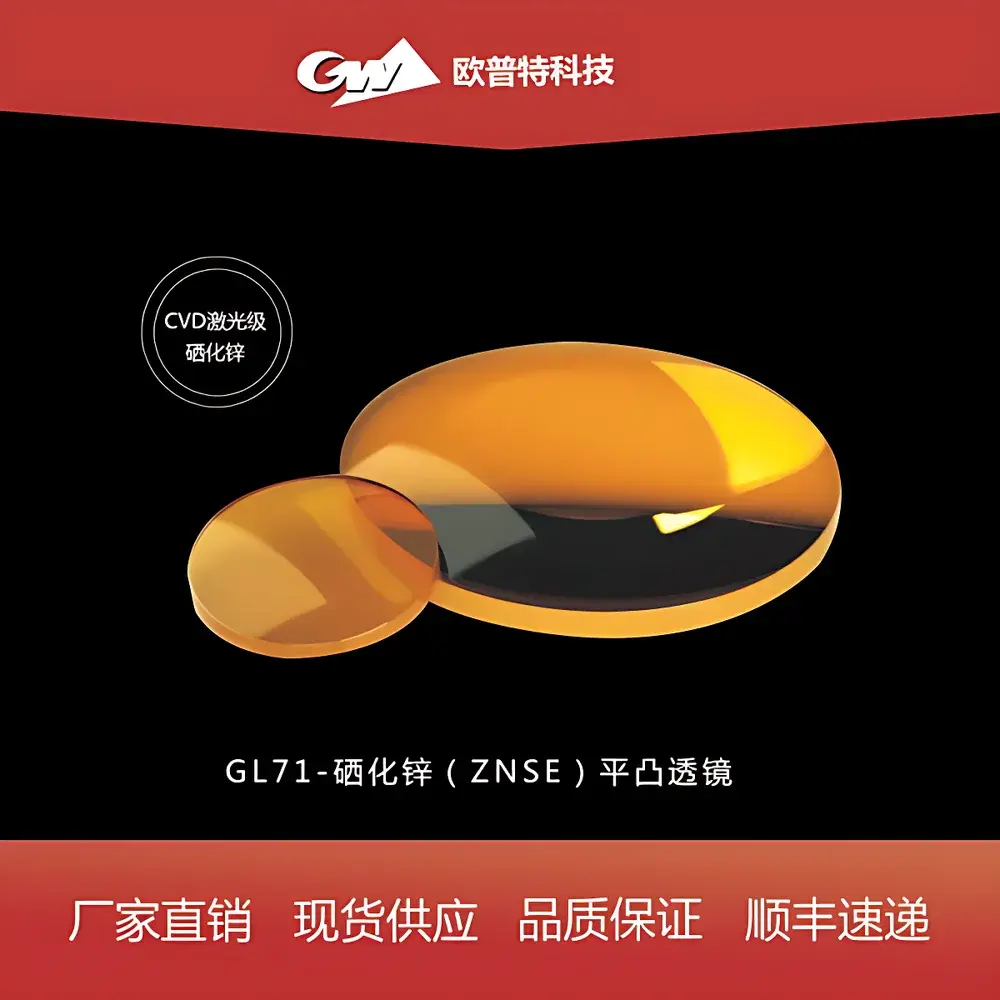
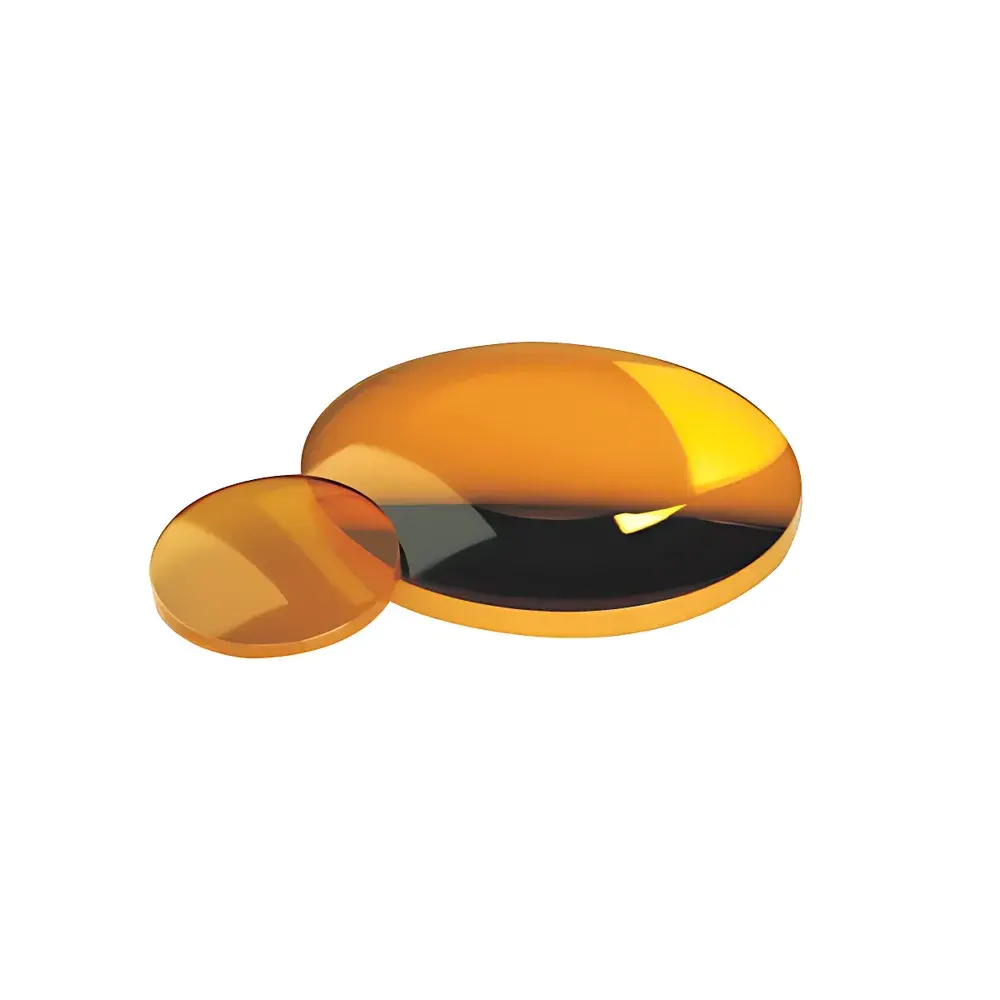
GL71 Zinc Selenide (ZnSe) Plano-Convex Lens, Uncoated with IR2 Anti-Reflection Coating for 8–12 µm
| Origin | Beijing, China |
|---|---|
| Manufacturer Type | Authorized Distributor |
| Regional Origin | Domestic (PRC) |
| Model | GL71 |
| Price Range | USD 70 – 140 |
| Component Category | Optical Element |
| Coating Specification | IR2 Broadband AR Coating, Rₐᵥg < 1.5% @ 8–12 µm |
| Substrate Material | CVD-Grown Zinc Selenide (ZnSe) |
| Surface Quality | 60–40 Scratch-Dig |
| Surface Flatness (Plano Side) | λ/4 @ 632.8 nm |
| Centering Tolerance | < 3 arcmin |
| Clear Aperture | ≥ 90% of Diameter |
Overview
The GL71 series comprises precision-engineered zinc selenide (ZnSe) plano-convex lenses designed explicitly for mid-wave to long-wave infrared (MWIR–LWIR) optical systems operating within the 8–12 µm atmospheric transmission window. Fabricated from chemically vapor-deposited (CVD) ZnSe, these lenses exhibit high transmittance (>70% bulk), low absorption, and excellent thermal stability—critical attributes for CO₂ laser delivery (10.6 µm), thermal imaging, FTIR spectroscopy, and passive infrared sensing applications. Unlike silica or BK7 optics, ZnSe offers minimal dispersion and negligible thermal lensing in high-power IR environments. Each GL71 lens features a plano surface polished to λ/4 wavefront accuracy and a convex surface generated via deterministic single-point diamond turning, ensuring diffraction-limited performance when paired with appropriate beam geometry and alignment.
Key Features
- CVD-grade ZnSe substrate with certified homogeneity and low intrinsic stress—verified per MIL-O-13830A surface quality standards (60–40 scratch-dig)
- IR2 broadband anti-reflection coating optimized for 8–12 µm spectral band; average reflectance Ravg < 1.5% across full operational range, deposited via ion-assisted e-beam evaporation
- Center thickness tolerance ±0.1 mm; focal length tolerance ±1% (specified at 10.6 µm wavelength)
- Plano side flatness maintained at λ/4 @ 632.8 nm (HeNe reference); convex surface figure error ≤ λ/2 PV over clear aperture
- Centering accuracy < 3 arcminutes, enabling direct integration into collimation and focusing assemblies without iterative alignment
- Available in diameters from 12.7 mm to 25.4 mm and focal lengths spanning 15 mm to 1000 mm—covering common requirements for IR beam expanders, detector coupling, and objective optics
Sample Compatibility & Compliance
The GL71 lens series is compatible with standard kinematic mounts (e.g., SM1-threaded lens tubes, Ø1″ post holders) and integrates seamlessly into OEM IR modules compliant with ISO 10110-1 (optical element specification) and ISO 10110-7 (surface imperfection grading). All IR2-coated variants meet RoHS Directive 2011/65/EU material restrictions. While not individually certified, the ZnSe substrate and coating process adhere to ASTM F1722-18 (Standard Specification for Zinc Selenide Optical Materials) and are routinely qualified for use in systems requiring conformance to IEC 61000-4-2 (ESD immunity) and MIL-STD-810G (environmental durability). No hazardous outgassing observed under vacuum conditions up to 1×10⁻⁵ Torr—validated per ECSS-Q-ST-70-02C for space-qualified optical subsystems.
Software & Data Management
No embedded firmware or software control is associated with the GL71 lens—it is a passive optical component. However, full metrology data (interferometric surface maps, spectral transmittance curves, coating reflectance spectra, and dimensional inspection reports) are provided digitally upon request in standardized formats: Zemax .ZAR files for sequential ray tracing, STEP AP203 (.stp) for mechanical integration, and CSV/Excel datasets for QA traceability. All calibration records comply with ISO/IEC 17025:2017 requirements for accredited optical testing laboratories. Traceable NIST-traceable interferometry (using Zygo Verifire™ MST) and FTIR spectrophotometry (PerkinElmer Frontier™) are performed prior to shipment.
Applications
- CO₂ laser beam shaping and focusing in industrial cutting, welding, and marking systems
- Objective and relay optics in uncooled microbolometer-based thermal imaging cameras (e.g., FLIR Tau², Seek Thermal)
- Sample compartment optics in Fourier-transform infrared (FTIR) spectrometers operating in the fingerprint region (625–1250 cm−1)
- Collimation elements in quantum cascade laser (QCL) spectroscopy platforms
- Transmissive windows and condenser optics in IR radiometry and blackbody calibration setups
- Custom beam combiners and dichroic stacks where ZnSe serves as substrate for hybrid multilayer interference coatings
FAQ
What is the damage threshold for GL71 lenses under continuous-wave CO₂ laser irradiation?
For uncoated ZnSe, the CW laser-induced damage threshold (LIDT) is approximately 500 W/cm² at 10.6 µm. With IR2 coating, LIDT increases to ≥750 W/cm² due to reduced interfacial absorption—measured per ISO 21254-2 using 10.6 µm, 100 ms pulse duration.
Can GL71 lenses be used in vacuum or high-humidity environments?
Yes. CVD ZnSe exhibits negligible water absorption (hygroscopicity < 0.01% w/w) and maintains structural integrity under vacuum down to 10−6 Torr. IR2 coating demonstrates no delamination after 96 hr exposure to 85°C/85% RH per JEDEC JESD22-A101.
Is custom focal length or diameter available?
Yes. Non-standard geometries—including diameters up to Ø50.8 mm and focal lengths beyond 1000 mm—are available under OEM agreement with minimum order quantities and extended lead times. Custom coating options (e.g., dual-band AR for 3–5 µm + 8–12 µm) can also be engineered.
Do you provide mounting hardware or cell designs?
Standard SM1-threaded lens cells (e.g., Thorlabs LA1951-B) and kinematic mounts are fully compatible. Custom machined aluminum or Invar lens cells with thermal expansion matching (α ≈ 7.1 × 10⁻⁶/K) are offered upon engineering review.
How is surface cleanliness verified before shipment?
Each lens undergoes Class 100 cleanroom inspection using dark-field microscopy and passes particle count verification per ISO 14644-1 Class 5 criteria. Final cleaning follows ANSI/OEOSC OP1.002-2020 protocol with reagent-grade acetone and methanol rinses, followed by nitrogen purge.




