
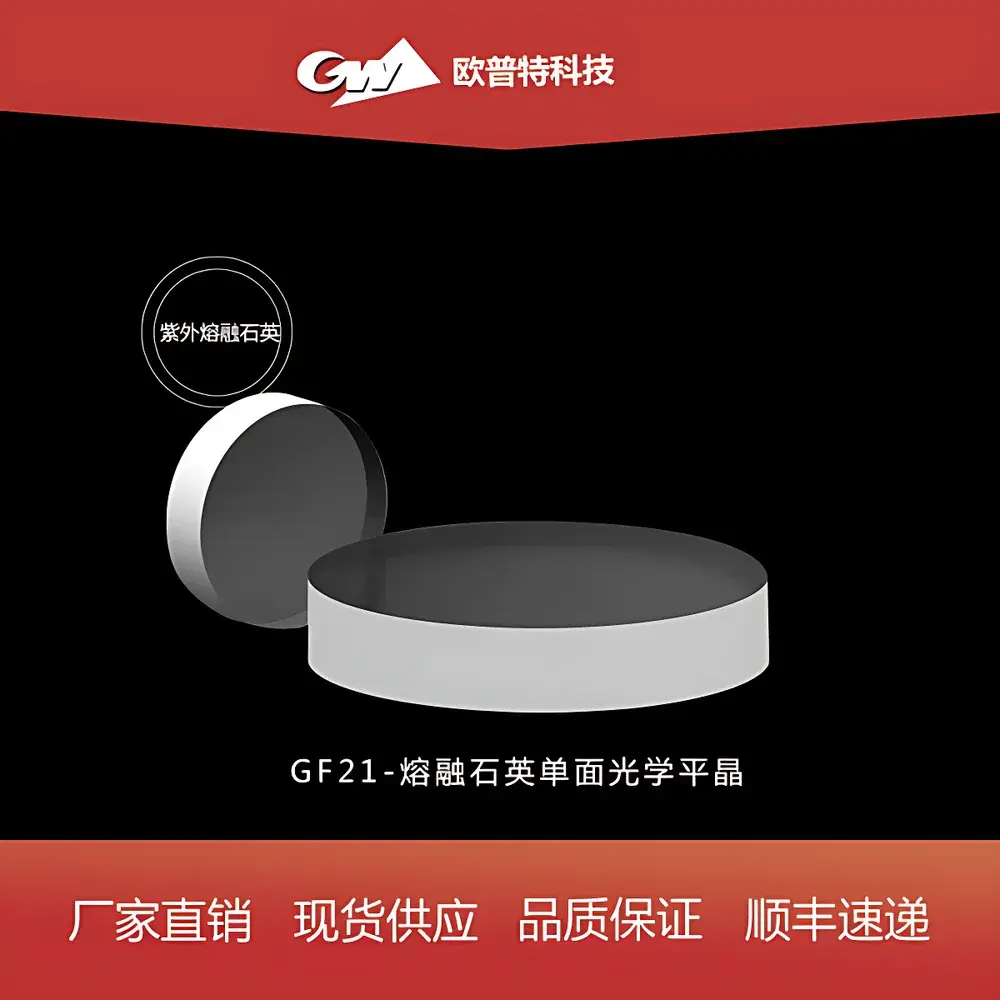
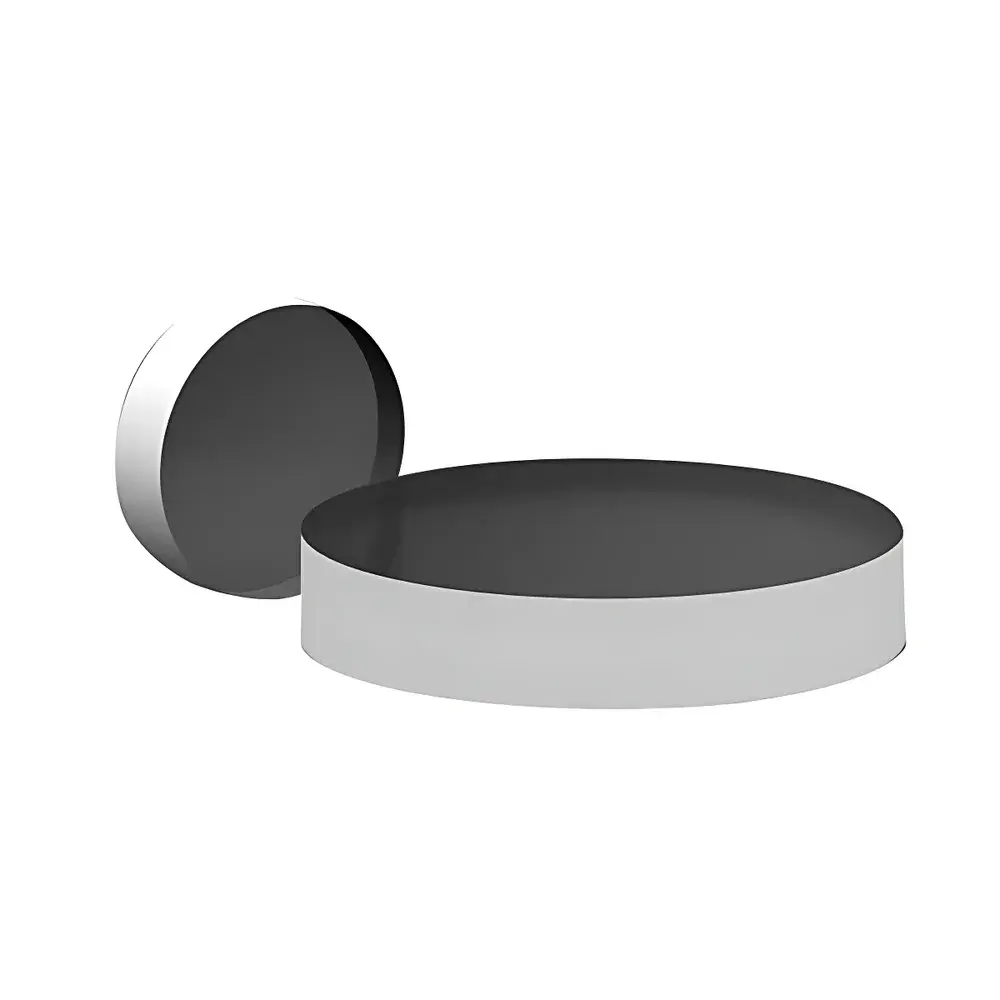
GF21 Single-Sided Optical Flat
| Origin | Beijing |
|---|---|
| Manufacturer Type | Distributor |
| Origin Category | Domestic |
| Model | GF21 |
| Price Range | USD 70–140 |
| Component Category | Optical Element |
| Material | UV Fused Silica |
| Surface Figure | λ/20 or λ/10 @ 633 nm |
| Parallelism | < 1 arcminute |
| Surface Quality | 3–4 grade (MIL-PRF-13830B) |
| Back Surface | Fine ground |
| Diameter Tolerance | ±0.2 mm |
| Thickness Tolerance | ±1 mm to ±2 mm (model-dependent) |
| Edge Treatment | Protective 45° chamfer, 0.2–0.5 mm |
| Coating | Optional custom thin-film coating per customer specification |
Overview
The GF21 Single-Sided Optical Flat is a precision reference standard engineered for high-accuracy planarity verification in optical metrology and precision mechanical assembly. Fabricated from UV-grade fused silica, it exhibits exceptional thermal stability (CTE ≈ 0.55 × 10⁻⁶ /°C), low fluorescence, and broad spectral transmission from 190 nm to 2.2 µm—making it suitable for applications ranging from deep-ultraviolet lithography alignment to visible-light interferometric flatness testing. Unlike double-sided flats, the GF21 features a single optically finished surface paired with a fine-ground non-functional back—reducing mass, minimizing thermal lag, and eliminating ghost reflections during monochromatic interference measurements. Its surface figure is certified at either λ/20 or λ/10 at the HeNe laser wavelength (633 nm), traceable to NIM (National Institute of Metrology, China) calibration protocols. The flat operates on the principle of optical interference: when placed in contact or near-contact with a test surface under monochromatic illumination, Newton’s rings or fringe patterns reveal deviations in surface topography with sub-wavelength resolution.
Key Features
- UV fused silica substrate ensuring high homogeneity, low birefringence, and minimal wavefront distortion
- Optically polished front surface meeting λ/20 or λ/10 surface figure tolerance at 633 nm (as specified per part number)
- Parallelism controlled to < 1 arcminute between functional surface and mounting base plane
- Surface quality rated 3–4 per MIL-PRF-13830B (equivalent to 10–20 scratch-dig)
- Protective 45° edge chamfer (0.2–0.5 mm) to prevent chipping and reduce edge diffraction artifacts
- Diameter tolerance held to ±0.2 mm; thickness tolerances range from ±1 mm (for thinner variants) to ±2 mm (for larger apertures), optimized for mechanical stability and interferometer compatibility
- Custom thin-film coatings available—including broadband antireflection (BBAR), high-reflection (HR), or polarization-selective stacks—designed for specific laser lines or spectral bands
Sample Compatibility & Compliance
The GF21 is compatible with all standard optical flats handling workflows, including contact interferometry using HeNe (633 nm), green DPSS (532 nm), or LED-based fringe projection systems. It meets dimensional and surface integrity requirements for ISO 10110-7 (optical element surface form tolerances) and aligns with general practices defined in ISO 14999-3 for interferometric flatness measurement. While not certified to ISO/IEC 17025 as a calibrated artifact out-of-box, each unit is supplied with a manufacturer’s conformance report listing measured surface figure (via phase-shifting interferometry), surface quality inspection results, and dimensional verification. For GLP/GMP environments requiring audit-ready documentation, optional NIST-traceable calibration certificates (including Zernike polynomial fit data and PV/RMS error maps) are available upon request.
Software & Data Management
The GF21 itself is a passive optical component and does not incorporate embedded electronics or firmware. However, it integrates seamlessly with industry-standard interferometric analysis platforms—including Zygo MetroPro, 4D Technology’s InSpec, and QED Technologies’ QED-Interferometer software—enabling quantitative extraction of surface deviation maps, PV and RMS flatness values, and localized slope errors. When used in automated metrology cells, its consistent geometry and stable material properties support repeatable registration in machine vision alignment routines and robotic handling protocols compliant with SEMI E10 standards. All part numbers (e.g., GF21-1016-1-0) encode aperture, thickness, surface figure grade, and coating status—facilitating traceability in ERP and LIMS systems.
Applications
- Verification of surface flatness in optical components (lenses, mirrors, windows, prisms) during manufacturing and incoming inspection
- Calibration reference for coordinate measuring machines (CMMs) and stylus profilometers requiring planar datum surfaces
- Interferometric evaluation of semiconductor wafer carriers, photomask blanks, and EUV mirror substrates
- Alignment reference in ultra-precision assembly of laser cavities, beam combiners, and vacuum chamber viewports
- Teaching and research applications in undergraduate and graduate optics laboratories for demonstrating wavefront analysis and coherence theory
FAQ
What does “λ/20 @ 633 nm” mean in practical terms?
It indicates that the peak-to-valley (PV) surface deviation across the clear aperture does not exceed one-twentieth of the wavelength of helium-neon laser light (633 nm), i.e., ≤ 31.65 nm PV. This corresponds to high-grade metrology performance suitable for Class 1 cleanroom optical assembly.
Can the GF21 be used in vacuum or UHV environments?
Yes—UV fused silica has negligible outgassing (per ASTM E595) and maintains dimensional stability under vacuum. Ensure the fine-ground back surface is cleaned via solvent rinse and plasma treatment prior to bakeout.
Is the surface figure certified per individual unit or batch?
Each GF21 flat undergoes full interferometric characterization; conformance reports are provided per serial-numbered unit—not batch-certified.
How should the flat be mounted to avoid deformation-induced errors?
Use kinematic or soft-contact mounts (e.g., three-point elastomeric supports) that avoid clamping stress. Never tighten retaining rings beyond finger-tight; torque-induced flexure degrades effective surface figure.
Do you offer ISO 17025-accredited calibration?
Yes—upon request, third-party accredited calibration (including uncertainty budgets per GUM) can be arranged through our partner metrology labs in Germany and Singapore. Lead time: 3–4 weeks.




