
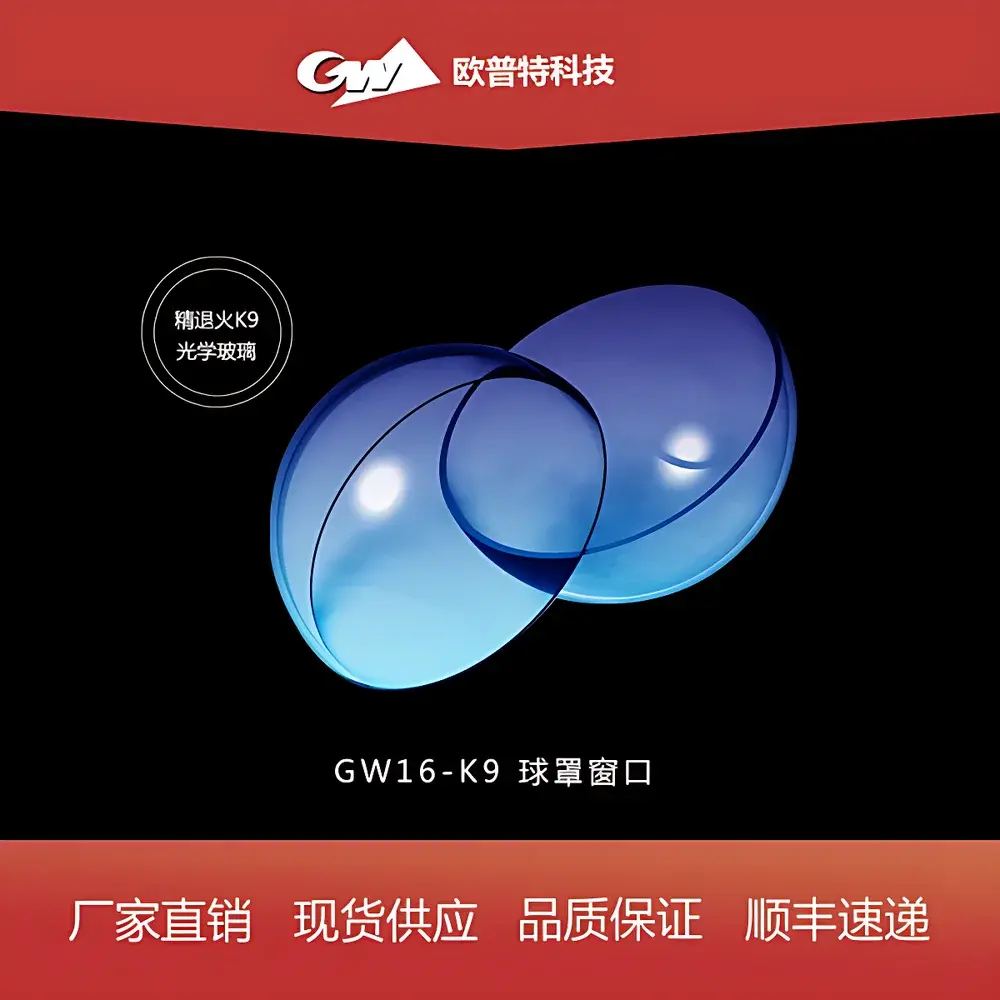
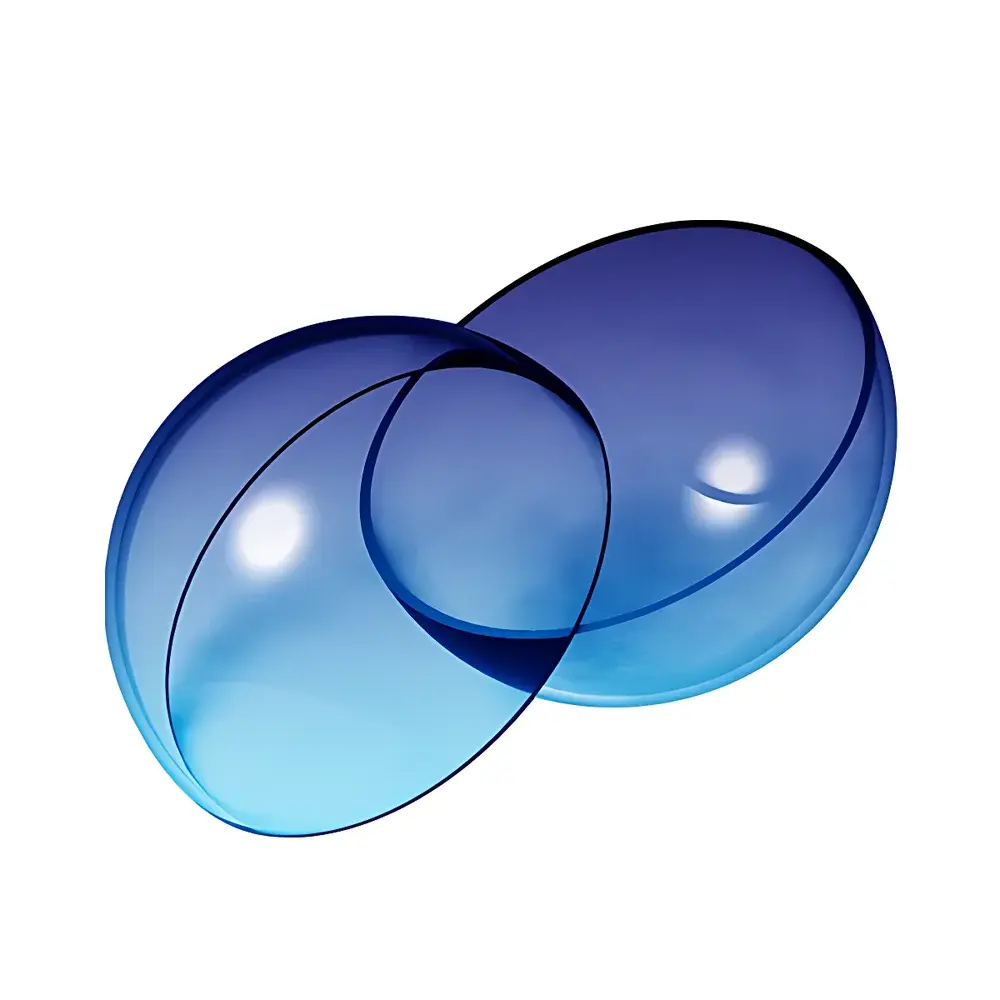
GW16-K9 Spherical Dome Window
| Material | Precision Annealed K9 Optical Glass |
|---|---|
| Surface Figure | Local ΔN < 10 @ 633 nm |
| Surface Quality | 4/0 (per ISO 10110-7) |
| Diameter Tolerance | +0.0 / −0.2 mm |
| Thickness Tolerance | ±0.2 mm |
| Edge Treatment | Protective 45° Chamfer, 0.2–0.5 mm |
| Coating | Optional Broadband AR or Custom Coating (see product matrix) |
| Component Type | Optical Element |
Overview
The GW16-K9 Spherical Dome Window is a precision-engineered optical component designed for demanding applications requiring wide-angle transmission and environmental protection of sensitive optical sensors, detectors, and imaging systems. Unlike flat windows, the spherical dome geometry provides uniform optical path length across large incident angles—typically up to ±45°—minimizing wavefront distortion, astigmatism, and beam deviation under off-axis illumination. Constructed from precision-annealed K9 borosilicate crown glass (Schott BK7 equivalent), the window exhibits excellent transmission in the visible spectrum (350–2000 nm), low thermal expansion (7.1 × 10⁻⁶ /K), and high homogeneity (< 5 × 10⁻⁶), making it suitable for integration into laser diagnostics, aerospace sensor housings, underwater optical systems, and industrial vision modules where mechanical robustness and optical fidelity must coexist.
Key Features
- Precision spherical dome profile with radius-to-diameter ratio optimized for minimal spherical aberration and consistent focal shift across field angles
- Surface figure accuracy of local ΔN < 10 waves @ 633 nm (λ/10 PV), verified via interferometric testing per ISO 10110-5
- Surface quality rated at 4/0 (scratch/dig), conforming to MIL-PRF-13830B and ISO 10110-7 standards
- Tight dimensional tolerances: diameter held to +0.0 / −0.2 mm; center thickness controlled within ±0.2 mm
- Protective 45° chamfer (0.2–0.5 mm) applied to all peripheral edges to mitigate chipping during handling and mounting
- Optional anti-reflection coatings available—including broadband AR (R<0.25% avg. from 400–700 nm) and custom V-coatings for specific laser lines (e.g., 532 nm, 1064 nm)
Sample Compatibility & Compliance
The GW16 series is compatible with standard kinematic and flexure-based optical mounts (e.g., SM1-threaded cages, Ø25 mm lens tubes). Its K9 substrate meets RoHS Directive 2011/65/EU and REACH SVHC compliance requirements. All units undergo batch-level certification including spectral transmittance verification (PerkinElmer Lambda 950 spectrophotometer), surface inspection under 100× dark-field microscopy, and environmental stress screening (thermal cycling: −40°C to +80°C, 5 cycles). The dome geometry inherently satisfies MIL-STD-810G vibration and shock resistance criteria when properly secured—no additional adhesives or gaskets required for moderate-pressure sealing (up to 0.5 bar differential).
Software & Data Management
While the GW16-K9 is a passive optical element, its metrological data is traceable to NIM (National Institute of Metrology, China) via calibrated interferometric characterization reports. Each shipment includes a Certificate of Conformance (CoC) listing measured surface figure, transmitted wavefront error (TWE), and coating performance curves (if applicable). For integration into automated optical assembly workflows, dimensional and coating specifications are provided in STEP AP242 format and can be imported into Zemax OpticStudio, CODE V, or ASAP for tolerance analysis and stray-light modeling. Full documentation supports audit readiness for ISO 9001:2015 and IATF 16949 quality management systems.
Applications
- Laser-based LIDAR receiver apertures requiring minimal beam walk-off at wide field angles
- Underwater photodetector housings exposed to hydrostatic pressure and biofouling environments
- Thermal imaging systems operating in harsh industrial settings (e.g., steel mill furnace monitoring)
- Space-qualified star tracker windows where zero-focus shift over temperature gradients is critical
- Medical endoscopic illumination channels requiring high UV-VIS throughput and scratch resistance
- Custom vacuum chamber viewports for synchrotron beamline diagnostics
FAQ
What is the maximum recommended incident angle for minimal wavefront error?
For optimal performance, the GW16 dome maintains transmitted wavefront error < λ/8 RMS up to ±40° full field angle in collimated illumination at 633 nm.
Can this dome be mounted in vacuum environments?
Yes—K9 glass has negligible outgassing (per ASTM E595); combined with clean-room assembly and optional vacuum-compatible edge sealing, it is rated for UHV applications down to 10⁻⁸ Torr.
Is custom diameter or curvature available?
Yes—custom radii, diameters (Ø3–200 mm), and substrate materials (e.g., fused silica, CaF₂) are available under OEM agreement with minimum order quantities.
How is coating durability validated?
All AR coatings undergo 20-cycle tape peel test (ASTM D3359), abrasion testing (ISO 9211-4), and humidity exposure (85% RH, 1000 h) per MIL-C-48497A.
Do you provide mounting hardware or alignment fixtures?
Standard SM1-threaded retaining rings and kinematic lens mounts are offered separately; custom CNC-machined alignment sleeves with fiducial marks are available upon request.



