
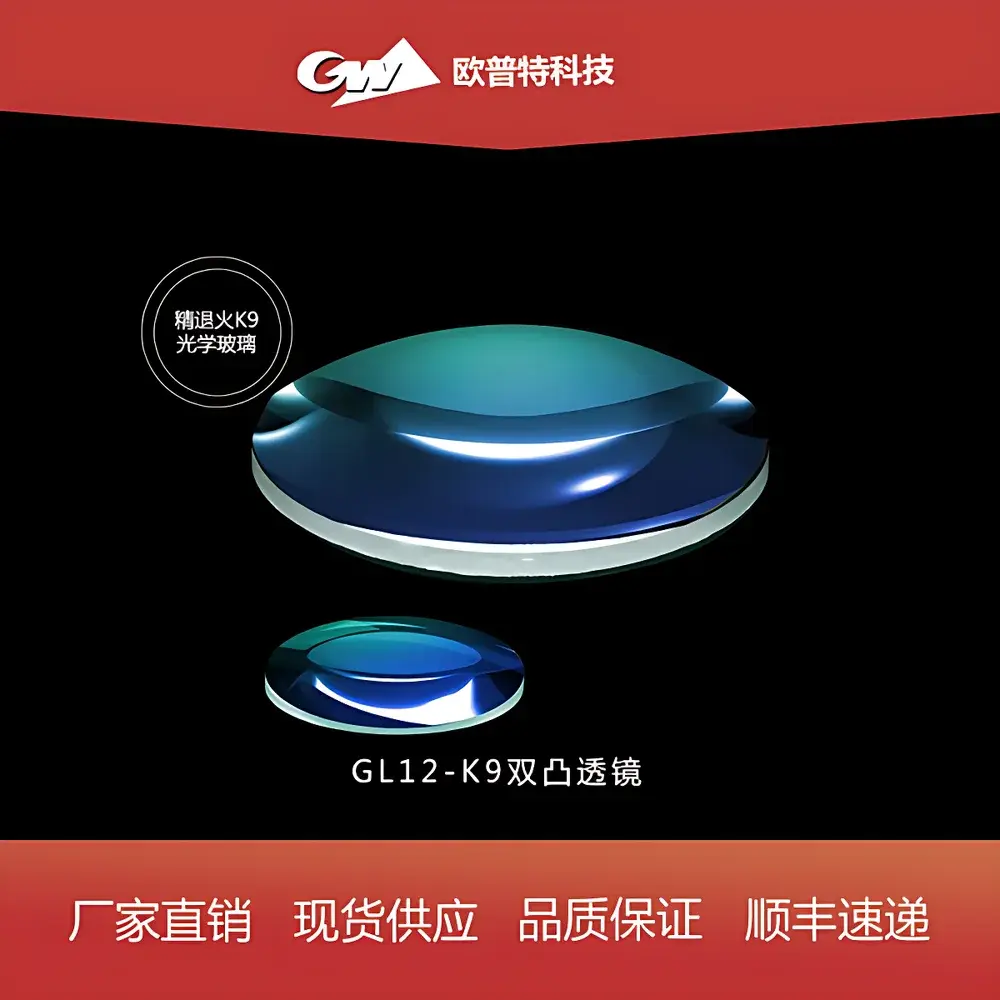
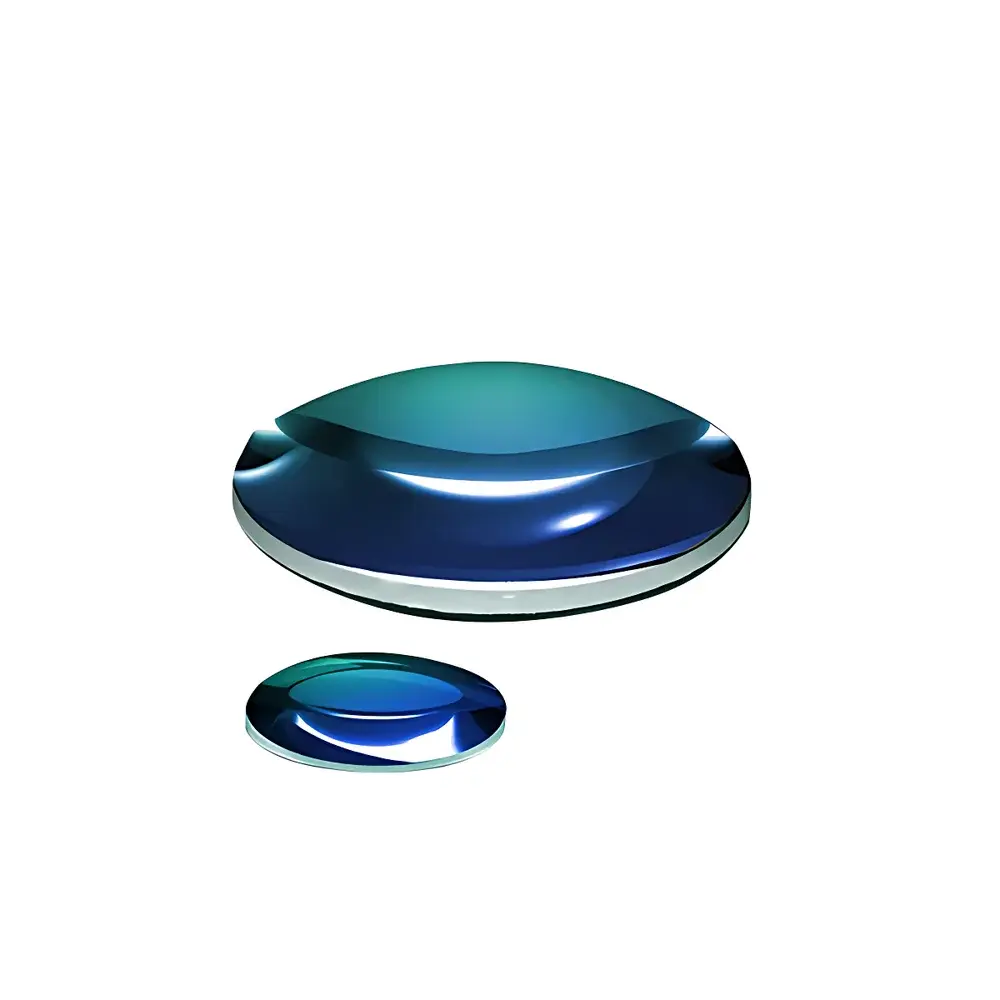
GL12-K9 Biconvex Lens (Uncoated), Diameter 2–100 mm
| Material | Precision-Annealed K9 Optical Glass |
|---|---|
| Design Wavelength | 587.6 nm |
| Diameter Tolerance | +0.0 / −0.1 mm |
| Center Thickness Tolerance | ±0.2 mm |
| Surface Irregularity | λ/4 @ 632.8 nm |
| EFL Tolerance | ±2% |
| Centration Error | 3 arcmin |
| Surface Quality | 3–4 scratch-dig |
| Edge Chamfer | 0.2 mm × 45° |
| Spectral Range (Uncoated) | VIS (400–700 nm), NIR (650–1050 nm), SWIR (1000–1650 nm) |
| Mounting Compatibility | Standard lens retention rings for Ø2–100 mm optics |
Overview
The GL12-K9 Biconvex Lens is a precision optical component engineered for fundamental and applied optical systems requiring high wavefront fidelity, minimal chromatic aberration, and robust mechanical stability. Fabricated from precision-annealed K9 borosilicate crown glass—a material standardized under ISO 10110-1 and widely referenced in DIN 3141—this uncoated biconvex lens operates on the principle of symmetric refraction at two convex spherical surfaces. Its positive focal length enables collimated beam focusing or point-source collimation, making it foundational in relay imaging, laser cavity design, illumination homogenization, and optical train alignment. The lens adheres to standard optical fabrication tolerances defined by ISO 10110-5 for surface form and ISO 10110-7 for surface quality, ensuring compatibility with metrology-grade alignment setups and interferometric verification workflows.
Key Features
- Optical substrate: High-homogeneity, low-bubble K9 glass (Schott BK7 equivalent), certified per MIL-PRF-174B Class A for refractive index uniformity (nd = 1.5163 ±0.0002)
- Symmetric biconvex geometry optimized for minimum spherical aberration at paraxial conjugates; radius of curvature balanced per Abbe invariant condition
- Tight dimensional control: diameter tolerance +0.0/−0.1 mm ensures repeatable mounting in kinematic lens cells and SM-threaded housings
- Surface irregularity ≤λ/4 PV @ 632.8 nm (HeNe wavelength), verified via phase-shifting interferometry (PSI) per ISO 10110-5
- Centration error ≤3 arcminutes—critical for minimizing beam walk-off in multi-element assemblies and fiber coupling optics
- Edge preparation: 0.2 mm × 45° chamfer compliant with ISO 10110-3 to prevent chipping during handling and mounting
- Uncoated surface finish supports custom AR coating integration (e.g., MgF₂ single-layer or broadband dielectric stacks) without substrate interference
Sample Compatibility & Compliance
The GL12-K9 lens is compatible with industry-standard mechanical mounts including SM-series threaded lens tubes (SM05, SM1, SM2), kinematic lens holders (e.g., Thorlabs LM1XY, Newport 98-010 series), and optomechanical breadboard adapters. As an uncoated optical element, it meets RoHS Directive 2011/65/EU and REACH Annex XVII compliance for restricted substances. While not inherently certified to IEC 61000-4 electromagnetic immunity standards (as a passive component), its material composition and surface treatment are fully compatible with cleanroom environments classified per ISO 14644-1 Class 5. Documentation includes traceable metrology reports for surface figure, centration, and transmitted wavefront error—supporting GLP-aligned optical assembly validation protocols.
Software & Data Management
As a passive optical component, the GL12-K9 lens does not incorporate embedded firmware or digital interfaces. However, its geometric and material specifications are fully parameterized in industry-standard optical design software libraries—including Zemax OpticStudio (as “K9_BK7” material with Sellmeier coefficients), CODE V, and FRED—enabling accurate ray tracing, tolerance analysis, and sensitivity modeling. Manufacturing data sheets include full ISO 10110-compliant notation for surface prescription, allowing direct import into optical CAD environments. For quality assurance traceability, batch-specific test reports (including interferometric fringe maps and spectral transmission scans) are archived in accordance with ISO 9001:2015 clause 8.5.2—available upon request for audit-ready documentation packages.
Applications
- Visible and near-infrared imaging systems: microscope objectives, endoscope relay lenses, machine vision telecentric modules
- Laser beam manipulation: collimation of diode lasers (e.g., 405 nm, 635 nm, 785 nm), focus conditioning in LIDAR receiver optics
- Interferometric reference optics: as field lenses in Michelson and Twyman-Green configurations where low scatter and high surface fidelity are essential
- Educational optics labs: demonstrating Gaussian beam propagation, ABCD matrix formalism, and thin-lens equation validation
- Custom filter and detector coupling: serving as input windows or focusing elements in spectrometer fore-optics and photodetector modules
FAQ
What is the refractive index dispersion profile of K9 glass across the visible spectrum?
K9 follows the Schott BK7 Sellmeier equation with nd = 1.5163, nF = 1.5224, and nC = 1.5139; Abbe number νd = 64.2.
Can this lens be used in vacuum or high-humidity environments?
Yes—K9 exhibits negligible outgassing (per ASTM E595) and no hygroscopic degradation; however, uncoated surfaces require controlled RH <40% to avoid micro-condensation-induced scatter.
Is centration error measured relative to mechanical axis or optical axis?
Per ISO 10110-7, centration error is defined as the angular deviation between the mechanical cylinder axis (derived from outer diameter) and the optical axis (defined by surface vertex normals); measurement uses autocollimation or prism-based null testing.
Do you provide ISO 10110-compliant test reports with each shipment?
Yes—batch-level interferometric surface figure data, centration verification records, and spectral transmission curves (200–2000 nm) are included digitally with every order.
What is the maximum permissible power density for continuous-wave laser use at 532 nm?
For uncoated K9 at 532 nm, the damage threshold is ≥500 MW/cm² for 10 ns pulses (ISO 21254-1), and ~10 kW/cm² for CW operation with adequate heat sinking and beam homogenization.




