
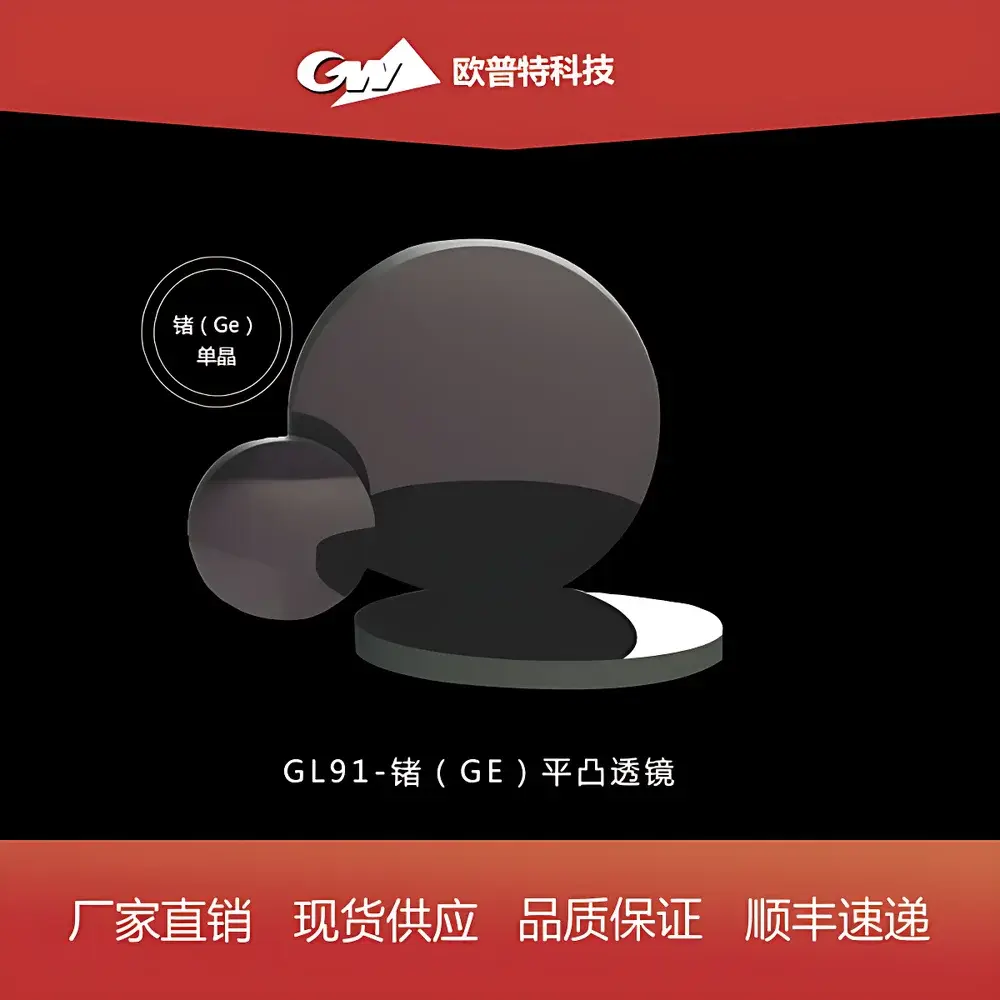
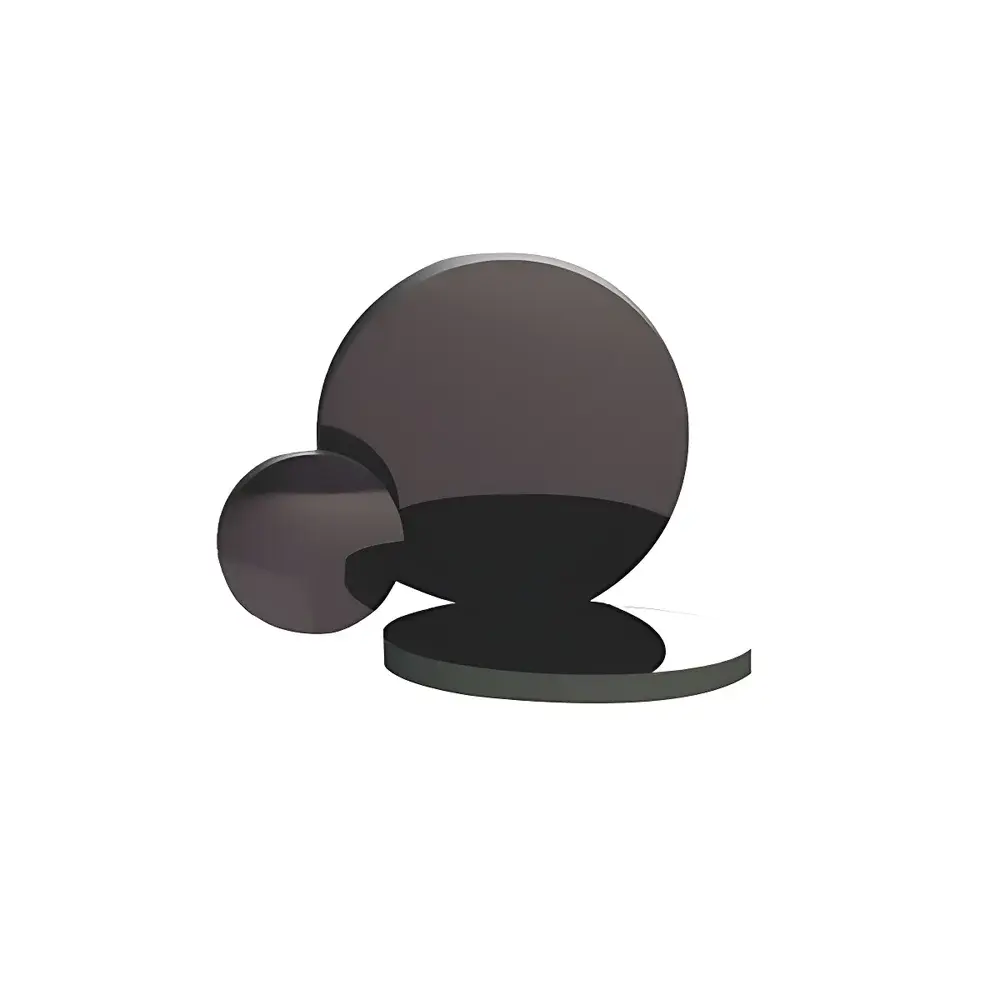
GL91 Germanium Plano-Convex Lens (Uncoated Base with Dual-Side IR2 Anti-Reflection Coating @ 8–12 µm)
| Origin | Beijing, China |
|---|---|
| Manufacturer Type | Authorized Distributor |
| Regional Origin | Domestic (PRC) |
| Model | GL91 |
| Price Range | USD 70–140 (per unit, FOB Beijing) |
| Component Category | Optical Element |
| Substrate Material | Germanium (Ge) |
| Coating Specification | IR2 Broadband AR Coating, Rₐᵥg < 1.5% @ 8–12 µm |
| Mounting Compatibility | Standard SM-threaded lens mounts (e.g., PN35030-LM127-S for Ø12.7 mm |
Overview
The GL91 series comprises precision-ground germanium (Ge) plano-convex lenses engineered for high-transmission performance in the long-wave infrared (LWIR) spectral region — specifically optimized for operation between 8 and 12 micrometers. Germanium’s high refractive index (~4.0 at 10 µm) and negligible absorption within this atmospheric transmission window make it the substrate of choice for thermal imaging systems, FTIR spectrometers, CO₂ laser beam delivery optics, and uncooled microbolometer-based detection platforms. Unlike silica or fused quartz optics, Ge lenses require anti-reflection coatings to mitigate Fresnel losses inherent to high-index materials; the GL91 incorporates a proprietary dual-side IR2 coating that achieves average reflectance 97% transmission per surface) while maintaining wavefront fidelity under collimated or moderately convergent illumination. All GL91 lenses are fabricated to ISO 10110-3 surface quality standards (scratch-dig 60–40), with surface irregularity ≤λ/4 @ 10.6 µm and centration error <3 arcmin.
Key Features
- Germanium substrate with certified purity (>99.999%) and controlled crystal orientation to minimize birefringence and thermal lensing effects
- Dual-side IR2 broadband anti-reflection coating: Rₐᵥg < 1.5% over 8–12 µm; durable ion-assisted deposition (IAD) process compliant with MIL-C-48497A
- Plano-convex geometry optimized for minimal spherical aberration in collimated-to-focused configurations
- Standardized mechanical interfaces: compatible with industry-standard SM1 (1.035″-40) and SM25 (2.035″-40) threaded lens mounts (e.g., PN35030-LM127-S, PN35019-LM254-S)
- Thermal stability: coefficient of thermal expansion (CTE) matched to common LWIR housing materials; operational range −40 °C to +70 °C without delamination or stress-induced birefringence
- Traceable metrology: each lens supplied with individual test report including focal length verification (±0.5% tolerance), surface flatness (plano side), and radius-of-curvature measurement (convex side)
Sample Compatibility & Compliance
The GL91 lens family supports integration into both OEM optical engines and research-grade benchtop setups. Its uncoated germanium base material conforms to ASTM F2255–22 specifications for infrared-transmitting optical grade germanium. The IR2 coating is qualified per ISO 9211-3 for environmental durability (humidity, abrasion, adhesion) and exhibits no measurable degradation after 1,000-hour accelerated aging per MIL-STD-810H Method 507.5. All units are manufactured under documented quality control procedures aligned with ISO 9001:2015 and support GLP-compliant documentation packages upon request. No RoHS exemptions apply — the Ge substrate contains no restricted substances above threshold limits.
Software & Data Management
While the GL91 is a passive optical component, its geometric and spectral parameters are fully integrated into standard optical design software libraries. Zemax OpticStudio, CODE V, and FRED include native material definitions for CVD-grown germanium (Schott N-GERMANIUM, Hikari G-GERM) with accurate Sellmeier coefficients valid from 2–14 µm. Coating data (complex refractive index vs. wavelength) for the IR2 layer is available in .coating format upon NDA execution. Each product shipment includes a QR-coded label linking to downloadable PDF datasheets, coating spectral curves, and mechanical drawings in STEP and DXF formats — all timestamped and revision-controlled per internal document management system (DMS v3.2).
Applications
- Thermal imaging objective assemblies for uncooled VOx and a-Si microbolometer arrays
- Beam conditioning optics in quantum cascade laser (QCL) and external cavity QCL systems operating at 9.2–10.8 µm
- Fourier transform infrared (FTIR) interferometer output coupling and sample illumination paths
- LWIR collimators for gas sensing platforms targeting CH₄, CO₂, and NO₂ absorption lines
- Defense-grade forward-looking infrared (FLIR) subsystems requiring high transmittance and low ghost image generation
- Calibration targets and reference optics in radiometric traceability chains accredited to ISO/IEC 17025
FAQ
Is the germanium substrate polished on both sides prior to coating?
Yes — both surfaces undergo deterministic magnetorheological finishing (MRF) to achieve λ/8 surface figure accuracy @ 10.6 µm and RMS roughness <5 Å.
Can GL91 lenses be used in vacuum environments?
Yes — germanium exhibits negligible outgassing (TML <0.05%, CVCM <0.01% per ASTM E595) and maintains coating integrity under 10⁻⁶ Torr conditions.
What is the damage threshold for pulsed CO₂ laser exposure?
For 10.6 µm, 10 ns pulses at 10 Hz repetition rate, the certified LIDT is 0.5 J/cm² (tested per ISO 21254-2); continuous-wave threshold exceeds 5 kW/cm².
Are custom focal lengths or diameters available?
Yes — standard catalog covers Ø12.7 mm and Ø25.4 mm variants with EFLs from 15 mm to 1000 mm; non-standard sizes and aspheric modifications supported under engineering release (lead time: 8–12 weeks).
Does the IR2 coating meet MIL-PRF-13830B scratch-dig requirements?
Yes — coated surfaces meet 60–40 scratch-dig specification per MIL-PRF-13830B Annex A, verified via calibrated Nomarski interference microscopy.





