
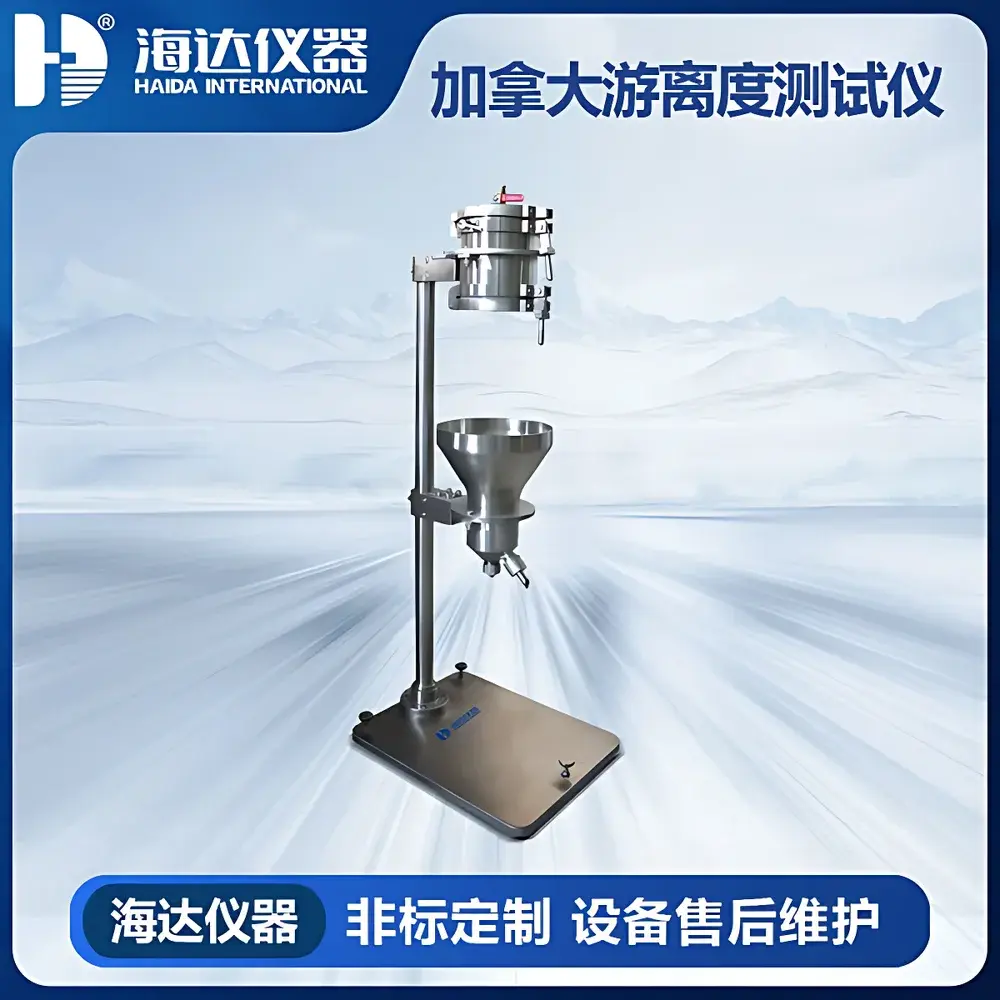
HAIDA HD-P006 Canadian Standard Freeness Tester
| Brand | HAIDA INTERNATIONAL |
|---|---|
| Origin | Guangdong, China |
| Manufacturer Type | Direct Manufacturer |
| Product Origin | Domestic (China) |
| Model | HAIDA HD-P006 Canadian Standard Freeness Tester |
| Pricing | Available Upon Request |
| Standards Compliance | TAPPI T227, ISO 5267-2, AS/NZS 1301.206s, BS 6035-2, CPPA C1, SCAN C21, QB/T 1669–1992 |
| Dimensions (L×H×W) | 300 mm × 1120 mm × 400 mm |
| Measurement Range | 0–1000 CSF |
| Weight | 57.2 kg |
| Mounting Option | Wall-Mountable Configuration Available |
Overview
The HAIDA HD-P006 Canadian Standard Freeness Tester is a precision-engineered instrument designed to quantify the drainage rate of pulp suspensions under standardized gravitational conditions, in strict accordance with the Canadian Standard Freeness (CSF) method. This gravimetric test measures the volume (in milliliters) of filtrate collected in 10 seconds through a specified mesh screen under controlled temperature and consistency—providing a reproducible index of pulp fiber flexibility, fibrillation degree, and fines content. Unlike dynamic or pressure-driven filtration methods, the CSF test reflects the intrinsic dewatering behavior of pulp in low-shear, gravity-fed scenarios—making it especially relevant for monitoring mechanical refining, groundwood processing, and early-stage chemical pulping operations. The HD-P006 delivers consistent results across diverse pulp types—including hardwood and softwood kraft, thermomechanical (TMP), chemithermomechanical (CTMP), and recycled fiber blends—while maintaining full traceability to internationally recognized test protocols.
Key Features
- Robust stainless-steel and anodized aluminum construction ensures long-term dimensional stability and corrosion resistance in humid laboratory environments.
- Integrated CSF funnel with precisely machined 0.5 mm diameter perforations and calibrated 14° conical angle, conforming to TAPPI T227 dimensional tolerances.
- Dual-mode operation: benchtop configuration (standard) and optional wall-mounted assembly for space-constrained labs or integration into QC workflow lines.
- Thermostatically stabilized water bath interface (external, not included) supports testing at 20.0 ± 0.5 °C per ISO 5267-2 requirements.
- High-precision 1000 mL graduated cylinder with ±1 mL volumetric accuracy, traceable to NIST-certified standards.
- Adjustable support frame with spirit-level alignment system guarantees vertical orientation of the CSF funnel within ±0.2°—critical for minimizing flow-path deviation.
Sample Compatibility & Compliance
The HD-P006 is validated for use with pulp slurries at standard consistency (0.3% w/w), prepared per TAPPI T205 and ISO 5263-1. It accommodates both unbleached and bleached chemical pulps, mechanical pulps, and blended fiber systems containing up to 30% synthetic or regenerated fibers (e.g., lyocell, rayon). All mechanical components comply with CE marking directives for laboratory equipment safety (2014/30/EU EMC and 2014/35/EU LVD). Test reporting meets GLP documentation requirements, with full audit trails available when paired with compliant data recording systems. The instrument satisfies mandatory clauses in ASTM D645 (replaced by TAPPI T227), ISO/IEC 17025:2017 clause 7.2.2 (method validation), and FDA 21 CFR Part 11 when used with validated electronic lab notebooks.
Software & Data Management
While the HD-P006 operates as a manual, operator-assisted instrument per classical CSF methodology, it is fully compatible with third-party digital data capture solutions. Users may integrate calibrated stopwatches with timestamped logging, or connect USB-enabled graduated cylinder sensors (e.g., Mettler Toledo ML series) to LIMS platforms via RS-232 or Modbus RTU. Raw CSF values are exported in CSV format, supporting automated calculation of statistical process control (SPC) metrics—including X̄ & R charts, Cp/Cpk indices, and trend analysis against master calibration curves. Audit-ready reports include operator ID, ambient temperature/humidity, pulp lot number, and instrument serial verification—enabling full compliance with ISO 9001:2015 clause 8.5.2 and ICH Q7 Annex 11.
Applications
- Real-time monitoring of refiner plate wear and energy efficiency in continuous refining circuits.
- Correlation of CSF values with handsheet formation, tensile strength, and porosity in pilot-scale sheet-making trials.
- Quality gate assessment for incoming pulp shipments against contractual CSF specifications (e.g., ≥550 CSF for newsprint grades).
- Process troubleshooting of abnormal drainage behavior—e.g., distinguishing true fiber shortening from “false freeness” caused by microfibril dispersion or cationic polymer overdosing.
- Educational use in pulp & paper engineering curricula for teaching fundamental relationships between fiber morphology, hornification, and dewatering kinetics.
FAQ
What is the difference between CSF and Schopper-Riegler (°SR) measurements?
CSF (mL/10 s) is inversely related to SR (°SR); higher CSF indicates faster drainage and lower fiber entanglement. While CSF is preferred in North America and for mechanical pulps, SR remains dominant in Europe and for chemical pulps. Conversion is approximate and pulp-dependent.
Does the HD-P006 require annual recalibration?
Yes—per ISO/IEC 17025, the funnel geometry, cylinder graduation, and stopwatch accuracy must be verified annually by an accredited metrology provider. HAIDA provides calibration certificates with NIST-traceable reference standards.
Can the HD-P006 be used for non-wood pulps such as bamboo or hemp?
Yes, provided slurry preparation follows TAPPI T205 and consistency is maintained at 0.3%. Non-wood fibers may require extended settling time prior to testing to ensure homogeneity.
Is wall-mounting hardware included with the standard unit?
No—wall-mounting brackets, anchors, and leveling kits are optional accessories (Order Code: HD-WM-KIT), supplied with installation drawings and torque specifications.
How does temperature variation affect CSF results?
A ±1 °C deviation from 20.0 °C introduces ~2.3% measurement error in CSF value. Use of a certified water bath or climate-controlled lab (20.0 ± 0.5 °C) is mandatory for ISO 5267-2 compliance.



