
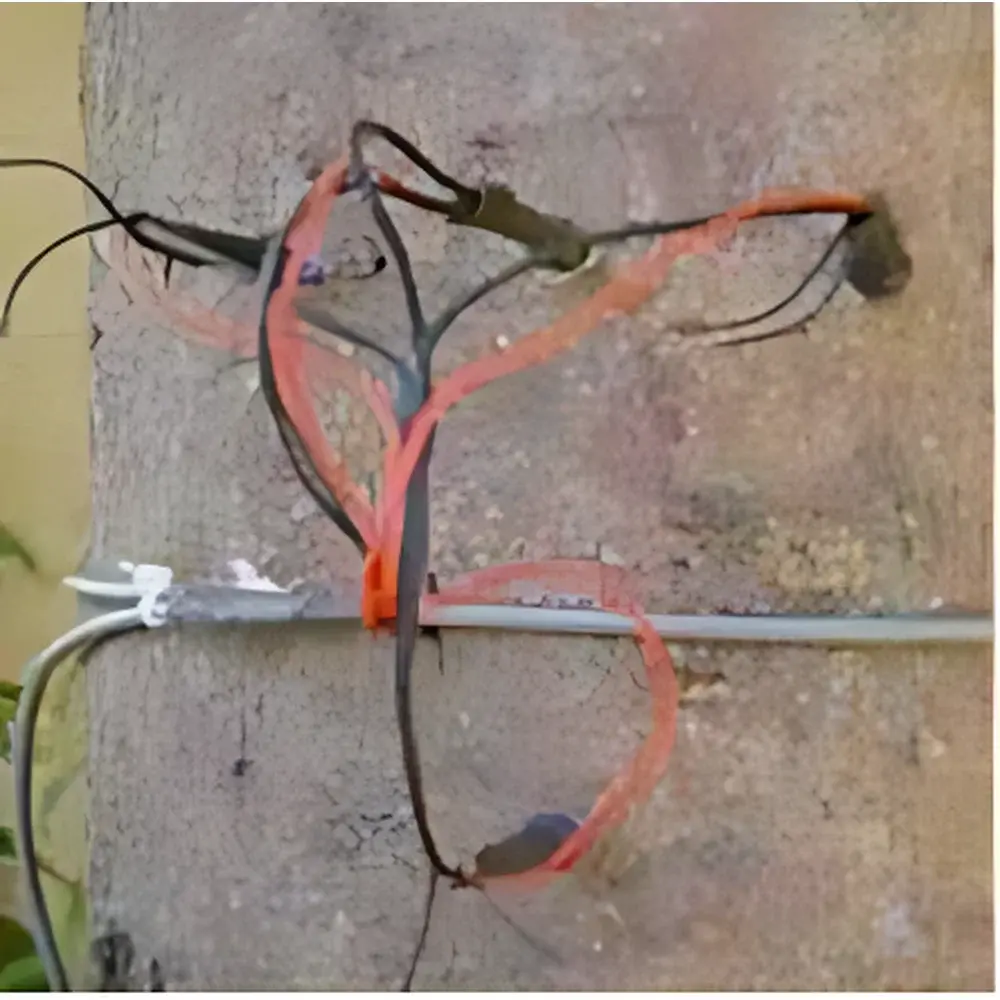
Ecomatik SF-L Stem Flow Meter
| Brand | Ecomatik |
|---|---|
| Origin | Germany |
| Model | SF-L |
| Probe Type | TDP-based Thermal Dissipation Probe (4-pin, dual-pair configuration) |
| Probe Length | 33 mm (heated) / 20 mm (reference) |
| Minimum Stem Diameter | >20 cm |
| Power Consumption | 0.2 W (84 mA DC) |
| Output Signal | –100 to +1000 µV differential |
| Cable Length | 5 m (extendable up to 20 m) |
| Compatible Data Logger | Campbell Scientific CR1000 (32 differential channels, expandable to 128 via AM16/32 multiplexer) |
| Power Supply | SF30 Constant-Current Source (supports 3 SF-L probes simultaneously) |
| Compliance | Designed for long-term field deployment under ISO 17025-aligned environmental monitoring practices |
| Software | PC-based acquisition and calibration suite with zero-point correction algorithms |
| Accessories Included | SF60 extension cable, SF40 installation kit, weatherproof enclosure, power supply, user manual |
Overview
The Ecomatik SF-L Stem Flow Meter is a precision field-deployable instrument engineered for continuous, in situ quantification of sap flow velocity and volumetric flux in woody plant stems. It operates on the validated Thermal Dissipation Probe (TDP) principle originally developed by Granier, enhanced through Ecomatik’s proprietary four-pin dual-pair architecture. Unlike single-pair TDP systems, the SF-L integrates two thermocouple pairs: the upper pair (33 mm heated probe + 20 mm unheated reference) measures heat dissipation induced by sap movement, while the lower pair (two passive 20 mm probes) concurrently records longitudinal stem temperature gradients. This real-time gradient compensation eliminates thermal artifacts arising from ambient fluctuations or radial conduction, enabling high reproducibility in sub-daily sap flow estimation across diverse microclimatic conditions. The system is calibrated for trees with stem diameters exceeding 20 cm and is optimized for integration into eddy covariance towers, watershed-scale ecohydrological networks, and long-term phenological observatories.
Key Features
- Dual-pair thermal dissipation design: separates sap-flow-induced cooling from non-physiological thermal drift via concurrent axial gradient measurement
- Low-power operation (0.2 W per probe): enables multi-year deployments powered by solar-charged 12 V battery systems
- CR1000-compatible analog output (–100 to +1000 µV differential): supports direct connection to Campbell Scientific dataloggers without signal conditioning
- Modular probe configuration: SF-L33 probes require three single-ended analog input channels per unit—scalable to 128 probes using AM16/32 relay multiplexers
- Integrated SF30 constant-current source: delivers stable excitation current to three SF-L probes simultaneously, minimizing inter-probe variance
- Weather-resistant hardware suite: includes IP66-rated enclosure, UV-stabilized cabling (SF60), and stainless-steel installation tools (SF40) for repeatable probe insertion depth and orientation
Sample Compatibility & Compliance
The SF-L is validated for use on broadleaf and coniferous species with minimum stem diameters of 20 cm, including but not limited to Quercus robur, Fagus sylvatica, Picea abies, and Pinus sylvestris. Probe insertion follows standardized protocols aligned with ISO 17025 technical requirements for environmental measurement traceability. When deployed alongside DD-series stem diameter variation sensors, the SF-L enables empirical zero-flow point determination under nocturnal conditions—critical for correcting baseline thermal offset and improving diurnal flux resolution. All firmware and calibration coefficients are stored within the CR1000’s non-volatile memory, supporting audit-ready data provenance per GLP-compliant research workflows.
Software & Data Management
Data acquisition is managed via Campbell Scientific’s LoggerNet software, with Ecomatik-supplied configuration files preloaded for SF-L channel mapping, cold-junction compensation, and Granier-type sap flux conversion (Js = 119 × (ΔTm/ΔT)1.231). The included desktop application provides post-processing tools for gap-filling (using Penman-Monteith-derived reference ET), night-time flux correction, and cross-validation against dendrometer-derived growth metrics. Raw voltage time series, processed sap flux (g H2O m–2 s–1), and auxiliary meteorological inputs are exportable in CSV and NetCDF formats—fully compatible with R packages (plantecophys, sapfluxnetr) and Python-based ecohydrological modeling frameworks (e.g., TREES, EcoSIS).
Applications
- Forest water use partitioning in catchment-scale hydrological models
- Validation of satellite-derived evapotranspiration products (e.g., MOD16, SSEBop)
- Drought response phenotyping across provenance trials and assisted migration studies
- Carbon–water coupling analysis in FACE (Free-Air CO2 Enrichment) experiments
- Long-term monitoring of hydraulic failure thresholds under climate change scenarios
- Calibration of process-based vegetation models (e.g., ORCHIDEE, LPJ-GUESS) at plot level
FAQ
How is zero-flow condition determined for calibration?
Zero-flow is empirically established during nocturnal periods when transpiration ceases—typically confirmed by concurrent DD-series stem shrinkage data and vapor pressure deficit (VPD) < 0.1 kPa. The SF-L’s dual-pair architecture inherently captures residual thermal drift, allowing algorithmic subtraction without requiring artificial stem girdling.
Can SF-L probes be reused across growing seasons?
Yes—probes are constructed from corrosion-resistant Inconel 600 sheathing and may be extracted and reinstalled provided insertion holes are sealed with paraffin wax and bark regrowth is minimal. Annual verification of probe contact resistance and voltage offset is recommended.
What is the minimum sampling interval supported?
The CR1000 datalogger supports 1-minute voltage logging per probe; however, 10-minute intervals are standard for noise reduction and storage optimization. Sub-minute resolution requires external high-speed acquisition modules and is not part of the base SF-L configuration.
Is the system compliant with FDA 21 CFR Part 11 or similar regulatory frameworks?
While not intended for clinical or pharmaceutical applications, the SF-L’s data integrity features—including electronic signatures, audit trails in LoggerNet, and immutable timestamped storage—meet foundational requirements for environmental data submitted to agencies such as the USGS, EFSA, and national forest inventory programs.






