
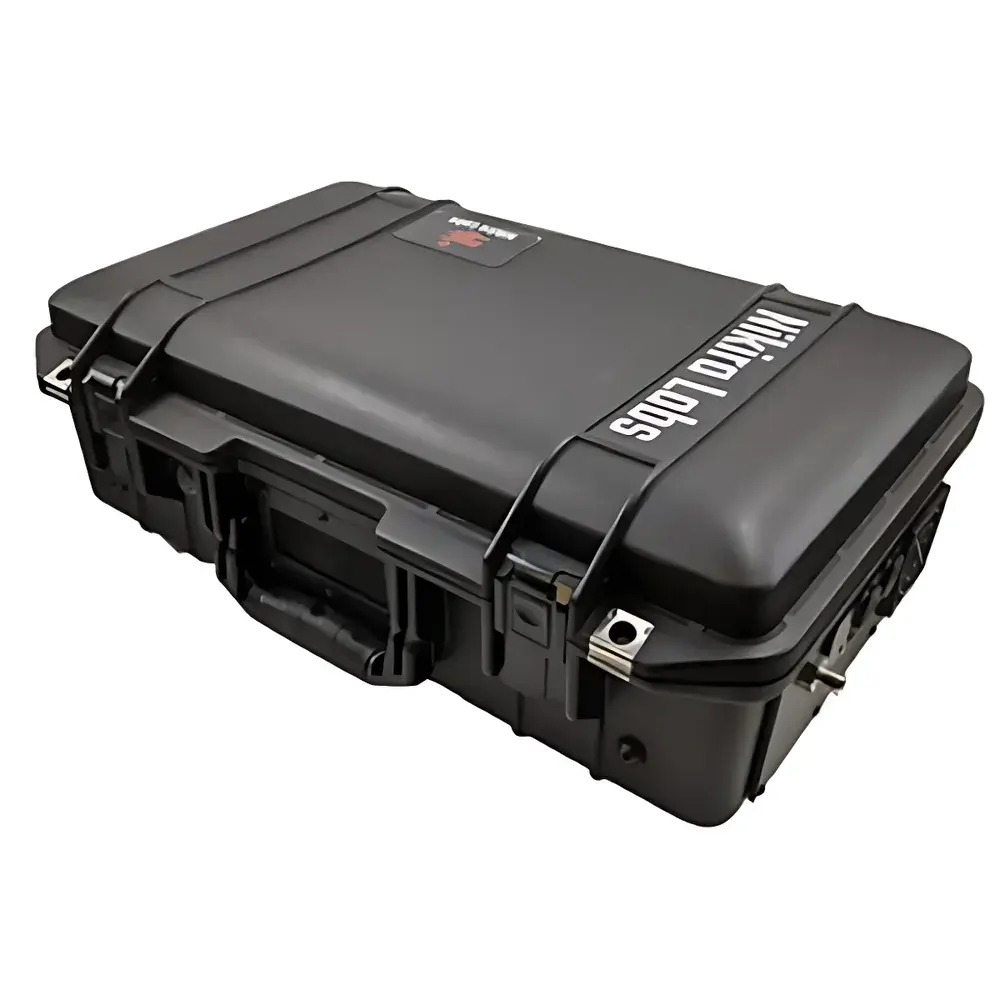
Nikira LI-G2002 Optical Ammonia Analyzer (OAA)
| Brand | Nikira |
|---|---|
| Origin | USA |
| Model | LI-G2002 Optical Ammonia Analyzer (OAA) |
| Measurement Principle | ICOS/CEAS (Integrated Cavity Output Spectroscopy / Cavity-Enhanced Absorption Spectroscopy) |
| NH₃ Accuracy | ±1 ppb (1 s, 1σ) |
| NH₃ Range | 1 ppb – 10 ppm |
| Data Output Rate | 1 Hz |
| Response Time | < 2 s |
| Sample Flow Rate | 2 SLPM |
| Operating Temperature | 5–45 °C |
| Operating Humidity | 0–95 % RH (non-condensing) |
| Communication Interfaces | RS-232 serial, built-in Wi-Fi, UART, USB 3.0, HDMI |
| Dimensions | 22" × 14" × 7.5" (55.9 × 35.6 × 19.1 cm) |
| Weight | 8 kg |
| Power Supply | 14–28 VDC, 2.5 A |
| Power Consumption | 35 W |
| Onboard Storage | 32 GB SD card (supports >1 million data points, ~2 years of continuous 1-Hz logging) |
| Calibration | Zero-air and span-gas optional |
| Filter | Replaceable inlet particulate filter |
| Warranty | 1 year |
Overview
The Nikira LI-G2002 Optical Ammonia Analyzer (OAA) is a high-sensitivity, field-deployable gas analyzer engineered for continuous, real-time quantification of atmospheric ammonia (NH₃) at sub-part-per-trillion levels. It employs Integrated Cavity Output Spectroscopy (ICOS), a variant of Cavity-Enhanced Absorption Spectroscopy (CEAS), which leverages ultra-stable optical cavities with high-finesse mirrors to achieve effective path lengths exceeding 10 km within a compact footprint. This enables exceptional detection sensitivity—±1 ppb at 1-second integration (1σ)—without chemical conversion or catalytic sampling, preserving molecular integrity and eliminating cross-sensitivity to common interferents such as H₂O, CO₂, or NO₂. Designed for unattended operation in ambient air monitoring networks, the LI-G2002 meets the stringent performance requirements of long-term environmental research, regulatory compliance programs, and process emission verification where trace-level NH₃ dynamics govern aerosol nucleation, nitrogen deposition, and secondary particulate formation.
Key Features
- Sub-ppb detection limit (1 ppb, 1σ @ 1 s) validated per ISO 14644-1 and EPA Method TO-15 supplemental criteria for trace gas analyzers
- Optical measurement architecture eliminates consumables, catalysts, or wet chemistry—no reagents, no ozone generators, no scrubbers
- Thermally stabilized cavity and active wavelength-locking ensure drift < 0.5 ppb over 30 days under field conditions
- Integrated sample conditioning: heated inlet line (optional), particulate filter (replaceable, 2.5 µm cut-off), and mass flow-controlled sampling at 2 SLPM
- Modular I/O architecture supports simultaneous RS-232, Wi-Fi (802.11n), UART, USB 3.0, and HDMI output for local visualization or remote telemetry
- Onboard 32 GB SD card with timestamped binary logging; firmware supports configurable data compression and automatic rollover
- Wide operating envelope: functional across 5–45 °C and 0–95 % RH (non-condensing), suitable for mobile platforms, rooftop stations, and soil flux chambers
Sample Compatibility & Compliance
The LI-G2002 is optimized for direct analysis of ambient air, stack effluents (with appropriate dilution and conditioning), and headspace gases from soil chambers or livestock enclosures. Its CEAS-based detection is inherently selective for the ν₁ symmetric stretch transition of NH₃ near 657 nm, with minimal spectral overlap from background gases. The analyzer complies with key international standards governing ambient air quality instrumentation, including ISO 14644-1 (cleanroom monitoring relevance), EN 14625:2012 (ambient NH₃ measurement), and ASTM D6348-19 Annex A1 (for trace gas calibration validation). While not certified under EPA EQOA or MCERTS, its performance characteristics align with Tier 2 specifications for reference-grade analyzers in EU National Air Quality Monitoring Networks (NAQMN) and U.S. State Implementation Plans (SIPs). All firmware and data handling modules support audit-ready metadata tagging and time synchronization via NTP or GPS input.
Software & Data Management
The LI-G2002 ships with Nikira’s OAA Control Suite—a cross-platform application (Windows/macOS/Linux) enabling remote configuration, real-time spectral diagnostics, zero/span validation, and raw absorbance curve visualization. Data files are stored in HDF5 format with embedded calibration coefficients, temperature/pressure logs, and mirror reflectivity metrics—ensuring full traceability per GLP and FDA 21 CFR Part 11 requirements when used in regulated environments. Optional cloud integration (via MQTT or HTTPS POST) allows ingestion into third-party platforms such as ThingSpeak, Grafana, or custom LIMS. Firmware updates are delivered via signed OTA packages; all configuration changes generate immutable log entries with user ID, timestamp, and hash-verified parameter set.
Applications
- Ambient air quality monitoring networks tracking NH₃ contributions to PM₂.₅ formation and regional haze
- Quantifying agricultural emissions from confined animal feeding operations (CAFOs) and fertilizer application sites
- Vehicle exhaust characterization studies, especially for SCR-equipped diesel engines and emerging ammonia-fueled powertrains
- Soil-atmosphere exchange flux measurements using eddy covariance or dynamic chamber methods
- Indoor air quality assessment in poultry barns, wastewater treatment facilities, and industrial refrigeration plants
- Calibration transfer and intercomparison campaigns among reference-grade analyzers in metrology laboratories
FAQ
Does the LI-G2002 require daily calibration?
No. The instrument’s optical stability and integrated zero-check capability enable calibration intervals of 7–30 days depending on site conditions. A certified zero-air source and traceable NH₃ span gas (e.g., 100 ppb in N₂) are recommended for periodic verification.
Can it operate outdoors without climate control?
Yes. Its IP54-rated enclosure and internal thermal management system maintain cavity alignment and detector performance across the full 5–45 °C range. For extended deployment in freezing or high-humidity environments, an optional heated inlet assembly is available.
Is the data output compatible with SCADA systems?
Yes. RS-232 ASCII output follows Modbus RTU protocol; Wi-Fi interface supports TCP/IP socket streaming and RESTful API endpoints for seamless integration into industrial automation frameworks.
What maintenance is required beyond filter replacement?
Only annual inspection of optical cavity cleanliness and mirror reflectivity (performed by authorized service centers); no lamp replacement or detector recalibration is needed within the first 36 months of operation.
How is measurement uncertainty quantified and reported?
Uncertainty budgets follow GUM (JCGM 100:2008) methodology and include contributions from spectral noise, pressure/temperature transducer accuracy, cavity length drift, and calibration gas uncertainty—fully documented in the Certificate of Conformance shipped with each unit.
Related Products







