
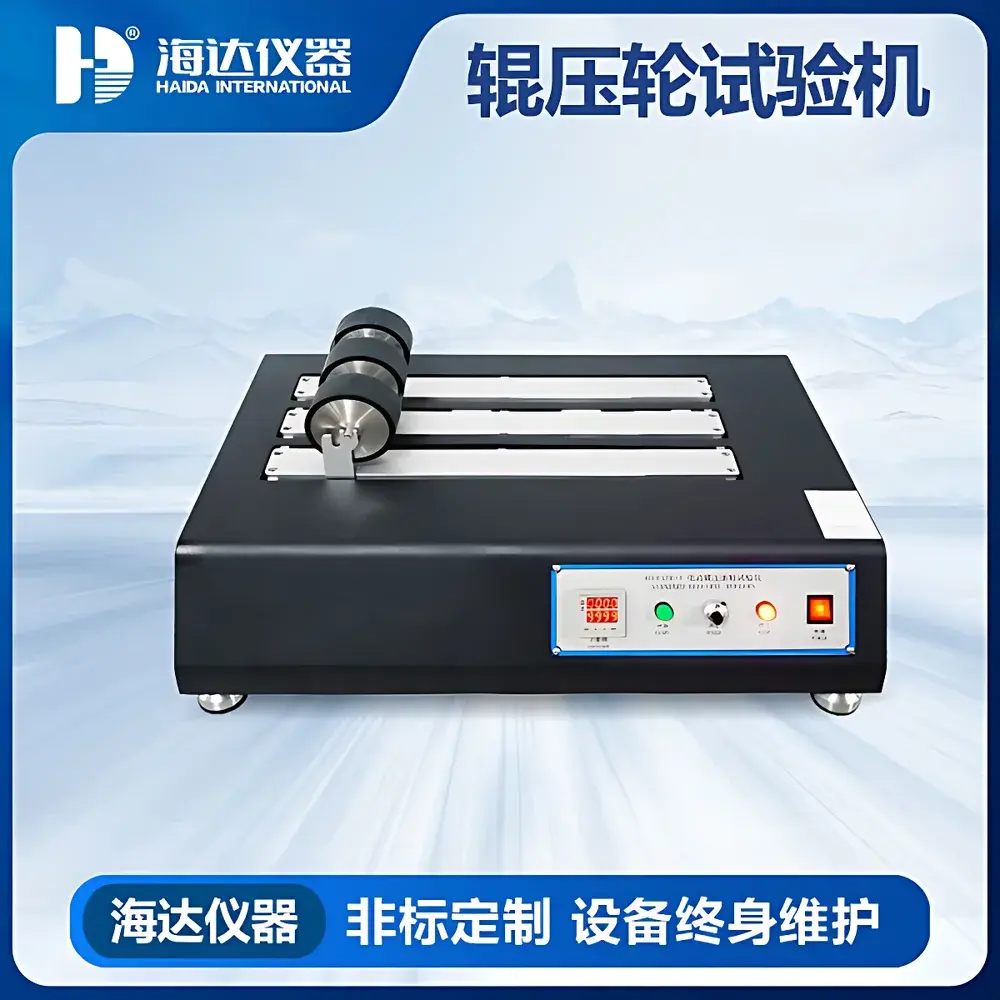
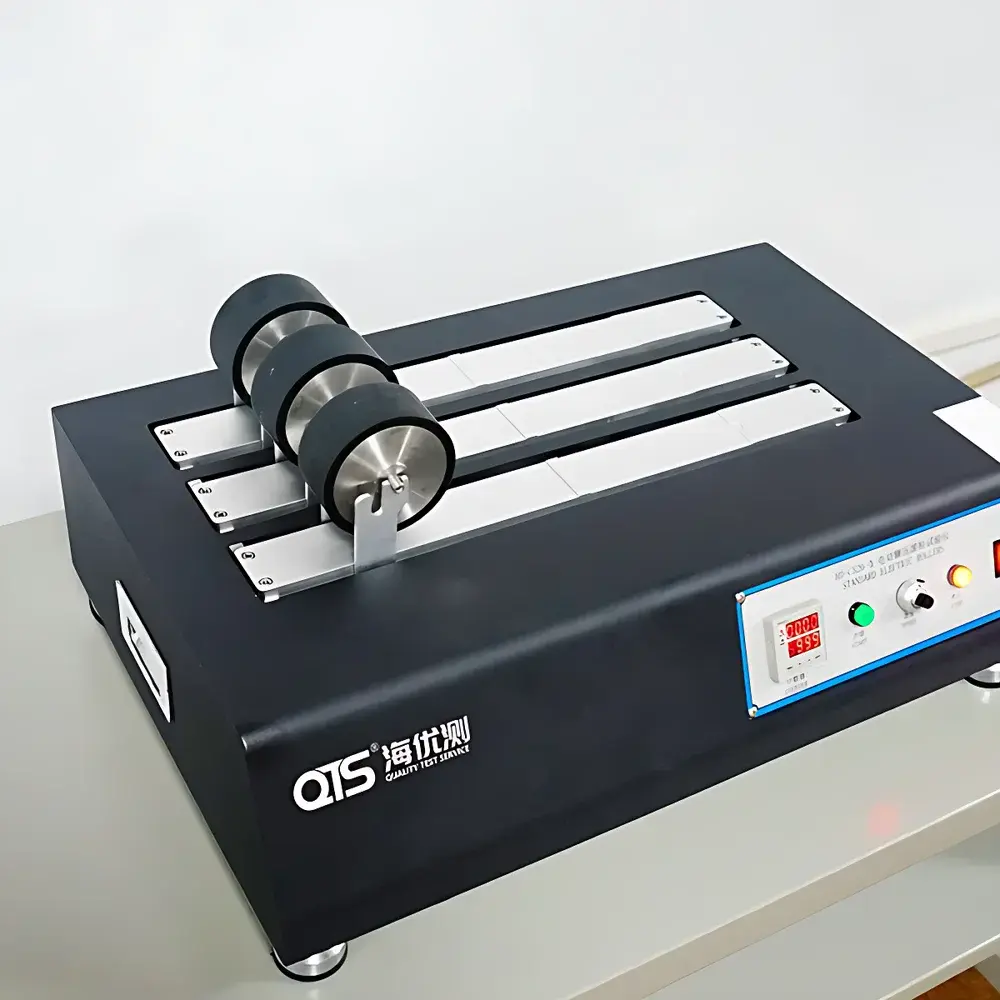
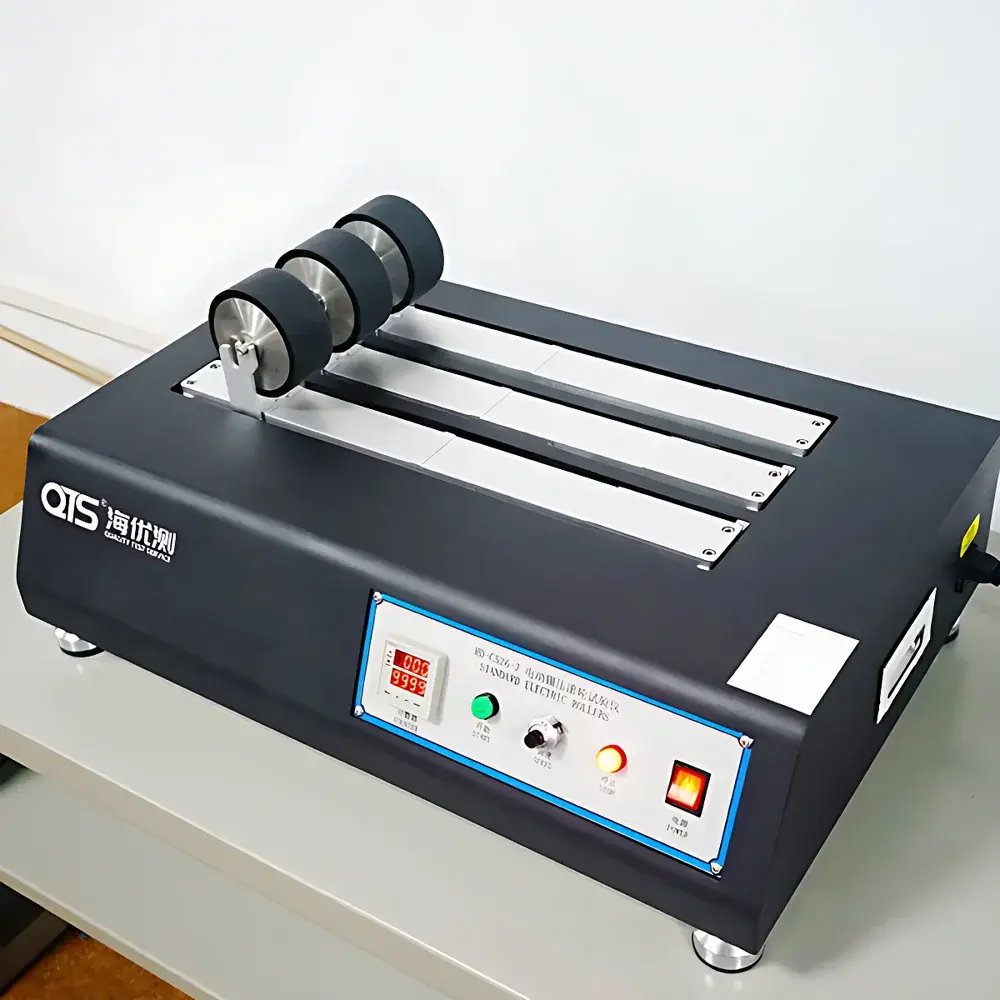
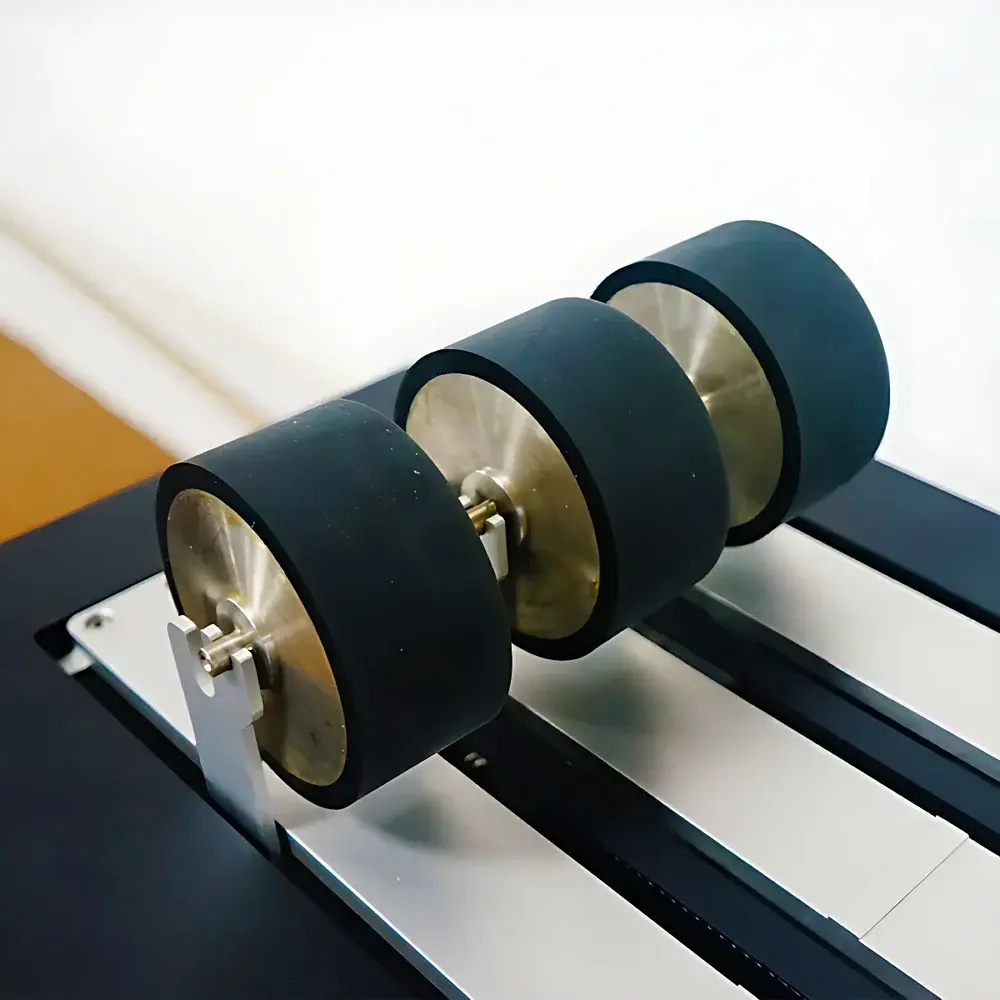
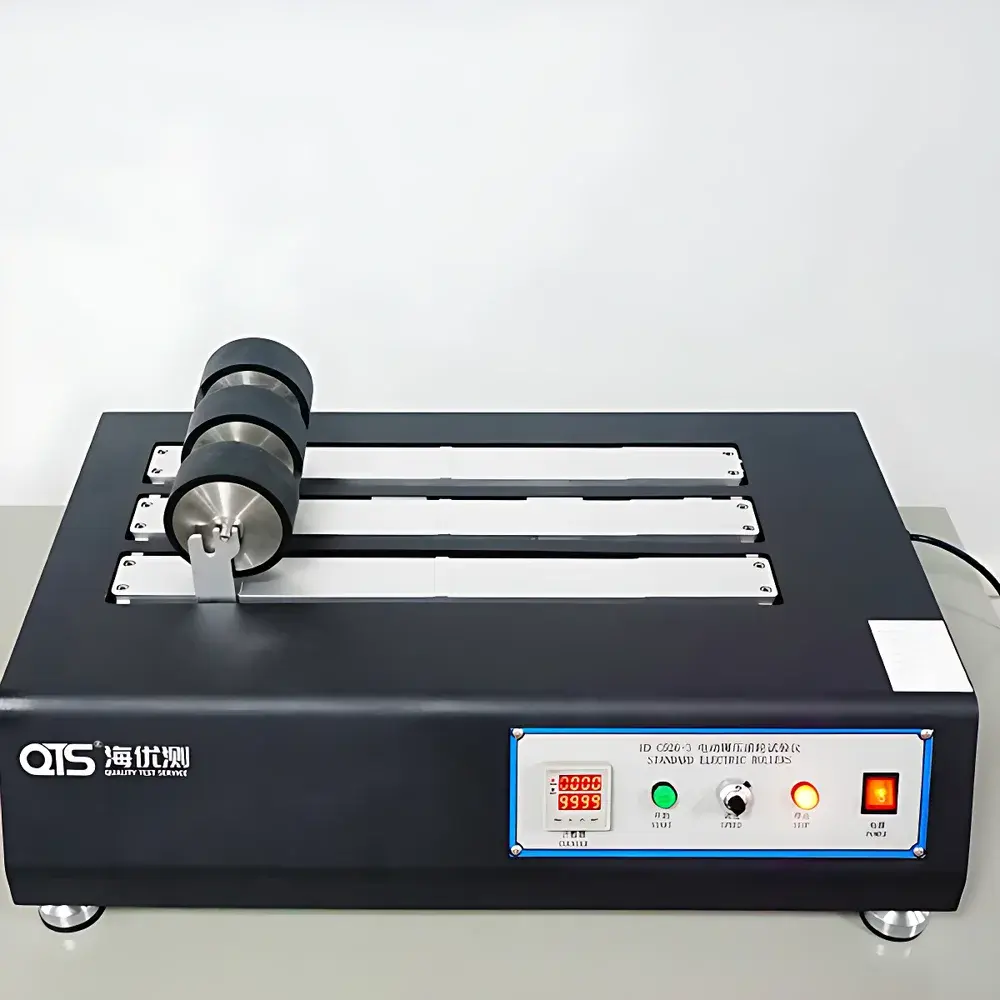
HAIDA HD-C526-3 Electric Roller Compaction Tester (3-Roller Assembly, 6-Station)
| Brand | HAIDA INTERNATIONAL |
|---|---|
| Origin | Guangdong, China |
| Manufacturer Type | OEM Manufacturer |
| Country of Origin | China |
| Model | HAIDA HD-C526-3 Electric Roller Compaction Tester (3-Roller Assembly, 6-Station) |
| Display | LED counter |
| Motor | 60 W adjustable-speed motor |
| Rolling Speed | (100 / 150 / 200 / 250 / 300 / 600) ±3 mm/min (adjustable) |
| Roller Load (Mass) | 2000 ±50 g |
| Roller Width | 45 ±1.5 mm |
| Rubber Thickness | 6 mm |
| Roller Diameter (Rubber-clad) | 84 ±1 mm |
| Rubber Hardness | Shore A 80 ±5 |
| Roller Sets | 3 |
| Stations | 6 |
| Specimen Dimensions | ≤300 mm (L) × ≤48 mm (W) |
| Counter Range | 1–999,999 |
| Dimensions (L×W×H) | ≈695 × 440 × 310 mm |
| Weight | ≈40 kg |
| Power Supply | 1-phase AC 220 V |
| Total Power Consumption | ≈70 W |
Overview
The HAIDA HD-C526-3 Electric Roller Compaction Tester is an engineered precision instrument designed for standardized sample preparation in adhesion performance testing. It operates on the principle of controlled gravitational compaction: three independently mounted rubber-coated rollers—each precisely weighted and dimensionally specified—apply consistent linear pressure to adhesive specimens as they traverse a rigid test plate at user-selectable speeds. This process ensures uniform contact, eliminates air entrapment, and produces reproducible, ASTM- and ISO-compliant test specimens for peel strength, tack, and holding power evaluation. Unlike manual rolling methods, the HD-C526-3 eliminates operator variability and conforms to the mechanical requirements outlined in GB/T 2792–2014 (Sections 5.3.3 and 5.3.4), PSTC-8 (Section 4.2), and equivalent international protocols for pressure-sensitive adhesive (PSA) qualification.
Key Features
- Triple-roller assembly with synchronized motion and independent mechanical stability—enabling parallel preparation of six standardized specimens per cycle without cross-contamination or timing skew.
- Rubber rollers manufactured to strict metrological tolerances: Shore A hardness 80 ±5, diameter 84 ±1 mm, width 45 ±1.5 mm, and rubber thickness 6 mm—fully compliant with GB/T 2792–2014 dimensional specifications for roller-based specimen conditioning.
- Six-position stainless steel test plate mounting system, pre-aligned for standard 25 mm × 100 mm PSA specimens; accommodates both metric and imperial substrate formats via configurable fixture spacing.
- Adjustable rolling speed range from 100 to 600 mm/min (±3 mm/min accuracy) across six discrete steps—supports method-specific requirements including low-speed creep conditioning and high-throughput QA screening.
- Robust structural architecture: powder-coated steel frame with vibration-damped base; integrated safety interlocks prevent unintended operation during maintenance or specimen loading.
- LED digital counter with 6-digit resolution (1–999,999 cycles), non-volatile memory retention, and automatic end-of-cycle signaling—ensures traceability and alignment with GLP documentation workflows.
Sample Compatibility & Compliance
The HD-C526-3 is validated for use with flexible, planar substrates up to 300 mm in length and 48 mm in width—including polymeric films (PET, PE, PP), release liners (silicone-coated paper, fluoropolymer films), medical pressure-sensitive adhesives (acrylic, silicone, rubber-based), protective films, battery separator membranes, nonwovens, metallic foils, and coated papers. Its roller geometry and load profile meet the physical prerequisites defined in ISO 29862:2017 (adhesive tape testing), ASTM D3330/D3330M (peel adhesion), and USP <85> Annex for pharmaceutical label adhesion validation. The device supports full audit readiness under FDA 21 CFR Part 11 when paired with compliant laboratory information management systems (LIMS) that log roller usage count, speed setting, and operator ID.
Software & Data Management
The HD-C526-3 utilizes a deterministic electromechanical control architecture—featuring industrial-grade relays and a calibrated LED counter—eliminating firmware dependencies and ensuring long-term calibration stability. While not software-driven, its counter output is compatible with external data acquisition interfaces (e.g., RS-232 or opto-isolated TTL pulse output upon request) for integration into automated QA reporting platforms. All operational parameters—including speed selection, total cycle count, and error flags—are physically logged via front-panel indicators. The absence of embedded microprocessors simplifies 21 CFR Part 11 compliance: no electronic records require validation, and mechanical counters satisfy ALCOA+ principles (Attributable, Legible, Contemporaneous, Original, Accurate, Complete, Consistent, Enduring, Available) for regulated environments operating under GMP or ISO 17025.
Applications
- Pre-conditioning of PSA specimens prior to 180° peel testing per ASTM D903 or ISO 8510-2.
- Standardized sample preparation for loop tack, probe tack, and shear hold time assays per PSTC-1, PSTC-7, and FINAT FTM 1.
- Quality control of release liner integrity and silicone migration profiling in medical device packaging.
- Validation of electrode coating uniformity and calendering effects in lithium-ion battery separator manufacturing.
- Reproducible lamination setup for multi-layer film structures undergoing accelerated aging or thermal cycling studies.
- Method transfer support between R&D labs and contract manufacturing organizations (CMOs) requiring identical specimen fabrication protocols.
FAQ
Is the HD-C526-3 suitable for ISO/IEC 17025-accredited laboratories?
Yes—the device’s mechanical design, traceable roller mass (2000 ±50 g), and documented dimensional conformity enable direct linkage to national metrology standards. Calibration certificates for roller mass and speed verification are available upon request.
Can the roller hardness be customized for specialized elastomer testing?
Standard configuration uses Shore A 80 ±5 rubber. Custom rollers with Shore A 40–90 hardness ranges are available as optional accessories, subject to NIST-traceable hardness certification.
Does the unit include test plates or only roller assemblies?
The standard configuration includes six stainless steel test plates (125 mm × 25 mm × 1.5 mm, Ra ≤0.8 µm surface finish) conforming to GB/T 2792–2014 Annex A. Alternative plate materials (aluminum, anodized aluminum, or electroplated steel) are offered as configurable options.
What maintenance intervals are recommended for sustained accuracy?
Roller surface inspection every 5,000 cycles; rubber replacement every 20,000 cycles or when Shore hardness deviates beyond ±5 units. Full mechanical recalibration (load verification + speed verification) is advised annually or after relocation.
Is electrical safety certification provided for export markets?
Units shipped internationally include CE-marked power modules (EN 61000-6-3, EN 61000-6-4) and optional UL/cUL listing for North America, subject to order specification.



