
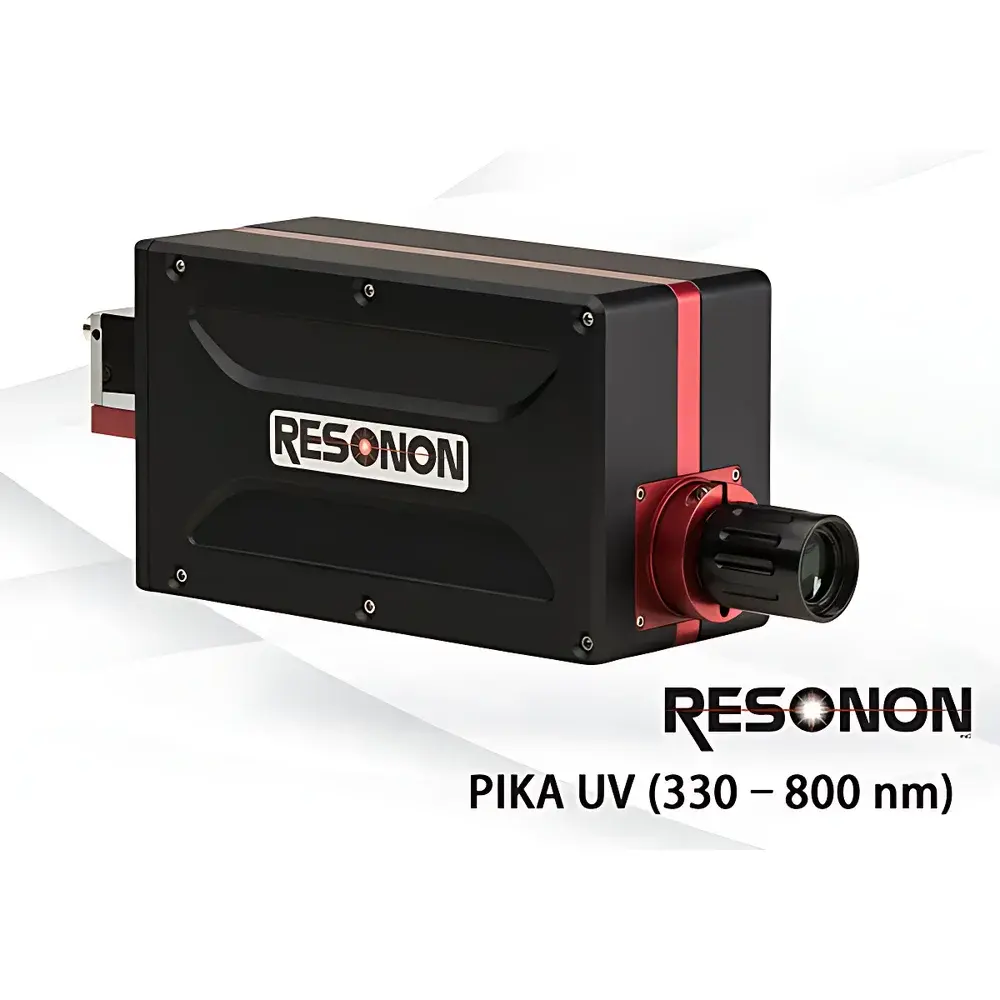
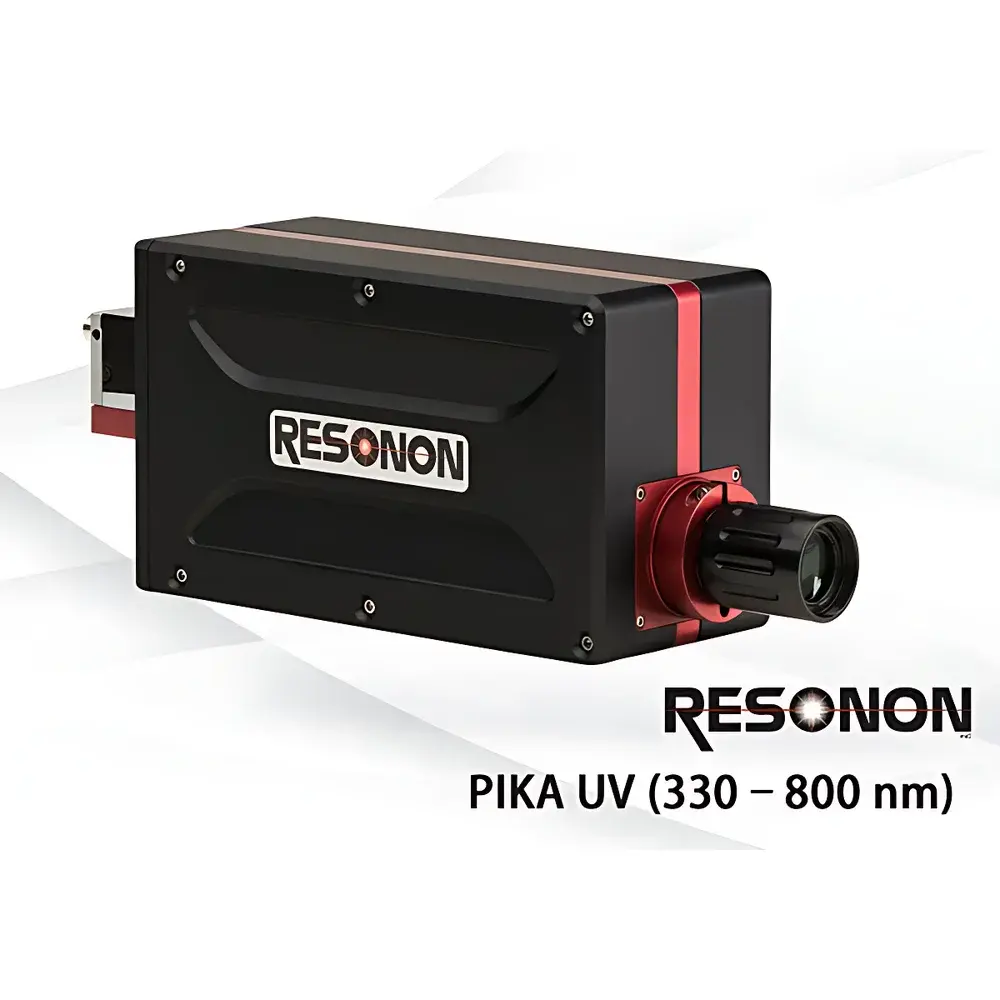
Resonon Pika UV Hyperspectral Imaging System
| Brand | Resonon |
|---|---|
| Origin | USA |
| Model | Pika UV |
| Operating Principle | Push-broom |
| Imaging Method | Dispersive |
| Platform Compatibility | Ground-based & Airborne |
| Spectral Range | 350–800 nm |
| Spectral Resolution | 2.3 nm |
| Spatial Channels | 1600 |
| Spectral Channels | 196 |
| Field of View (TFOV) | 29.0° |
| Instantaneous Field of View (IFOV) | ≤1600 × n (n = scan lines) |
| Frame Rate | 165 fps |
| Bit Depth | 12-bit |
| Weight | 2.1 kg |
| Dimensions | 10.0 × 26.4 × 7.4 cm |
| Interface | USB 3.0 |
| Operating Temperature | 5–40 °C |
| Aperture | f/2.4 |
| Pixel Size | 8 µm |
| RMS Spot Radius (avg.) | 8 µm |
| Smile (peak-to-peak) | 4 µm |
| Keystone (peak-to-peak) | 6 µm |
| SNR | >600:1 (typ. @ full well) |
| Stray Light Rejection | <0.05% |
| Distortion | <0.1% radial |
Overview
The Resonon Pika UV is a compact, lightweight push-broom hyperspectral imaging system engineered for high-fidelity spectral data acquisition across the ultraviolet–visible (UV–Vis) spectrum (350–800 nm). Leveraging dispersive prism-based optics and a high-quantum-efficiency CMOS sensor, the Pika UV captures spatially registered spectral cubes at up to 165 frames per second—enabling real-time, line-scan-based imaging without mechanical scanning motion. Its optical architecture minimizes smile and keystone distortions (≤4 µm and ≤6 µm peak-to-peak, respectively), ensuring pixel-level spectral fidelity critical for quantitative reflectance, fluorescence, and absorption analysis. Designed for integration into laboratory benchtop setups, UAV-mounted payloads, handheld field units, or industrial inspection stations, the system delivers consistent radiometric performance under ambient operating conditions (5–40 °C) and complies with ISO 17025 traceable calibration protocols for spectral responsivity and wavelength accuracy.
Key Features
- UV–Vis optimized optical train with f/2.4 aperture and diffraction-limited performance (RMS spot radius ≤8 µm)
- High spectral resolution of 2.3 nm across 196 contiguous bands, supporting fine spectral feature discrimination (e.g., chlorophyll-a absorption at 430 nm, anthocyanin peaks near 530 nm)
- 1600-pixel spatial sampling per line, enabling sub-millimeter ground sample distance (GSD) at typical standoff distances (e.g., <0.5 mm GSD at 1 m with optional UV telecentric lens)
- Low stray light (<0.05% relative intensity) and minimal geometric distortion (<0.1% radial), essential for calibrated reflectance mapping and multivariate spectral unmixing
- USB 3.0 interface with deterministic latency and full 12-bit dynamic range, compatible with Linux, Windows, and RTOS-based acquisition hosts
- Ruggedized aluminum chassis (2.1 kg, 10.0 × 26.4 × 7.4 cm) rated for vibration (MIL-STD-810G) and thermal cycling in field-deployable environments
Sample Compatibility & Compliance
The Pika UV supports non-contact, non-destructive analysis of solid, liquid, and particulate samples—including biological tissues, agricultural produce, pharmaceutical tablets, mineral specimens, and painted surfaces. Its UV-sensitive quantum efficiency (>45% at 365 nm) enables detection of UV-induced fluorescence (e.g., lignin, NADH, tryptophan) and UV-absorbing compounds (e.g., nitrate, humic substances, sunscreen actives). The system conforms to ASTM E131–22 (Standard Terminology Relating to Molecular Spectroscopy), ISO 18392:2020 (Hyperspectral imaging — Performance testing methods), and supports GLP-compliant data capture via timestamped metadata embedding (exposure time, integration gain, lens ID, temperature). Optional NIST-traceable spectral calibration kits are available for routine verification per ISO/IEC 17025 requirements.
Software & Data Management
Bundled Resonon Spectron software provides real-time preview, radiometric correction (dark current subtraction, flat-field normalization), and on-the-fly spectral cube export in ENVI-compatible BIL/BIP formats. API support (C/C++, Python SDK) enables integration with MATLAB, ENVI, QGIS, and custom machine learning pipelines (e.g., PCA, SVM, CNN-based classification). All raw acquisitions include embedded EXIF-like metadata compliant with HDF5 v1.12 and support FDA 21 CFR Part 11 audit trails when deployed with validated third-party LIMS platforms. Data integrity is enforced via cyclic redundancy checksums (CRC-32) per frame and SHA-256 hash generation for full-cube archives.
Applications
- Agricultural phenotyping: Early stress detection via UV-induced fluorescence quenching and pigment ratio analysis (e.g., F440/F520, R730/R680)
- Pharmaceutical QA/QC: Coating uniformity assessment, API distribution mapping, and counterfeit detection using spectral fingerprint libraries
- Environmental monitoring: Surface water quality assessment (CDOM, chlorophyll-a, turbidity) and soil organic carbon estimation
- Materials science: Thin-film thickness measurement via interference fringe analysis in UV–Vis reflectance spectra
- Cultural heritage: Non-invasive pigment identification and degradation product mapping on manuscripts and paintings
- Industrial sorting: Real-time defect classification in electronics manufacturing (solder mask integrity, PCB contamination)
FAQ
Is the Pika UV calibrated for absolute radiance measurements?
Yes—each unit ships with factory-applied radiometric and spectral calibration coefficients traceable to NIST SRM 2035 and 2036, valid for two years under standard operating conditions.
Can the system operate onboard a small UAV?
Yes—the 2.1 kg mass, low power draw (<8 W), and shock-tolerant design meet Class I UAV payload requirements; integration kits include GPS-PPS synchronization and IMU fusion support.
What spectral preprocessing is required before quantitative analysis?
At minimum: dark frame subtraction, flat-field correction, and wavelength registration using the built-in calibration lamp or reference panel; advanced users may apply atmospheric correction (e.g., QUAC) for airborne data.
Does Resonon provide application-specific spectral libraries?
Yes—validated libraries for vegetation indices, mineral absorption features, and pharmaceutical excipients are available under NDA; custom library development services are offered.
How is long-term stability maintained in field deployments?
The system includes an internal thermal stabilization loop (±0.1 °C control) and periodic auto-calibration routines triggered by ambient temperature drift thresholds, ensuring <0.5 nm wavelength drift over 8-hour continuous operation.





