
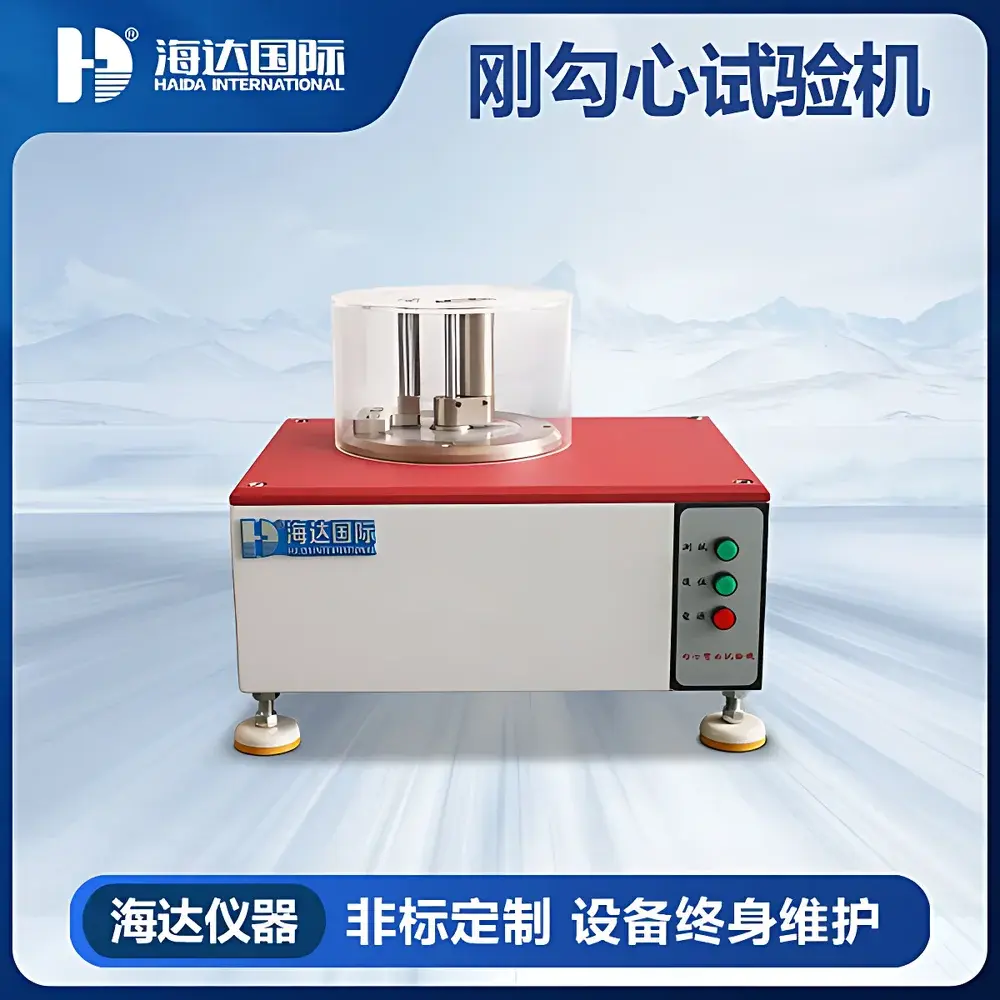
HAIDA International HAIDA-GBB Rigid Hook Bending Tester
| Brand | HAIDA International |
|---|---|
| Origin | Guangdong, China |
| Manufacturer Type | Direct Manufacturer |
| Country of Origin | China |
| Model | HAIDA-GBB Rigid Hook Bending Tester |
| Pricing | Upon Request |
Overview
The HAIDA-GBB Rigid Hook Bending Tester is an electromechanical testing instrument engineered for standardized evaluation of mechanical integrity and fatigue resistance in rigid hook fasteners—commonly used in furniture hardware, automotive interior trim, aerospace cabin fittings, and industrial latching systems. It operates on a controlled three-point bending principle: a fixed lower support span and a vertically actuated upper indenter apply monotonic or cyclic loading to the hook’s curved section until specified deflection, load threshold, or failure criteria are met. Designed in strict alignment with ASTM F1554, ISO 8434-4, EN 1634-1, and GB/T 23444–2009 (Metal Furniture—Mechanical Performance Requirements and Test Methods), the HAIDA-GBB delivers repeatable, traceable bending force–displacement data essential for product validation, quality control, and regulatory compliance.
Key Features
- Programmable servo-electric actuation system with closed-loop load and displacement control, enabling both static bending tests and stepwise cyclic loading protocols (e.g., 5–50,000 cycles at user-defined frequency and amplitude)
- Integrated high-precision load cell (±0.5% FS accuracy) and linear variable differential transformer (LVDT) displacement sensor (resolution ≤1 µm) for synchronized force–deflection curve acquisition
- Modular fixture system accommodating hook geometries with radii from 3 mm to 25 mm and shank diameters ranging from 2.5 mm to 12 mm
- Stainless-steel test frame with reinforced base plate and anti-vibration damping mounts, ensuring structural stability during high-load operation (max. 2,000 N capacity)
- Compliance-ready firmware architecture supporting audit trails, user-level access control (admin/operator/guest), and calibration certificate logging per ISO/IEC 17025 requirements
Sample Compatibility & Compliance
The HAIDA-GBB accommodates rigid metallic and high-strength polymer hooks—including stamped steel, die-cast zinc alloy, and glass-filled nylon variants—without requiring custom tooling. Fixture adaptability extends to flat-back, offset, and swivel-mount configurations. All test methods implemented satisfy mandatory clauses in GB/T 23444–2009 (Clause 6.3.2: Bending Resistance), ASTM F1554–22 (Annex A1: Hook Deformation Testing), and EN 1634–1:2014+A1:2018 (Section 7.2: Mechanical Endurance). The system supports full documentation traceability required for GLP-compliant laboratories and third-party certification bodies (e.g., SGS, TÜV Rheinland, BV). Calibration certificates are issued per ISO/IEC 17025 and include uncertainty budgets referenced to national metrology institutes (NIM, China NMI).
Software & Data Management
The HAIDA-GBB operates via HAIDA TestSuite v4.2—a Windows-based application compliant with FDA 21 CFR Part 11 for electronic records and signatures. Software features include real-time force–displacement plotting, automatic yield point detection using tangent modulus analysis, pass/fail logic based on user-defined thresholds (e.g., max permanent set ≤0.3 mm after 10,000 cycles), and export to CSV, PDF, and XML formats. Audit trail logs record operator ID, timestamp, test parameters, calibration events, and result modifications—retained for ≥15 years as required under ISO 9001:2015 Clause 8.5.2. Data files conform to ASTM E2709–21 for statistical process control integration and may be imported into LIMS platforms via ODBC drivers.
Applications
- Validation of hinge-to-hook interface strength in office and hospital furniture assemblies
- Endurance assessment of latch hooks in transport packaging containment systems (ISTA 3A/3E certified workflows)
- Material selection support for automotive interior fasteners subjected to thermal cycling and vibration profiles
- Conformance testing for fire-rated door hardware per UL 10C and EN 1634–1 fire-resistance classification protocols
- Root cause analysis of hook fracture modes (ductile vs. brittle) in supplier qualification audits
FAQ
What standards does the HAIDA-GBB directly support out-of-the-box?
ASTM F1554, ISO 8434-4, EN 1634-1, GB/T 23444–2009, and CY/T 229–2020—all preconfigured in TestSuite v4.2 with method templates and reporting formats.
Can the system perform cyclic fatigue testing?
Yes; programmable cycle counts up to 50,000, frequency range 0.01–5 Hz, and load reversal capability enable full S–N curve generation per ASTM E466.
Is calibration traceable to national standards?
Yes; factory calibration includes NIM-traceable certificates with expanded uncertainty (k=2) for both load and displacement channels.
Does the software meet FDA 21 CFR Part 11 requirements?
Yes; electronic signature workflows, audit trail integrity, and role-based permissions are validated and documented per IQ/OQ protocols.
What maintenance intervals are recommended?
Load cell and LVDT verification every 12 months; mechanical guide rail lubrication every 6 months; full system performance verification annually or after 10,000 test cycles—whichever occurs first.



