
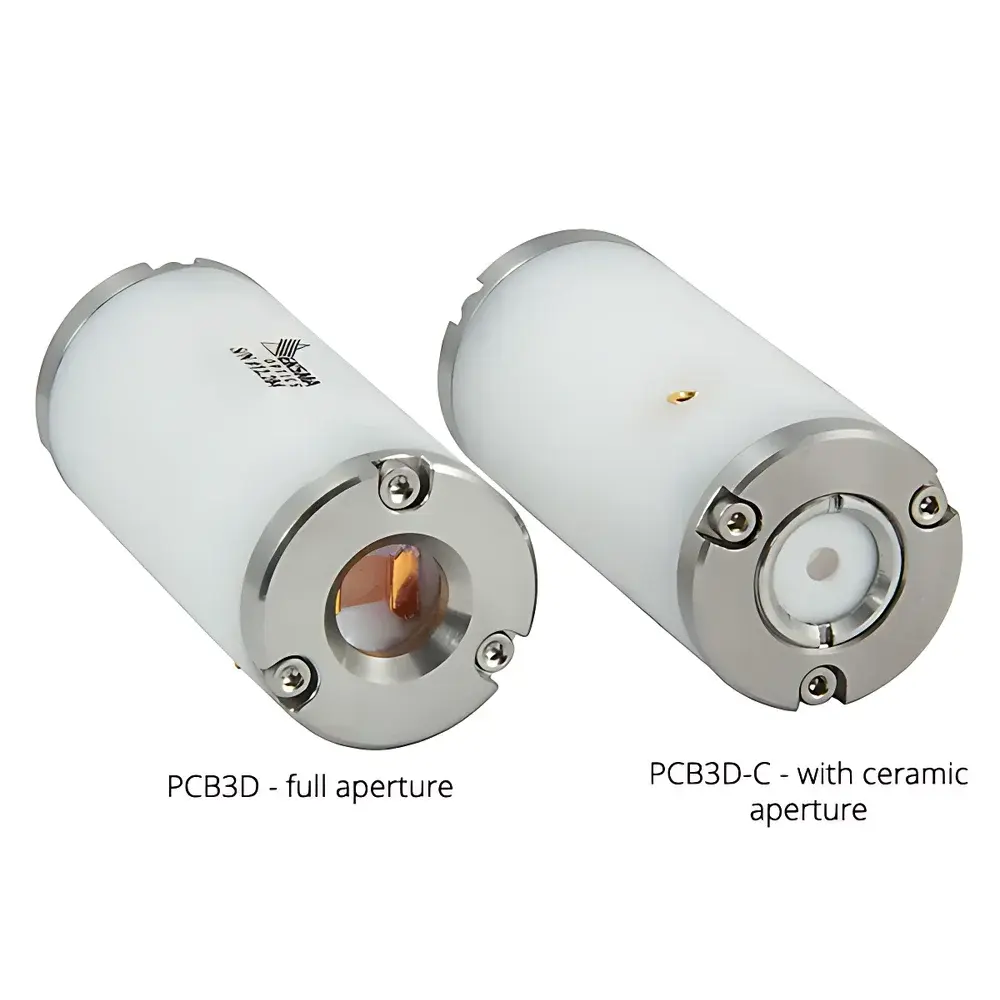
EKSMA BBO Pockels Cell Kit
| Brand | EKSMA |
|---|---|
| Origin | Imported (Lithuania) |
| Model | BBO |
| Operating Repetition Rate | Up to 100 kHz |
| Cooling | Air-Cooled (No External Water Cooling Required) |
| High-Voltage Rise Time | <10 ns |
| Crystal Material | Beta-Barium Borate (BBO) |
| Driver Compatibility | Integrated High-Repetition-Rate Pockels Cell Driver |
| Power Supply | Dedicated High-Voltage DC-DC Module |
| Component Type | Electro-Optic Modulation Kit |
Overview
The EKSMA BBO Pockels Cell Kit is a fully integrated electro-optic modulation solution engineered for precise, high-speed control of laser pulse trains in demanding ultrafast and nanosecond laser systems. Based on beta-barium borate (β-BaB2O4, or BBO) — a widely adopted nonlinear crystal with excellent transparency from 190 nm to 3500 nm and high electro-optic coefficient — this kit enables voltage-controlled birefringence modulation with minimal optical loss and high extinction ratio. The system operates on the principle of the longitudinal Pockels effect, where an applied electric field induces a linear change in refractive index along the crystal’s optical axis, allowing for sub-nanosecond polarization switching, Q-switching, cavity dumping, and pulse picking. Designed specifically for lasers operating at repetition rates up to 100 kHz, it eliminates thermal management bottlenecks associated with water-cooled alternatives while maintaining stable performance under continuous high-duty-cycle operation.
Key Features
- Optimized BBO crystal assembly with anti-reflection coatings (R < 0.2% per surface) at user-specified wavelengths (e.g., 1064 nm, 532 nm, or 800 nm)
- Integrated high-repetition-rate driver with fast rise time (<10 ns) and low jitter (<100 ps RMS), compatible with TTL/LVDS trigger inputs
- Dedicated high-voltage power supply delivering stable DC output up to ±4 kV with ripple <0.01% and programmable voltage ramping
- Robust mechanical housing with kinematic mounting interface (M6 tapped holes, Ø25.4 mm clear aperture), designed for alignment stability in vibration-sensitive optical tables
- Air-cooled architecture — no external chiller or plumbing required — enabling compact integration into OEM laser heads or laboratory setups
- Electrical isolation rated to 5 kV DC between high-voltage electrodes and chassis ground, compliant with IEC 61010-1 safety standards
Sample Compatibility & Compliance
The kit supports standard TEM00 Gaussian beams with diameters up to 6 mm (1/e²) and peak intensities ≤500 MW/cm² (for nanosecond pulses). It is suitable for Nd:YAG, Nd:YLF, Ti:sapphire, and fiber-based laser systems operating in Q-switched, mode-locked, or regenerative amplifier configurations. All optical components meet RoHS 2015/863/EU directives. Mechanical and electrical design adheres to ISO 10110-7 (optical component surface quality) and EN 61326-1 (EMC requirements for laboratory equipment). Traceability documentation — including crystal certification (orientation, phase-matching angle, damage threshold test report), driver calibration certificate, and HV supply linearity verification — is provided with each shipment.
Software & Data Management
While the kit operates as a stand-alone hardware module, optional digital control interfaces (USB 2.0 or RS-485) enable integration with LabVIEW™, Python (PyVISA), or MATLAB® environments. Firmware supports remote voltage setting, trigger delay adjustment (0–10 µs range, 10 ps resolution), and real-time status monitoring (HV output, temperature, fault flags). Audit trails for parameter changes are recorded locally with timestamping, supporting GLP-compliant experimental documentation. For regulated environments (e.g., medical laser development), optional firmware upgrades provide 21 CFR Part 11-compliant electronic signatures and role-based access control.
Applications
- Active Q-switching of diode-pumped solid-state lasers (DPSSL) at 10–100 kHz repetition rates
- Pulse picking in femtosecond Ti:sapphire oscillators and amplifiers
- Cavity dumping for high-energy, low-repetition-rate pulse extraction
- Optical synchronization and timing control in pump-probe experiments
- Laser beam gating for time-resolved fluorescence or LIBS signal isolation
- Integration into industrial laser marking or micromachining platforms requiring precise pulse-on-demand capability
FAQ
What is the maximum average power the BBO Pockels cell can handle without thermal lensing?
Thermal effects are minimized by the air-cooled design and low absorption coefficient of BBO (<5 × 10⁻⁴ cm⁻¹ at 1064 nm); typical safe operation limits are ≤5 W average power for CW-equivalent loading, depending on beam size and duty cycle.
Is the driver compatible with arbitrary waveform generators (AWG)?
Yes — the driver accepts analog voltage input (0–5 V) for proportional HV scaling and supports external modulation up to 1 MHz bandwidth with appropriate impedance matching.
Can the kit be customized for UV wavelengths below 210 nm?
Standard AR coatings cover 210–2000 nm; custom deep-UV coatings (e.g., MgF₂-based) are available upon request with extended lead time and qualification testing.
Does EKSMA provide OEM support for volume integration?
Yes — full mechanical drawings (STEP, PDF), electrical schematics, driver firmware SDK, and application engineering support are available under NDA for qualified OEM partners.
What is the typical half-wave voltage (Vπ) for the BBO cell at 1064 nm?
Vπ ranges from 3.2–3.8 kV depending on crystal length and electrode geometry; exact value is specified per unit in the calibration report included with shipment.





