
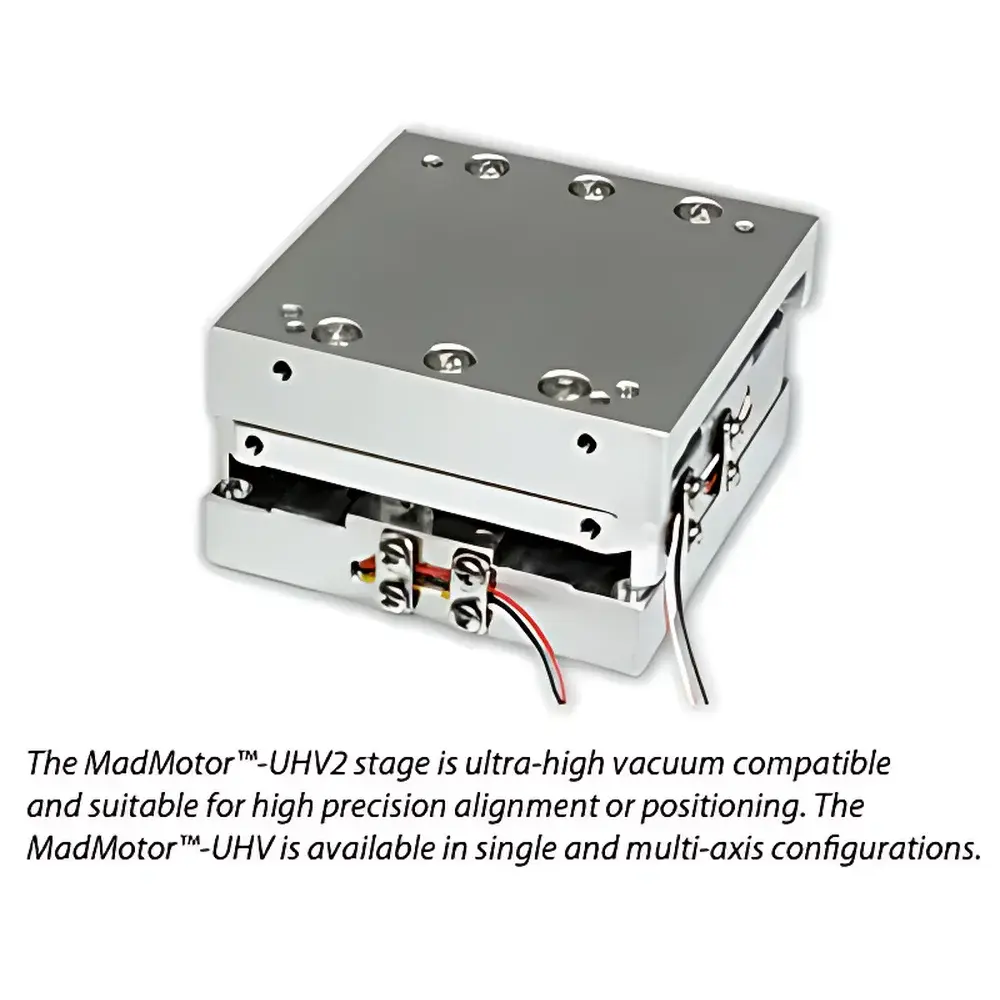
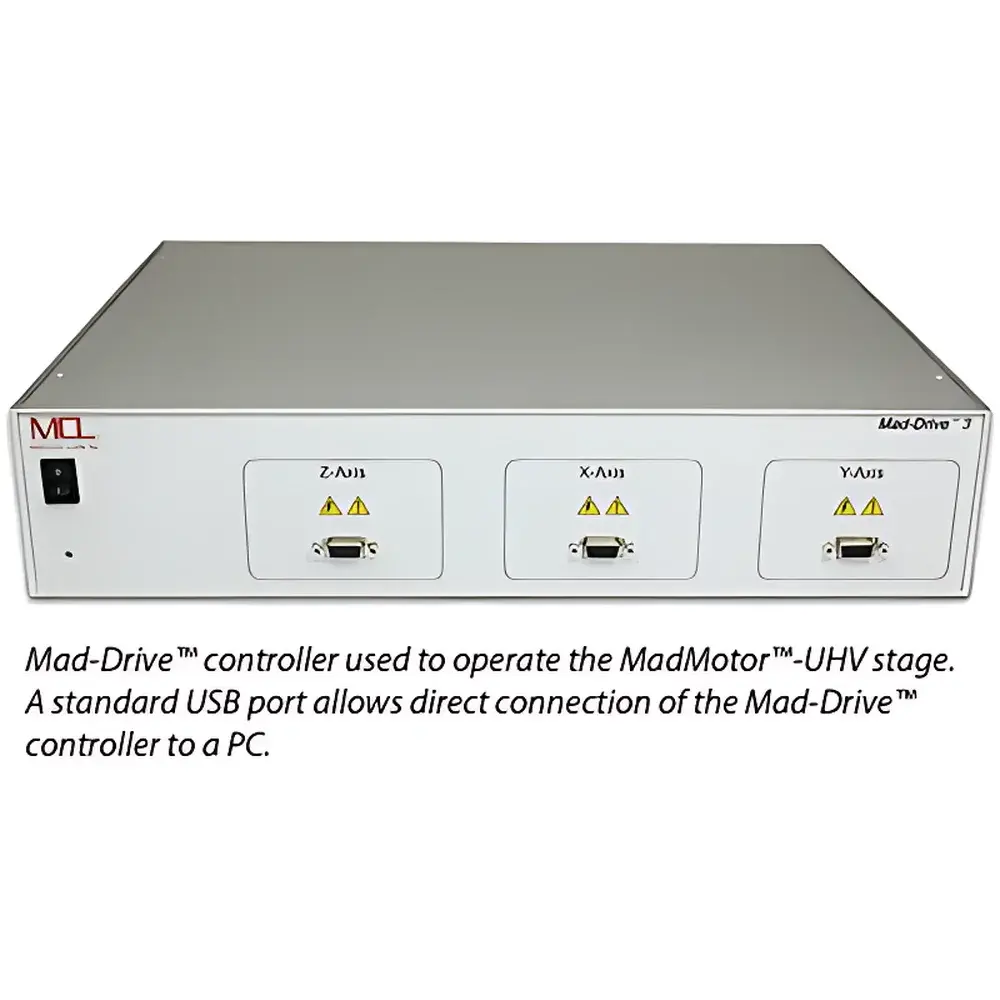
Mad City Labs UHV Micropositioners
| Brand | Mad City Labs (MCL Think Nano) |
|---|---|
| Origin | USA |
| Manufacturer Type | Authorized Distributor |
| Origin Category | Imported |
| Model | UHV Micropositioners |
| Product Type | Manual Translation Stage |
| UHV Compatibility | 1 × 10⁻¹¹ mbar |
| Travel Range | 10 mm per axis |
| Sensor Resolution (optional) | 500 nm |
| Minimum Step Size | 100 nm |
| Max Speed | 1 mm/s |
| Configurations | 1-, 2-, or 3-axis |
| Bakeable Temperature | 150 °C |
| Max Recommended Load | 6 kg |
| Body Material | Aluminum |
| Motor Type | MadMotor™ piezo motor |
| Controller | Mad-Drive™ DSP controller with USB interface |
| LabVIEW Compatibility | Yes |
| Optional Wireless Joystick | Available |
Overview
The Mad City Labs UHV Micropositioners are ultra-high vacuum (UHV)-rated, piezo motor–driven translation stages engineered for nanoscale precision positioning in demanding scientific environments. Based on Mad City Labs’ proprietary MadMotor™ actuation technology, these stages operate on the principle of inertial piezoelectric stepping—combining high-force piezo elements with optimized frictional coupling to achieve sub-micron resolution and long-range linear motion without backlash or hysteresis. Unlike traditional stepper or voice-coil actuators, the MadMotor™ architecture delivers continuous, non-resonant motion over a full 10 mm travel range per axis while maintaining mechanical stability under thermal cycling and vacuum-induced outgassing constraints. Designed specifically for integration into UHV chambers operating down to 1 × 10⁻¹¹ mbar, the stages meet stringent material compatibility requirements—including low-outgassing aluminum construction, vacuum-bakeable components, and absence of organic adhesives or elastomers. Their robustness extends to repeated bakeout cycles up to 150 °C, making them suitable for surface science, molecular beam epitaxy (MBE), scanning probe microscopy (SPM), and synchrotron end-station applications where positional integrity must persist across pressure transitions and thermal transients.
Key Features
- UHV-rated to 1 × 10⁻¹¹ mbar, validated per ASTM E595 outgassing specifications
- 10 mm unidirectional travel per axis with <100 nm minimum step size and ≤500 nm closed-loop sensor resolution (with optional eddy-current position sensors)
- MadMotor™ piezo motor technology enabling high-force, zero-backlash motion without external gear trains or lead screws
- Aluminum body with UHV-compatible surface finish and passivation; no internal lubricants or polymer seals
- Bakeable to 150 °C for extended chamber conditioning without stage degradation or calibration drift
- Integrated Mad-Drive™ DSP controller supporting single-, dual-, or triple-axis configurations via USB 2.0
- Native LabVIEW support with pre-validated VIs and DLL-based API for custom motion sequencing and synchronization
- Modular flange-mount design compatible with CF, KF, and ISO-FW vacuum port standards
Sample Compatibility & Compliance
The UHV Micropositioners are constructed exclusively from materials certified for UHV service: 6061-T6 aluminum alloy (electropolished and vacuum-annealed), ceramic-insulated piezo stacks, and metal-to-metal kinematic mounts. All fasteners are stainless steel (A2-70 or equivalent), and no epoxies, potting compounds, or plastic components are used in load-bearing or vacuum-facing assemblies. The stages comply with ISO 10110 optical mounting conventions and are routinely deployed in systems requiring GLP/GMP-aligned documentation packages. While not FDA-regulated, their design adheres to principles outlined in ASTM F1800 (Standard Guide for Vacuum System Integrity Testing) and supports traceable motion control under 21 CFR Part 11 when paired with validated LabVIEW logging environments.
Software & Data Management
The Mad-Drive™ controller embeds a real-time DSP core that executes motion profiles—including ramped acceleration, multi-segment trajectories, and trigger-synchronized stops—with microsecond-level timing resolution. Communication occurs via a vendor-supplied USB HID interface, exposing a deterministic command set (ASCII-based SCPI-like syntax) and binary streaming mode for high-throughput position feedback. The included MadMotor™ DLL provides thread-safe C/C++/C# bindings and is fully compatible with Python (via ctypes) and MATLAB Instrument Control Toolbox. LabVIEW drivers include example projects demonstrating closed-loop homing, multi-axis coordinated motion, and error-handling routines compliant with NI’s recommended architecture for automated test systems. Audit trails, parameter versioning, and user-access controls can be implemented at the host application layer to satisfy laboratory quality system requirements.
Applications
- Precision alignment of optical components (mirrors, gratings, fiber couplers) inside UHV interferometers and laser cavities
- Probe and sample positioning in low-temperature scanning tunneling microscopy (STM) and atomic force microscopy (AFM) systems
- Controlled transfer of substrates between preparation and analysis chambers in MBE and sputtering systems
- Active stabilization of X-ray optics in synchrotron beamlines requiring sub-100 nm repeatability over thermal cycles
- Integration with cryogenic positioning systems where magnetic immunity and thermal contraction matching are critical
- Custom OEM subsystems requiring vacuum-rated, programmable linear motion with minimal electromagnetic interference
FAQ
What vacuum level is the UHV Micropositioner rated for?
The stage is qualified for continuous operation at pressures down to 1 × 10⁻¹¹ mbar and has undergone full thermal bakeout validation at 150 °C.
Can the stage be used in cryogenic environments?
Yes—its aluminum structure and piezo motor design exhibit predictable thermal contraction behavior down to 4 K; however, cryogenic performance validation is application-specific and should be discussed with engineering support.
Is closed-loop feedback standard or optional?
Eddy-current position sensing with 500 nm resolution is an optional add-on; open-loop operation achieves 100 nm step resolution based on calibrated motor drive parameters.
Does the Mad-Drive™ support third-party motion control software?
Yes—the ASCII command protocol and DLL interface enable integration with EPICS, Tango, and custom Python-based orchestration frameworks.
What mounting configurations are supported?
Stages ship with standard CF-40 and CF-63 flange options; freestanding base plates and custom kinematic mounts are available upon request.





