
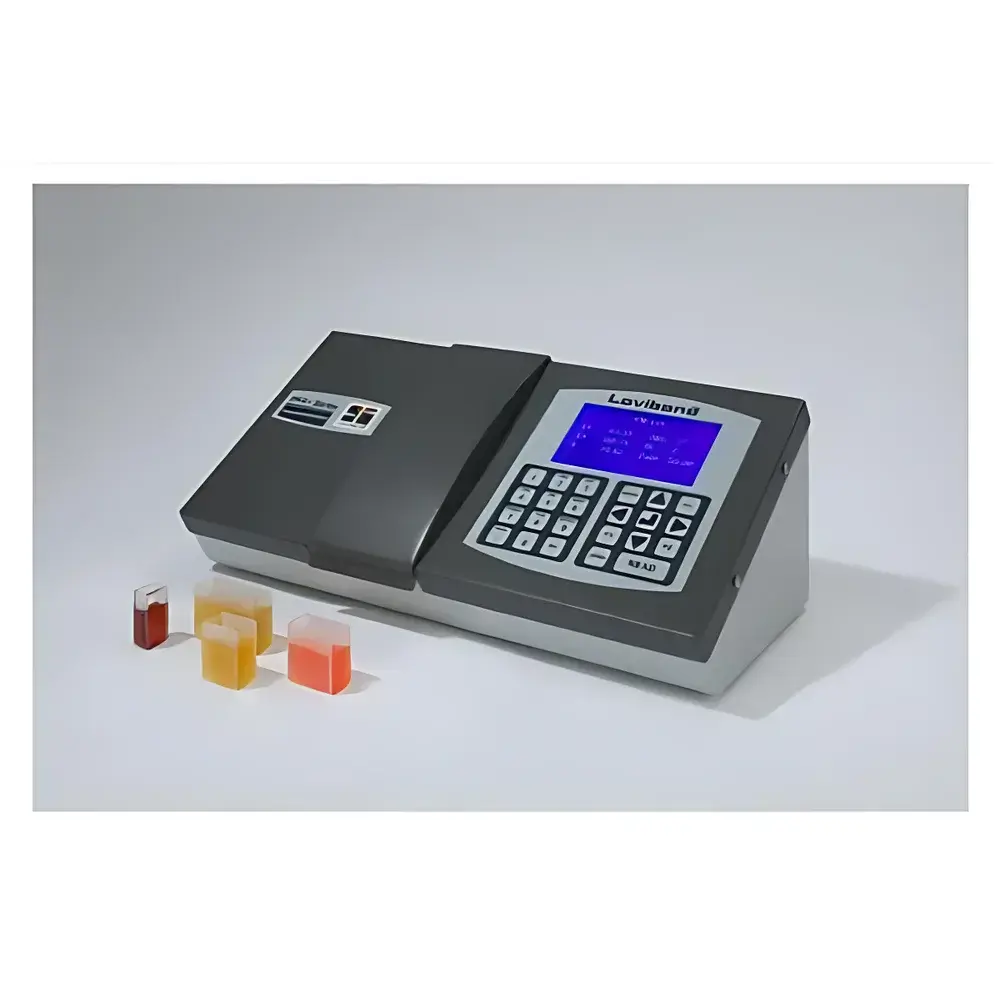
Lovibond PFXi195/3 Automatic Colorimeter
| Brand | Lovibond (Tintometer) |
|---|---|
| Origin | United Kingdom |
| Model | PFXi195/3 |
| Measurement Principles | Tristimulus colorimetry (CIE 1931 XYZ), Gardner, FAC, APHA/Pt-Co, Saybolt |
| Display | High-contrast backlit LCD with multi-language UI (including Chinese) |
| Interface | USB 2.0 & 10/100 Mbps Ethernet (LAN) |
| Compliance | ISO/IEC 17025 traceable standards support (ASTM D1500, ASTM D6166, ISO 4630, ISO 27875, ISO 6271), GLP-compliant data logging |
| Sample Handling | Removable stainless-steel measurement cell, flow-through cuvette option available |
| Software | Included Lovibond Colour Control Software (Windows-compatible), CIE chromaticity diagram visualization, spectral reflectance/data export (CSV, XML), remote instrument control |
| Data Management | User ID, sample ID, timestamp, method ID, and deviation metrics (ΔE*, Δa*, Δb*, saturation ratio, hue angle offset) stored per measurement |
| Enclosure | Corrosion-resistant stainless-steel housing |
| Power | 100–240 V AC, 50/60 Hz |
Overview
The Lovibond® PFXi195/3 Automatic Colorimeter is a precision-engineered tristimulus color measurement system designed for objective, repeatable quantification of color in liquid samples—particularly dark oils, fats, resins, and industrial process streams. Operating on the CIE 1931 standard observer model, it employs stable tungsten-halogen illumination and interference-filtered photodetectors to capture spectral reflectance or transmittance across the visible spectrum (approximately 400–700 nm). Unlike visual comparison methods, the PFXi195/3 eliminates observer bias, ambient lighting influence, and inter-operator variability by delivering numerically defined color coordinates (L*a*b*, L*C*h°), as well as industry-specific indices including Gardner, FAC (Ferric Ammonium Citrate), Saybolt, APHA/Pt-Co, and ISO color scales. Its optical architecture is calibrated against NIST-traceable reference standards and supports measurement traceability aligned with ISO/IEC 17025 requirements when used with certified liquid or filter standards.
Key Features
- Automated, single-button operation with <20-second measurement cycle—no operator training required
- Removable stainless-steel measurement cell with chemical-resistant surface finish for easy cleaning and long-term durability in aggressive environments
- Integrated RCMSi (Remote Calibration & Maintenance System) enabling over-the-network firmware updates, method validation, and diagnostic reporting via LAN or USB
- Multi-standard capability: preloaded with >20 standardized color scales—including ASTM D1500 (Gardner), ASTM D6166 (FAC), ISO 4630 (Saybolt), ISO 27875 (APHA), and ISO 6271 (CIE L*a*b*)
- Comprehensive deviation analysis: calculates ΔE*ab, Δa*, Δb*, hue angle shift (Δh°), chroma ratio, and custom “off-color” metrics relative to user-defined references
- Full GLP compliance: automatic timestamping, operator ID, sample ID, method ID, and audit trail export in CSV or XML format
- Flexible connectivity: dual-interface support (USB 2.0 and 10/100 Mbps Ethernet) for integration into laboratory information management systems (LIMS) or centralized QA/QC networks
Sample Compatibility & Compliance
The PFXi195/3 accommodates standard rectangular cuvettes (10 mm, 20 mm, 50 mm pathlengths) and optional flow-through cells for inline or at-line monitoring. Its optical design ensures high linearity and repeatability across absorbance ranges typical of highly colored media (e.g., edible oils, lubricants, polymer melts, and pharmaceutical intermediates). All measurements adhere to internationally recognized protocols: ASTM D1500 for petroleum products, ISO 4630 for light-colored oils, ISO 27875 for water clarity assessment, and ISO 6271 for general-purpose color evaluation. Certified reference standards—liquid or solid-state filters—are supplied with calibration certificates compliant with ISO 9001 and traceable to national metrology institutes under ISO/IEC 17025 accreditation.
Software & Data Management
The bundled Lovibond Colour Control Software provides full instrument control from a Windows-based workstation, enabling method setup, real-time spectral visualization, CIE chromaticity diagram plotting, batch report generation, and statistical trend analysis. Data exports support regulatory submission formats and are compatible with common QA databases. The software enforces electronic signature workflows and maintains immutable records of all measurement events—including calibration history, user actions, and environmental logs—meeting FDA 21 CFR Part 11 requirements for electronic records and signatures when configured with appropriate access controls and audit trails.
Applications
This instrument serves critical quality assurance functions across multiple sectors: edible oil refining (monitoring bleaching efficiency and oxidation stability), petrochemical processing (crude fraction characterization and additive consistency), paint & coatings formulation (batch-to-batch color matching), pharmaceutical excipient grading (USP/EP color limits), and food ingredient manufacturing (caramel color intensity, honey grading, and vegetable oil classification). Its robust construction and IP-rated enclosure make it suitable for both controlled laboratory environments and factory-floor deployment within ISO 9001-certified production lines.
FAQ
What color standards are pre-programmed in the PFXi195/3?
It includes Gardner, FAC, Saybolt, APHA/Pt-Co, ISO color scales, and full CIE L*a*b*, L*C*h°, and XYZ coordinate output.
Can I define my own color reference standards?
Yes—users may import spectral or coordinate-based references and assign them to custom methods with pass/fail tolerances.
Is the instrument suitable for GMP/GLP-regulated environments?
Yes—GLP-compliant data logging, electronic signatures (via software), and audit-ready export formats support compliance with FDA 21 CFR Part 11, EU Annex 11, and ISO 17025.
How often does the instrument require recalibration?
Annual verification using certified reference standards is recommended; daily zeroing and routine checks with control samples ensure ongoing accuracy.
Does it support flow-through or continuous sampling?
An optional flow cell accessory enables unattended, real-time color monitoring during production runs or column elution processes.





