
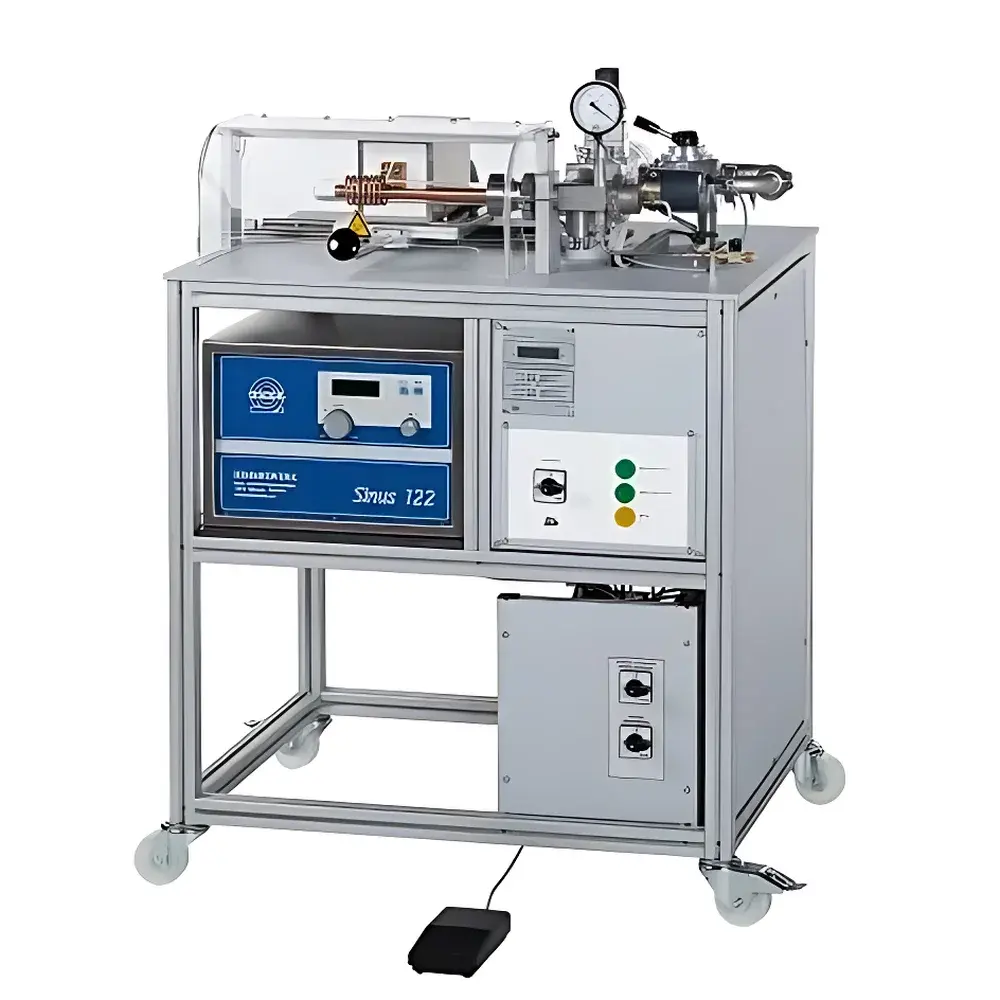
Edmund Bühler VIM-Cu Crucible Induction Melting Furnace
| Brand | Edmund Bühler |
|---|---|
| Origin | Germany |
| Model | VIM-Cu Crucible Induction Melting Furnace |
| Maximum Sample Mass | 20 g |
| Maximum Melting Temperature | 1800 °C |
| Ultimate Vacuum | 10⁻³ mbar |
| Pumping Speed (at atmospheric pressure) | 2.5 m³/h |
| Time to Reach 10⁻³ mbar | ~8 min |
| Generator Power | 12 kW |
| Operating Frequency Range | 50–200 kHz |
| Input Voltage | 230 V / 50–60 Hz (1-phase) or 400 V / 50–60 Hz (3-phase) |
| Standard Copper Mold Dimensions (L × W × D) | 50 × 12 × 4.5 mm |
| Sample Cavity Dimensions (L × W × D) | 16 × 12 × 4.5 mm |
| Overall Footprint (W × D × H) | 880 × 900 × 1300 mm |
Overview
The Edmund Bühler VIM-Cu Crucible Induction Melting Furnace is a compact, high-precision vacuum induction melting (VIM) system engineered for controlled synthesis and homogenization of small-volume metallic alloys under inert or high-vacuum atmospheres. Based on electromagnetic induction heating principles, the furnace generates eddy currents directly within electrically conductive samples placed inside a water-cooled copper crucible mold—eliminating contamination from external heating elements and enabling rapid, uniform thermal response. Designed for laboratory-scale metallurgical research, it supports reproducible melt processing of up to 20 g of material at temperatures up to 1800 °C, with ultimate vacuum performance of 10⁻³ mbar achieved in approximately eight minutes using its integrated two-stage pumping architecture (mechanical backing pump + HVM7 turbo-molecular pump). The system operates with a high-frequency (50–200 kHz), 12 kW solid-state RF generator housed within a grounded safety enclosure, ensuring electromagnetic compatibility and operator protection in compliance with IEC 61000-6-4 and IEC 61000-6-2 standards.
Key Features
- Water-cooled copper crucible mold with precise dimensional tolerances (standard: 50 × 12 × 4.5 mm), enabling efficient heat dissipation and extended service life during repeated high-temperature cycles
- Integrated mobile control cabinet housing vacuum gauges, pressure sensors, pump interlocks, and emergency stop circuitry—designed for ISO 13857-compliant access separation
- Dual-mode atmosphere control: compatible with high-purity argon purging (for reactive alloy stabilization) or full vacuum operation (for oxygen-sensitive systems such as Ti-, Zr-, or rare-earth-based compositions)
- Safety-integrated RF generator with automatic power cutoff triggered by coolant flow interruption, door interlock activation, or overtemperature detection in the coil zone
- Modular vacuum train featuring a calibrated Pirani gauge for rough vacuum monitoring and a Bayard-Alpert-type high-vacuum gauge paired with the HVM7 turbo-molecular pump for stable 10⁻³ mbar operation
- Optional integration with nitrogen-boron (BN) sample holders for improved thermal isolation and reduced crucible interaction during low-mass melts
Sample Compatibility & Compliance
The VIM-Cu furnace accommodates metallic feedstock in elemental or pre-alloyed form—including Fe-, Ni-, Co-, Cu-, Al-, Ti-, and refractory-based systems—provided they exhibit sufficient electrical conductivity for effective induction coupling. Samples are sealed within fused silica ampoules prior to loading into the copper mold, ensuring containment integrity during thermal cycling and preventing volatile loss or oxidation. The system conforms to ASTM F2627-18 (Standard Guide for Vacuum Induction Melting of Reactive Metals) and supports GLP-compliant process documentation when operated with optional audit-trail-enabled controllers. All vacuum components meet ISO 2859-1 sampling standards for leak-tightness verification; the quartz tube assembly is rated for continuous use at 1000 °C and short-term exposure up to 1200 °C.
Software & Data Management
While the base configuration operates via analog front-panel controls with real-time analog metering of vacuum pressure, RF current, and cooling water temperature, optional digital upgrades include a programmable logic controller (PLC) interface with RS-485/Modbus RTU support. This enables remote parameter logging (vacuum level vs. time, power ramp profiles, cooldown rates) and synchronization with external data acquisition platforms. For regulated environments, the optional software package complies with FDA 21 CFR Part 11 requirements—including electronic signature capability, role-based access control, and immutable audit trails for all critical setpoint changes and alarm events.
Applications
- Development and validation of novel intermetallic compounds and high-entropy alloys requiring compositional homogeneity at sub-gram scale
- Preparation of master alloys for subsequent arc-melting or directional solidification studies
- Inert-atmosphere melting of oxygen-sensitive materials such as magnesium-based or lithium-containing intermetallics
- Thermophysical property calibration—e.g., enthalpy of fusion determination via differential thermal analysis (DTA)-coupled setups
- Small-batch synthesis of target compositions for XRD, SEM-EDS, or TEM microstructural characterization
- Process qualification of additive manufacturing feedstock powders through controlled remelting and solidification trials
FAQ
What vacuum level is achievable without optional turbo-pumping?
With only the standard mechanical pump installed, the system reaches ≤5 × 10⁻² mbar—sufficient for argon-flushed operations but not for ultra-high-purity reactive metal processing.
Can the furnace be integrated into an argon-filled glovebox?
Yes—custom flanged interfaces and shortened electrical/vacuum feedthroughs are available upon request to enable direct mounting within ISO Class 4–5 inert-atmosphere enclosures.
Is water cooling provided internally or externally?
External chilled water supply is required; the system specifies minimum flow rate (≥8 L/min) and temperature range (10–25 °C) for stable RF generator and coil operation.
What safety certifications does the unit carry?
CE-marked per Machinery Directive 2006/42/EC, Low Voltage Directive 2014/35/EU, and EMC Directive 2014/30/EU; full test reports available upon commercial inquiry.
Are custom crucible geometries supported?
Yes—Edmund Bühler offers OEM machining of copper molds to customer-specified dimensions, including tapered, stepped, or multi-cavity configurations, subject to minimum wall thickness and cooling channel constraints.



