
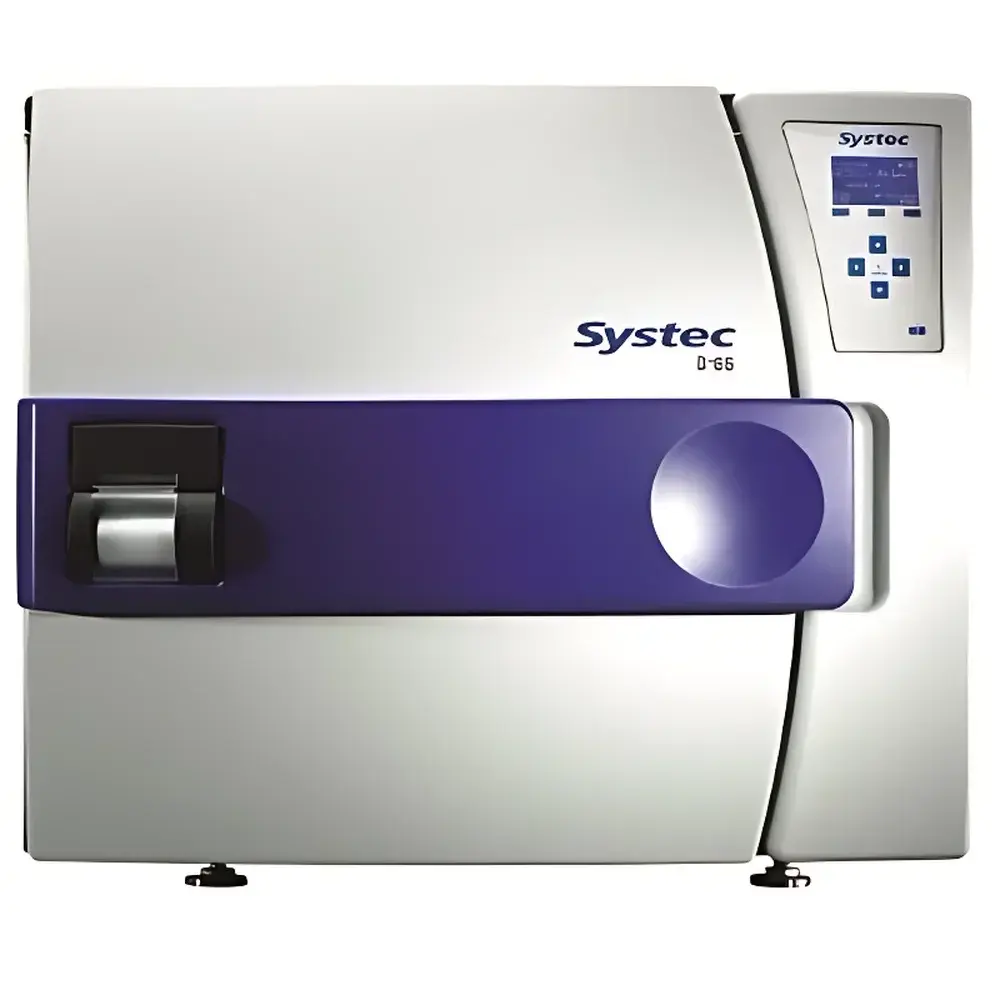
Systec D-Series Benchtop Steam Sterilizer
| Brand | Systec |
|---|---|
| Origin | Germany |
| Model | D-Series |
| Type | Benchtop Steam Sterilizer |
| Voltage & Phase | D-23/D-45: 220–240 V, 50/60 Hz, Single-Phase, 16 A |
| D-65 to D-200 | 380–400 V, 50/60 Hz, Three-Phase Five-Wire (with PE and N), 16 A |
| Chamber Volume | Model-Dependent (D-23: ~23 L |
| D-45 | ~45 L |
| D-65 | ~65 L |
| up to D-200 | ~200 L) |
| Max Operating Temperature | 135 °C |
| Max Working Pressure | 2.2 bar (gauge) |
| Compliance | EN 61010-1, EN 61010-2-040, EN 285 (for small sterilizers), PED 2014/68/EU (Category I/II), CE Marked |
Overview
The Systec D-Series Benchtop Steam Sterilizer is a fully compliant, microprocessor-controlled Class B vacuum-assisted steam sterilization system engineered for precision, safety, and reproducibility in research laboratories, quality control environments, and small-scale production facilities. Based on the internationally recognized ISO 17665-1 and EN 285 standards for moist heat sterilization, the D-Series employs a pre-vacuum air removal cycle followed by saturated steam penetration under controlled pressure and temperature conditions—ensuring complete microbial inactivation of vegetative bacteria, spores (including Bacillus stearothermophilus ATCC 7953), and viruses across porous and hollow loads. Unlike gravity-displacement sterilizers, the D-Series integrates a dual-vacuum pump system that achieves ≥99.9% air removal prior to steam admission, eliminating cold spots and enabling reliable sterilization of wrapped instruments, pipette tips, culture media in bottles, and complex labware configurations.
Key Features
- Three-tier performance architecture: DX (fully configurable with full validation support), DE (optimized for routine media and instrument sterilization), and DB (entry-level fixed-cycle operation)
- Vacuum-assisted Class B cycle classification per EN 13060, supporting all load types including porous, hollow, and packaged items
- Integrated thermal validation ports (optional) for connection to calibrated thermocouples and data loggers meeting FDA 21 CFR Part 11 requirements
- Real-time graphical display of temperature, pressure, vacuum level, and cycle phase progression with event logging and timestamping
- Robust stainless-steel chamber (AISI 316L) with double-walled insulation, reinforced door sealing system, and mechanical safety interlock
- Programmable cycle library with up to 99 user-defined protocols, each supporting adjustable pre-vacuum depth, steam injection rate, exposure time, drying duration, and cooling parameters
- Comprehensive self-diagnostic system with fault code reporting, automatic error recovery, and maintenance scheduling alerts
Sample Compatibility & Compliance
The D-Series accommodates standard laboratory vessels—including Erlenmeyer flasks (up to 2 L), screw-cap culture bottles (50–500 mL), Petri dish stacks, autoclavable plasticware, and stainless-steel instrument trays—within its modular chamber configurations (23 L to 200 L). All models comply with EU regulatory frameworks: CE marking under the Low Voltage Directive (2014/35/EU) and Electromagnetic Compatibility Directive (2014/30/EU); conformity with the Pressure Equipment Directive (2014/68/EU) for Category I and II devices; and adherence to IEC 61010-1 and IEC 61010-2-040 for laboratory safety. For GxP environments, optional IQ/OQ documentation packages and electronic audit trail functionality (aligned with ALCOA+ principles) are available upon request.
Software & Data Management
Systec’s proprietary SteriControl™ software (Windows-based, USB or Ethernet interface) enables remote cycle initiation, real-time monitoring, and secure export of raw process data in CSV or PDF format. Each sterilization run generates a digitally signed report containing start/end timestamps, maximum/minimum chamber temperatures, vacuum depth profiles, pressure curves, and pass/fail status per EN 285 Annex C criteria. Optional 21 CFR Part 11 compliance modules provide role-based access control, electronic signatures, and immutable record retention—supporting GLP, GMP, and ISO 13485 quality systems. Data integrity is further ensured through cyclic redundancy check (CRC) verification and internal EEPROM storage of the last 1,000 cycles.
Applications
- Sterilization of microbiological growth media (e.g., agar, broth, selective formulations) without thermal degradation
- Decontamination of reusable glassware, metal instruments, and filtration assemblies prior to aseptic processing
- Preparation of sterile saline, buffers, and reagent solutions for cell culture and molecular biology workflows
- Validation support for cleanroom gowning procedures and environmental monitoring equipment
- Compliance-driven sterilization in academic core facilities, contract testing labs, and medical device R&D departments
FAQ
What sterilization standards does the Systec D-Series meet?
It conforms to EN 285 (large sterilizers, adapted for small units), EN 13060 (Class B small steam sterilizers), ISO 17665-1, and relevant sections of ISO 11134 and ISO 11135 for process validation.
Can the D-Series be integrated into a laboratory LIMS or MES system?
Yes—via optional RS485 Modbus RTU or Ethernet TCP/IP communication protocols, enabling bidirectional data exchange with enterprise systems for traceability and automated recordkeeping.
Is third-party validation support available?
Systec provides IQ/OQ templates and collaborates with certified validation partners to execute installation qualification, operational qualification, and performance qualification per ISO 13485 and GAMP 5 guidelines.
What maintenance intervals are recommended?
Daily door gasket inspection, weekly chamber drain flush, quarterly vacuum pump oil replacement, and annual calibration of temperature/pressure sensors—documented in the included Maintenance Logbook.
Does the system support dry-heat or ethylene oxide cycles?
No—the D-Series is designed exclusively for saturated steam sterilization. Alternative modalities require dedicated equipment compliant with EN 554 (dry heat) or EN 1422 (EO).



