
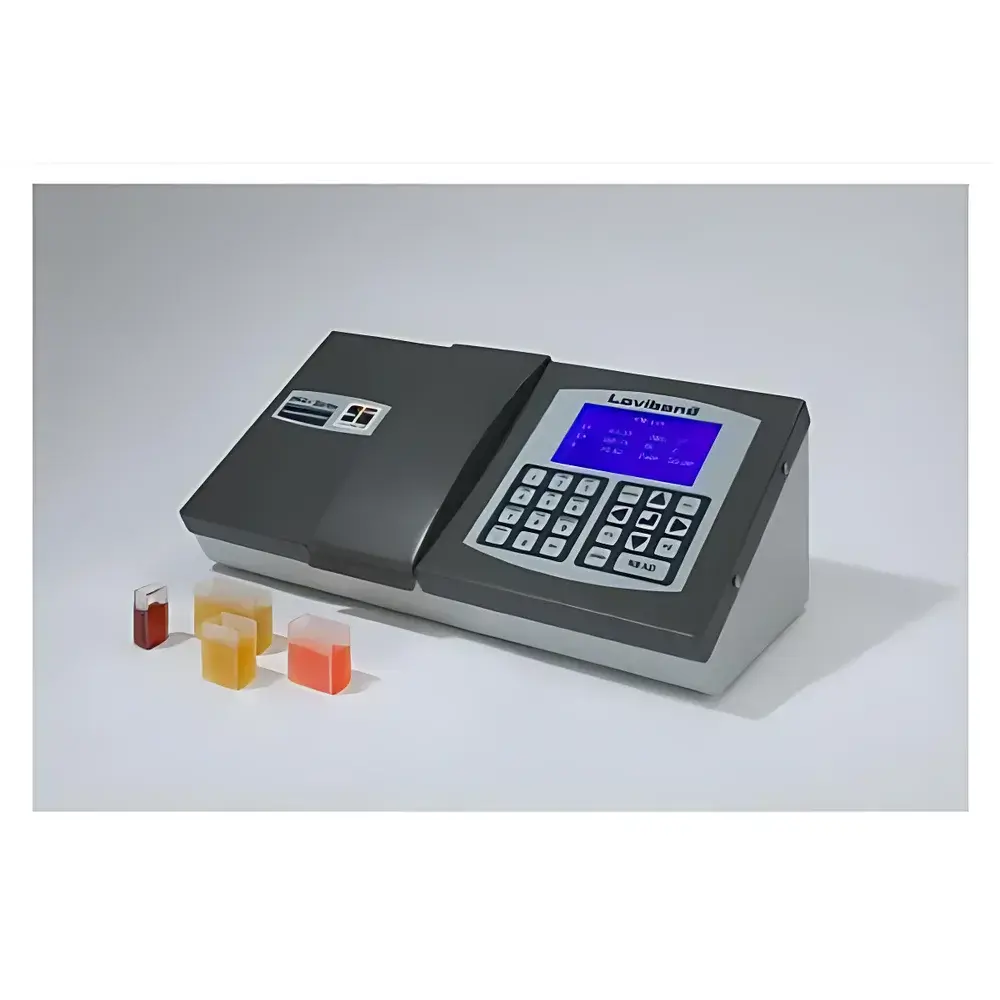
Lovibond PFXi195/8 Automated Colorimeter
| Brand | Lovibond (Tintometer) |
|---|---|
| Origin | United Kingdom |
| Model | PFXi195/8 |
| Measurement Standards | ADMI, Pt-Co/Hazen/APHA, CIE L*a*b*, CIE XYZ, Spectral Data (380–780 nm, 10 nm intervals) |
| Display | 7-inch TFT LCD with multi-language UI (including Chinese) |
| Interface | USB 2.0 & 10/100 Mbps Ethernet (LAN) |
| Compliance | ISO 9001, ISO/IEC 17025 (via certified reference standards), ASTM D1209, ASTM D5386, ISO 6271, ISO 2211 |
| GLP Support | Date/time stamp, sample ID, operator ID, audit trail export |
| Sample Cell Compatibility | 10–50 mm pathlength cuvettes (rectangular, round, flow-through optional) |
| Housing | Stainless steel chassis with chemical-resistant anodized aluminum front panel |
| Calibration | RCMSi Remote Calibration Management System enabled |
Overview
The Lovibond® PFXi195/8 Automated Colorimeter is a precision-engineered optical measurement instrument designed for objective, repeatable color quantification in water, wastewater, and process liquids. Operating on the principle of spectrophotometric absorbance analysis across the visible spectrum (380–780 nm at 10 nm resolution), it eliminates human subjectivity inherent in visual color comparison methods. Its optical architecture employs a stabilized tungsten-halogen light source, precision interference filters, and a silicon photodiode array detector—ensuring high photometric reproducibility (<0.002 ΔE*ab repeatability under controlled conditions). The instrument conforms to internationally recognized colorimetric methodologies including ASTM D1209 (Platinum-Cobalt scale), ASTM D5386 (instrumental color measurement), ISO 6271 (water color), and ISO 2211 (Hazen units), enabling traceable, regulatory-compliant reporting in environmental monitoring, pharmaceutical water testing, and industrial quality control laboratories.
Key Features
- Automated spectral acquisition and real-time calculation of multiple color scales—including ADMI, Pt-Co/Hazen/APHA, Gardner, Saybolt, and full CIE L*a*b*, L*C*h*, and XYZ coordinates
- RCMSi-enabled remote calibration verification and firmware updates via secure LAN or USB connection, supporting centralized instrument fleet management
- Dual-interface connectivity (USB 2.0 + Ethernet) for direct data export, remote operation, and integration into LIMS or MES environments
- Stainless steel measurement chamber with removable, autoclavable cuvette holder—designed for rapid cleaning and resistance to aggressive solvents, acids, and oxidants
- Intuitive 7-inch graphical TFT display with context-sensitive prompts, customizable language selection (12 languages, including Chinese), and password-protected user access levels
- Onboard偏色 analysis (Delta E, Delta a*, Delta b*, saturation ratio, hue angle deviation) against user-defined or standard reference spectra
- GLP-compliant data logging: automatic timestamping, operator ID, sample ID, method ID, and calibration history—all exportable as CSV or PDF reports
Sample Compatibility & Compliance
The PFXi195/8 accommodates standard rectangular (10–50 mm pathlength) and round cuvettes, with optional flow-through cells for inline process monitoring. Its optical design supports turbid and low-transmittance samples without dilution artifacts, thanks to dual-beam referencing and stray-light correction algorithms. Certified liquid color standards (e.g., NIST-traceable Pt-Co solutions per ASTM D1209) and solid glass filter standards (ISO 9001-manufactured, with certificate of calibration) are fully supported for routine verification. The system meets ISO/IEC 17025 requirements when used with accredited reference materials and documented calibration procedures—making it suitable for ISO 17025-accredited labs, USP , and EU Annex 1 water quality compliance workflows.
Software & Data Management
Supplied with ColorSoft™ PC software, the PFXi195/8 enables advanced spectral visualization (CIE chromaticity diagrams, reflectance/transmittance curves), statistical batch analysis, trend charting, and method library management. Software supports 21 CFR Part 11-compliant user authentication, electronic signatures, and audit trail generation—fully configurable for GMP/GLP-regulated environments. Data can be exported to Excel, LIMS-compatible XML formats, or directly ingested via ODBC drivers. Firmware updates and method synchronization occur seamlessly through the RCMSi cloud portal, eliminating manual version control overhead.
Applications
- Drinking water and wastewater treatment: ADMI and Pt-Co compliance reporting per EPA Method 180.1 and ISO 7887
- Pharmaceutical purified water (PW) and water-for-injection (WFI): USP color evaluation and trending
- Chemical manufacturing: Raw material QC of solvents, surfactants, and polymer intermediates
- Food & beverage R&D: Consistency monitoring of syrups, juices, and edible oils using Gardner or AOCS standards
- Paints & coatings: Batch-to-batch hue matching and deviation quantification against master standards
- Academic research: Teaching spectral color theory, CIE system fundamentals, and metrological traceability principles
FAQ
Does the PFXi195/8 support ASTM D5386-compliant instrumental color measurement?
Yes—the instrument implements the full spectral acquisition and tristimulus calculation workflow defined in ASTM D5386, including CIE 1931 2° observer functions and D65 illuminant simulation.
Can I perform GLP-compliant audits using the onboard data log?
Yes—each measurement record includes immutable timestamps, operator credentials, method parameters, and calibration status; full audit trails are exportable in CSV or PDF with digital signature support via ColorSoft™.
Is remote calibration verification possible without sending the unit to a service center?
Yes—RCMSi enables automated optical performance checks using network-connected reference standards, generating ISO/IEC 17025-aligned verification reports without physical intervention.
What cuvette pathlengths are supported natively?
Standard support includes 10 mm, 20 mm, and 50 mm rectangular quartz or glass cuvettes; custom pathlengths may be configured via software scaling factors.
How often must the tungsten-halogen lamp be replaced?
Rated lifetime exceeds 2,000 hours; the instrument monitors lamp output stability and alerts users when photometric drift exceeds ±0.5%—typically requiring replacement every 12–18 months under daily lab use.




