
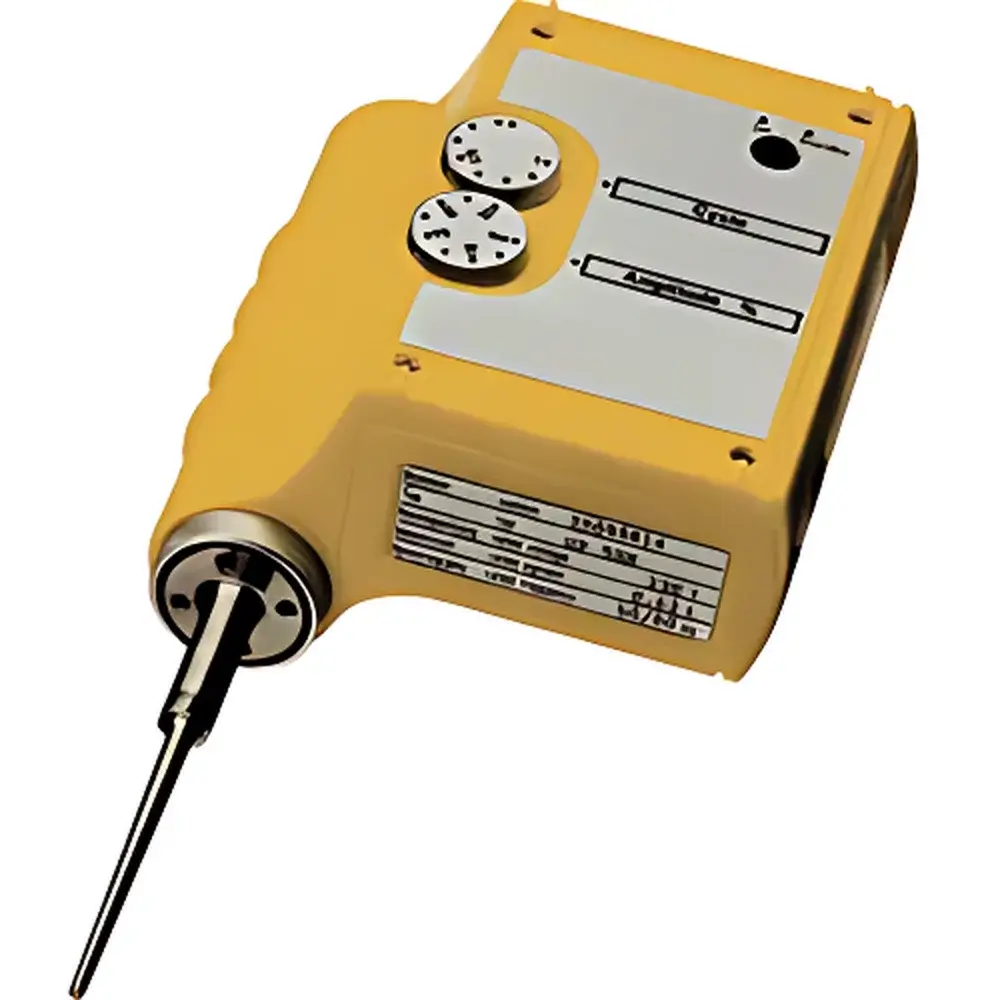
Hielscher UP50H Handheld Ultrasonic Homogenizer
| Brand | Hielscher |
|---|---|
| Origin | Germany |
| Model | UP50H |
| Ultrasonic Power | 50 W |
| Operating Frequency | 30 kHz (auto-tuned) |
| Amplitude Control Range | 20–100% (digital, real-time) |
| Pulse Mode | 0–100% duty cycle |
| Sample Volume Capacity | 0.1–500 mL |
| Dimensions (L×W×H) | 180 × 130 × 50 mm |
| Weight | 1.1 kg |
| Power Supply | 230 V, 0.63 A, 50–60 Hz |
| Probe Material | Grade 5 titanium alloy (Ti-6Al-4V) |
| Cooling Options | Optional recirculating chiller coupling or jacketed flow cell |
| Noise Level | <70 dB(A) at 10 cm |
| Compliance | CE, RoHS, IEC 61000-6-3/6-4 |
Overview
The Hielscher UP50H Handheld Ultrasonic Homogenizer is an engineered solution for precise, scalable ultrasonic processing in life science laboratories. Based on high-intensity focused ultrasound (HIU) operating at a nominal frequency of 30 kHz, the UP50H generates controlled cavitation in liquids via piezoelectric transduction—inducing localized shear forces, microstreaming, and transient hotspots that disrupt cellular membranes, emulsify immiscible phases, and accelerate mass transfer. Unlike benchtop systems with fixed geometry, the UP50H’s handheld architecture enables direct probe immersion into vials, tubes, and small reactors—making it ideal for low-volume applications where spatial control, sterility preservation, and minimal cross-contamination are critical. Its auto-frequency tracking ensures stable resonance across varying sample viscosities and temperatures, maintaining consistent energy delivery without manual tuning.
Key Features
- Compact integrated design: All-in-one transducer, generator, and ergonomic handle—no external power amplifier or cooling unit required.
- Digital amplitude regulation (20–100%) with closed-loop feedback, delivering reproducible mechanical output regardless of load impedance or mains voltage fluctuations.
- Pulse mode programming (0–100% duty cycle) for thermal management during sensitive biological sample processing (e.g., protein extraction, nucleic acid shearing).
- Grade 5 titanium alloy probe (Ti-6Al-4V) with optimized tip geometry for enhanced cavitation efficiency and resistance to erosion from acoustic cavitation collapse.
- Integrated dry-run protection: Automatic shutdown upon detection of no-load operation to prevent transducer overheating and probe damage.
- Low-noise operation (<70 dB[A] at 10 cm), compatible with standard lab environments; optional transparent acoustic enclosure available for further noise reduction and splash containment.
- Modular probe compatibility: Standard 3-mm and 7-mm diameter probes; optional flow-through cells with jacketed cooling for continuous or semi-continuous processing.
Sample Compatibility & Compliance
The UP50H accommodates aqueous, organic, and viscous media—including cell suspensions (bacterial, yeast, mammalian), tissue homogenates, nanoparticle dispersions, and polymer solutions. It supports single-use and reusable probe configurations under aseptic conditions. The device complies with EU directives CE 2014/30/EU (EMC), 2014/35/EU (LVD), and RoHS 2011/65/EU. Its electrical safety and electromagnetic compatibility meet IEC 61000-6-3 (emission) and IEC 61000-6-4 (immunity) standards. While not certified for GMP production, its repeatable amplitude control, pulse logging capability, and optional USB interface support GLP-aligned documentation workflows in R&D and QC labs.
Software & Data Management
The UP50H operates as a standalone instrument with front-panel digital controls but supports optional PC connectivity via USB. When paired with Hielscher’s proprietary software (e.g., “Hielscher LabControl”), users can configure multi-step protocols—including ramped amplitude profiles, timed pulse sequences, and real-time amplitude monitoring. The software records timestamped operational logs (duration, amplitude %, pulse ratio, total energy delivered), enabling traceability for method validation and internal audit requirements. Data export is supported in CSV format for integration into LIMS or statistical analysis platforms. No proprietary drivers are required—USB communication uses standard CDC ACM class.
Applications
- Cell lysis and organelle isolation from microbial cultures, plant tissues, and cultured mammalian cells—without significant protein denaturation when operated under pulsed, chilled conditions.
- Nucleic acid shearing for NGS library preparation, offering controllable fragment size distribution comparable to focused acoustic systems but at lower capital cost.
- Preparation of stable nanoemulsions and liposomes for drug delivery formulation development.
- Extraction of intracellular metabolites, enzymes, or secondary metabolites from biomass under non-thermal conditions.
- Deagglomeration of nanomaterials (e.g., graphene oxide, metal oxides) in aqueous or solvent-based dispersions prior to characterization.
- Cleaning of microfluidic chips and capillary tubing via acoustic streaming-assisted solvent circulation.
FAQ
What is the maximum recommended continuous operating time per session?
For optimal thermal stability and probe longevity, continuous operation should not exceed 5 minutes without a 2–3 minute cooling interval. Pulsed mode extends effective processing time while limiting heat accumulation.
Can the UP50H be used with corrosive solvents such as chloroform or strong acids?
Titanium alloy probes resist most aqueous and mild organic media, but prolonged exposure to halogenated solvents or concentrated mineral acids may compromise surface passivation. Consult Hielscher’s chemical compatibility chart before use.
Is the device suitable for sterile applications?
Yes—probes can be autoclaved (121°C, 20 min, saturated steam) or sterilized via ethylene oxide or gamma irradiation. Ensure probe threads and O-rings are rated for the chosen method.
Does the UP50H support FDA 21 CFR Part 11 compliance?
The base unit does not include electronic signature or audit trail features. However, when used with LabControl software and validated IT infrastructure, it can be incorporated into Part 11–compliant workflows for electronic records and signatures.
How is amplitude calibrated and verified?
Hielscher provides traceable calibration certificates (NIST-traceable reference standards) upon request. Amplitude is measured using laser vibrometry at the probe tip under defined load conditions and verified annually per ISO/IEC 17025-accredited service protocols.





