
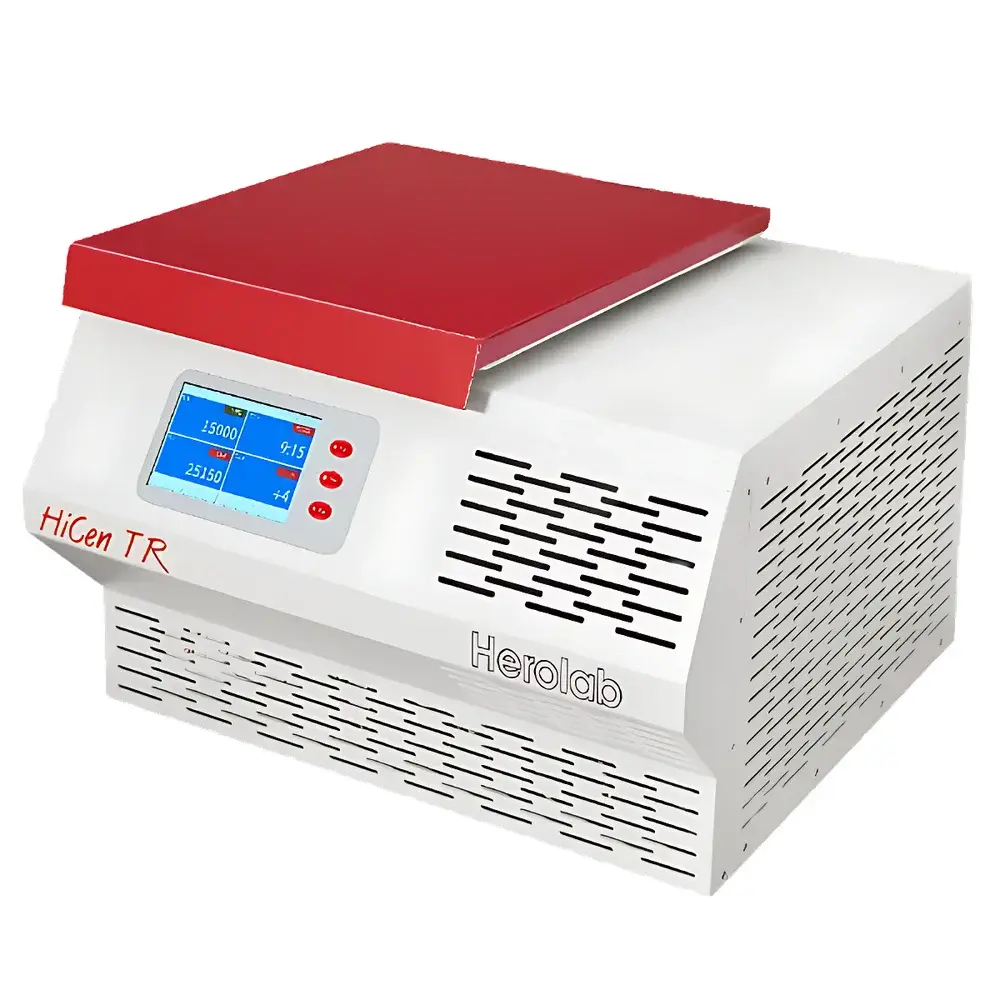
Herolab HiCen TR Benchtop High-Speed Refrigerated Centrifuge
| Brand | Herolab |
|---|---|
| Origin | Germany |
| Model | HiCen TR |
| Type | Benchtop Refrigerated Centrifuge |
| Speed Range | 10,000–16,000 rpm (Angular Rotor), 4,500 rpm (Swing Rotor) |
| Max RCF | 26,790 × g (Angular), 4,093 × g (Swing) |
| Max Capacity | 4 × 500 mL (Swing), 6 × 250 mL (Angular) |
| Temperature Range | −20 °C to +40 °C (CFC-free refrigeration) |
| Drive System | Maintenance-free high-speed induction motor with auto-centering |
| Rotor Recognition | Automatic |
| Imbalance Detection | Real-time monitoring with automatic shutdown |
| Brake System | Dynamic reverse magnetic resistance deceleration |
| Dimensions (W×D×H) | 72.1 × 67.0 × 49.0 cm |
| Weight (net) | 139 kg |
| Power Supply | 230 V, 50–60 Hz |
| Optional | Nitrogen purge for volatile/flammable sample handling |
Overview
The Herolab HiCen TR is a high-performance benchtop refrigerated centrifuge engineered for precision separation of biological and chemical samples under controlled thermal conditions. Designed and manufactured in Germany, it employs fixed-angle and swing-out rotor configurations based on classical sedimentation principles governed by centrifugal force (RCF), enabling efficient pelleting of cells, bacteria, subcellular organelles, and macromolecular complexes. Its refrigeration system maintains temperature stability from −20 °C to +40 °C using CFC-free cooling technology, ensuring sample integrity during prolonged runs—critical for heat-sensitive proteins, nucleic acids, and enzymatic assays. The instrument operates within ISO 13485-aligned quality systems and complies with IEC 61010-1 safety standards for laboratory equipment. Its robust cast-aluminum housing, reinforced rotor chamber, and electromagnetic braking architecture support long-term reliability in high-throughput QC, research, and clinical laboratories.
Key Features
- Maintenance-free high-speed induction motor with auto-centering capability ensures consistent rotational stability and extended service life without routine lubrication or alignment.
- Dynamic reverse magnetic resistance braking enables rapid, smooth, and vibration-controlled deceleration—reducing run time and minimizing sample resuspension.
- Automatic rotor recognition and real-time imbalance detection provide fail-safe operation; the system halts immediately upon detecting mass asymmetry exceeding ±5 g or angular deviation beyond tolerance thresholds.
- Constant-temperature preservation mode maintains set chamber temperature for up to 30 minutes post-run, facilitating sequential processing of temperature-critical samples.
- Programmable “constant RCF” mode initiates timing only after reaching target relative centrifugal force—ensuring reproducible exposure duration across variable loads and ambient conditions.
- Flexible rotor compatibility: supports 12 interchangeable rotors—including 10 angular and 2 swing-bucket configurations—optimized for applications ranging from high-RCF pelleting to gentle layer separation.
Sample Compatibility & Compliance
The HiCen TR accommodates standard conical tubes (15–50 mL), centrifuge bottles (up to 500 mL), and specialized carriers for microplates and PCR strips. Its swing-bucket rotors enable density gradient separations (e.g., sucrose, iodixanol), while angular rotors deliver maximum RCF for rapid cell harvesting. All rotors are certified to DIN EN ISO 15197:2022 mechanical load testing protocols and carry CE marking under Directive 2014/30/EU (EMC) and 2014/35/EU (LVD). For regulated environments, the system supports GLP-compliant audit trails when integrated with validated LIMS interfaces, and its nitrogen-purge option meets ATEX Category 2G requirements for use with Class I, Division 1 volatile solvents per NFPA 497.
Software & Data Management
The intuitive touch-panel interface provides full parameter control—including speed, time, temperature, acceleration/deceleration ramps, and RCF-based programming—with password-protected user profiles and method locking. All run logs (timestamp, rotor ID, actual vs. set RCF, temperature deviation, error codes) are stored internally for ≥10,000 cycles and exportable via USB to CSV or XML formats. When connected to Herolab’s optional CentriLink™ software suite (v3.2+), the system supports remote monitoring, electronic signature compliance per FDA 21 CFR Part 11, and automated report generation aligned with ISO/IEC 17025 documentation requirements.
Applications
- Microbial pelleting and lysate clarification in molecular microbiology workflows.
- Isolation of mitochondria, nuclei, and plasma membranes using differential centrifugation protocols (e.g., adapted from Alberts et al., Molecular Biology of the Cell).
- Preparative purification of exosomes and extracellular vesicles via ultracentrifugation-compatible angular rotors.
- Stability testing of biopharmaceutical formulations under accelerated thermal stress conditions.
- Environmental sample processing—e.g., sedimentation of suspended solids from wastewater effluents prior to ICP-MS analysis.
- Quality control of vaccine suspensions requiring strict temperature maintenance throughout centrifugal clarification.
FAQ
Does the HiCen TR support validation documentation for GMP environments?
Yes—Herolab provides IQ/OQ documentation packages, including calibration certificates traceable to PTB (Physikalisch-Technische Bundesanstalt), and supports third-party PQ execution per Annex 15 guidelines.
Can the nitrogen purge option be retrofitted to existing units?
No—the nitrogen inlet port and sealed gas-path manifold are factory-integrated during final assembly and require structural modification not supported under warranty.
What is the minimum detectable imbalance threshold for automatic shutdown?
The system triggers immediate stop at mass imbalances ≥±4.8 g across opposing positions, verified annually during metrological recalibration.
Is rotor lifetime tracked automatically?
Yes—each rotor contains an RFID tag storing cumulative run hours, max RCF history, and thermal cycle count; this data is read and logged at every startup.
How does the refrigeration system perform at ambient temperatures above 30 °C?
The compressor maintains setpoint within ±1.5 °C up to 35 °C ambient; performance degrades linearly beyond that, with full cooling capacity restored only below 30 °C ambient per IEC 60068-2-14 specifications.



