
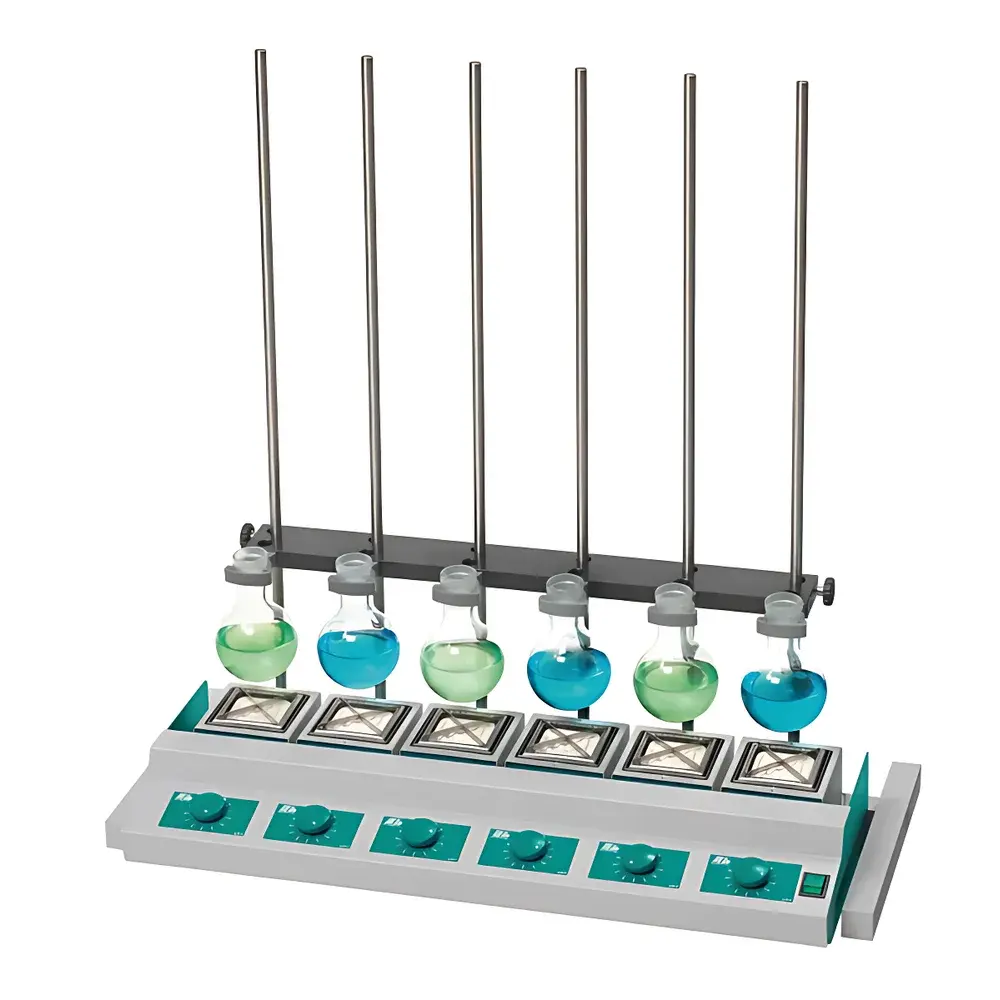
Edmund Büehler IRB 6 Modular Infrared Heating System
| Brand | Edmund Büehler |
|---|---|
| Origin | Germany |
| Model | IRB 6 Modular Infrared Heating System |
| Max. Temperature per Unit | 700 °C |
| Heating Power | 6 × 250 W (1200 W total) |
| Heating Area per Unit | 60 × 60 mm |
| Power Control | Continuous 0–100 % |
| Ambient Temperature Limit | 30 °C |
| Supply Voltage | 230 V, 50/60 Hz |
| Dimensions (W × D × H) | 697 × 305 × 122 mm |
| Weight | 9 kg |
Overview
The Edmund Büehler IRB 6 Modular Infrared Heating System is a precision-engineered laboratory heating platform designed for parallel thermal processing of up to six independent samples under identical or individually optimized conditions. Based on resistive infrared (IR) radiation technology, the system employs six discrete IRB 1 heating modules mounted on a rigid aluminum base frame—each operating as a fully autonomous heating station with independent power regulation and thermal output. Unlike convection or contact-based heaters, infrared heating delivers rapid, non-contact energy transfer via electromagnetic radiation in the near- to mid-infrared spectrum (approx. 1–5 µm), enabling fast thermal response, minimal thermal inertia, and high spatial selectivity. This makes the IRB 6 particularly suitable for applications requiring precise surface heating, solvent evaporation, controlled drying, preheating prior to thermogravimetric analysis (TGA), or sample conditioning in analytical workflows compliant with ISO 17025-accredited laboratories.
Key Features
- Six independent IRB 1 heating units integrated into a single modular chassis—enabling true parallel operation without cross-unit thermal interference.
- Continuous, analog power regulation from 0 to 100 % per unit, allowing fine-grained control over radiant intensity and surface temperature profiles.
- Maximum operational temperature of 700 °C per heating zone—validated for sustained use at ≤650 °C under continuous load (per IEC 61000-4-3 EMC and EN 60529 IP20 safety standards).
- Compact footprint (697 × 305 × 122 mm) optimized for benchtop integration in QC labs, R&D environments, and regulated pharmaceutical testing suites.
- Robust construction using anodized aluminum housing and ceramic-coated heating elements—ensuring long-term stability, oxidation resistance, and minimal maintenance.
- Compliant with CE marking requirements (2014/30/EU EMC Directive, 2014/35/EU LVD Directive) and RoHS 2011/65/EU material restrictions.
Sample Compatibility & Compliance
The IRB 6 accommodates standard laboratory vessels—including borosilicate glass beakers (50–500 mL), porcelain crucibles, quartz dishes, and stainless-steel trays—provided they are placed directly above the 60 × 60 mm active heating area of each module. Its open-top configuration supports real-time visual monitoring and optional integration with external temperature sensors (e.g., K-type thermocouples) for closed-loop validation. While the system itself does not include built-in temperature feedback, it is routinely deployed in GLP-compliant workflows where external calibration (traceable to NIST or DAkkS-certified references) and procedural SOPs govern thermal validation. The unit meets ambient thermal class T3 (≤30 °C max ambient) per IEC 60079-0, and its electrical architecture conforms to IEC 61010-1 for laboratory equipment safety.
Software & Data Management
The IRB 6 operates as a standalone analog instrument without embedded firmware or digital connectivity. All power adjustment is performed manually via front-panel potentiometers—ensuring electromagnetic immunity in environments sensitive to RF noise (e.g., adjacent to NMR spectrometers or mass spectrometers). For traceable process documentation, users integrate the system with external data loggers (e.g., Omega OM-DAQPRO-5300 or Testo 176 T4) connected to PT100 or thermocouple probes placed on sample surfaces or substrates. Such configurations support 21 CFR Part 11-compliant audit trails when paired with validated electronic lab notebook (ELN) platforms or LIMS systems—particularly relevant for pharmaceutical stability studies governed by ICH Q1A(R2) and USP .
Applications
- Rapid, uniform pre-drying of filter papers, membrane filters, or gravimetric precipitates prior to weighing in moisture content determination (ASTM D2231, ISO 787-2).
- Parallel solvent evaporation from multiple HPLC fractions or extraction vials—reducing batch processing time versus rotary evaporators.
- Controlled thermal activation of catalysts or adsorbents in materials science protocols.
- Preheating of metal coupons or polymer specimens before tensile testing (ISO 527, ASTM D638) to study temperature-dependent mechanical behavior.
- Conditioning of reference standards and calibration artifacts in metrology labs where thermal soak uniformity must be verified across multiple points.
FAQ
Does the IRB 6 include temperature feedback or PID control?
No—the IRB 6 is an open-loop analog heater. Precise temperature stabilization requires external thermometry and manual or third-party controller integration.
Can the individual IRB 1 modules be used separately from the IRB 6 chassis?
Yes—each IRB 1 unit is mechanically and electrically self-contained and may be operated independently with its own 230 V supply and mounting hardware.
Is the system compatible with inert atmosphere gloveboxes?
The IRB 6 is not rated for inert or explosive atmospheres. Its IP20 enclosure and lack of purge provisions restrict use to ambient air environments only.
What mounting accessories are required for standard labware?
Edmund Büehler supplies optional universal support crosses and clamp kits (e.g., IRB-SUP-6 and IRB-CLAMP-SET) to secure round-bottom flasks, beakers, or crucibles over each heating zone.
How is calibration performed for regulatory compliance?
Calibration follows a two-point method using DAkkS-traceable blackbody sources or calibrated infrared thermometers at 100 °C and 500 °C; full validation reports must be generated per ISO/IEC 17025 clause 6.5.



