
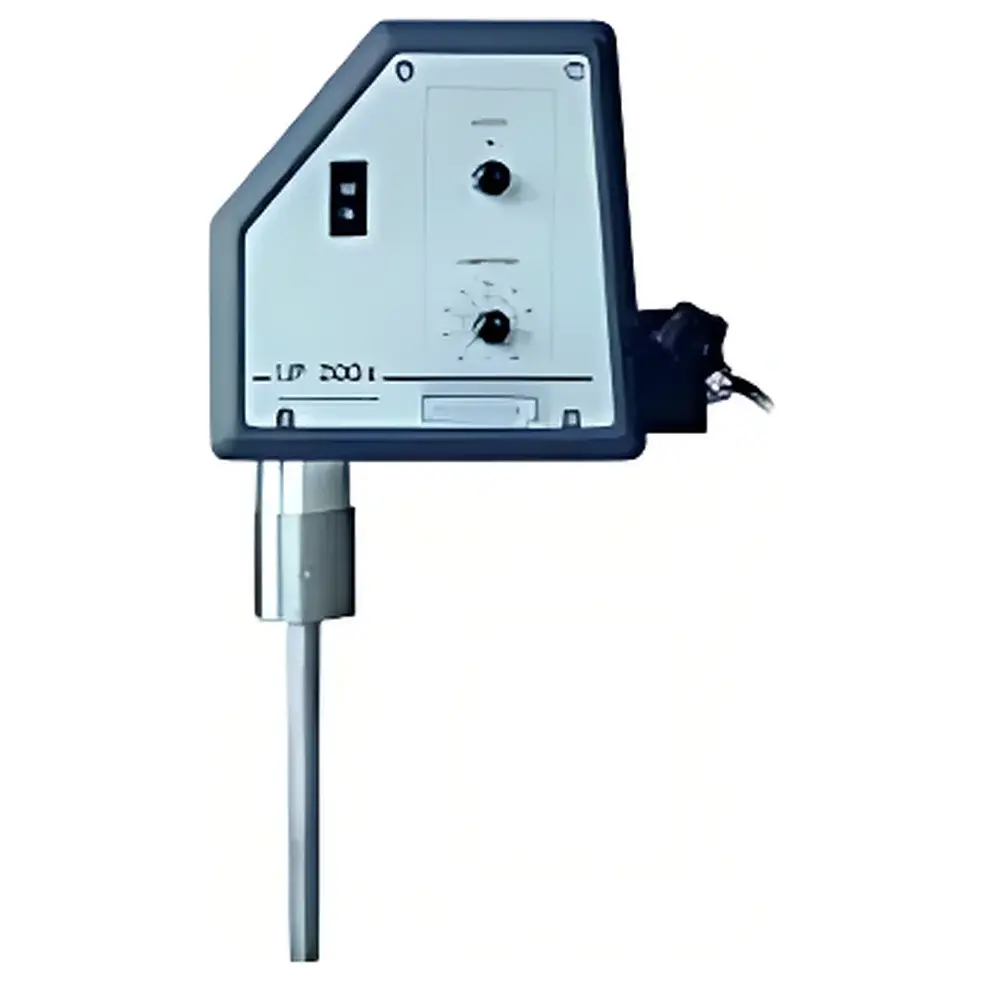
Hielscher UP400S Fixed-Mount Ultrasonic Cell Disruptor
| Brand | Hielscher |
|---|---|
| Origin | Germany |
| Model | UP400S |
| Ultrasonic Power | 400 W |
| Operating Frequency | 24 kHz |
| Amplitude Control Range | 20–100% (digitally adjustable) |
| Pulse Mode | 0–100% duty cycle |
| Sample Volume Capacity | 5–4000 mL (batch) |
| Continuous Flow Rate | Up to 50 L/h (with optional flow cell & cooling jacket) |
| Dimensions (L×W×H) | 280 × 210 × 150 mm |
| Weight | 3.2 kg |
| Input Power | 230 V, 4 A, 50–60 Hz |
| Probe Material | Grade 5 Titanium Alloy (Ti-6Al-4V) |
| Sterilization Compatibility | Autoclavable (121°C, 20 min, full probe assembly) |
Overview
The Hielscher UP400S is a fixed-mount, high-intensity ultrasonic processor engineered for reproducible, scalable cell disruption and physical sample processing in life science laboratories and pilot-scale bioprocessing environments. It operates on the principle of piezoelectrically generated high-frequency mechanical vibrations (24 kHz), transmitted via a titanium horn (sonotrode) into liquid media to induce controlled acoustic cavitation. This process generates localized extreme conditions—transient micro-hotspots (>5000 K), pressures exceeding 1000 atm, and intense shear forces—that effectively lyse microbial, yeast, plant, and mammalian cells while preserving labile biomolecules such as enzymes, plasmids, and exosomes when operated under optimized amplitude and pulse parameters. Unlike handheld or benchtop sonicators with thermal drift and inconsistent energy delivery, the UP400S features real-time frequency tracking and automatic impedance compensation to maintain resonant operation across variable load conditions—including viscosity changes, temperature shifts, or probe wear—ensuring consistent energy transfer per unit volume.
Key Features
- 400 W nominal output power with digitally regulated amplitude control (20–100%), enabling precise energy dosing without hardware recalibration
- Intelligent frequency auto-tracking system continuously monitors and adjusts operating frequency to sustain resonance at 24 kHz ± 0.5 kHz, minimizing transducer stress and maximizing conversion efficiency
- Full-titanium (Ti-6Al-4V) sonotrode assembly—chemically inert, autoclavable, and resistant to erosion from cavitation pitting—even during extended operation in aggressive solvents or high-salt buffers
- Integrated pulse mode with programmable on/off timing (0–100% duty cycle) to manage heat generation and prevent thermal denaturation of sensitive targets
- Modular design supports both batch processing (5–4000 mL) and continuous-flow operation (up to 50 L/h) using externally cooled flow cells compatible with inline temperature monitoring
- Robust industrial-grade housing (IP20 rating) with EMI-shielded electronics, designed for integration into GLP-compliant workflows and 24/7 unattended operation
Sample Compatibility & Compliance
The UP400S accommodates a broad spectrum of biological matrices—including Gram-positive and Gram-negative bacteria, fungal spores, algal cultures, tissue homogenates, and lipid-based nanocarriers—without requiring chemical lysis reagents. Its non-contact indirect sonication mode (via immersion horn or cup-horn configuration) enables processing of sealed vials or multi-well plates, eliminating cross-contamination risk. The system complies with IEC 61000-6-3 (EMC emission standards) and meets essential safety requirements under IEC 61010-1 for laboratory electrical equipment. While not inherently 21 CFR Part 11 compliant, its RS232/USB interface supports external audit-trail logging when integrated with validated LIMS or ELN platforms adhering to FDA and EMA data integrity guidelines.
Software & Data Management
The UP400S includes an embedded microcontroller with local parameter storage (up to 20 user-defined protocols), real-time display of instantaneous power, amplitude, and accumulated sonication time. Optional PC connectivity via USB or RS232 allows remote control and data export through Hielscher’s proprietary software suite (UPControl v3.x), which supports CSV-formatted log files containing timestamped amplitude, power, temperature (when paired with external PT100 sensor), and pulse profile metadata. All exported datasets retain traceability for QA/QC documentation, method validation reports, and regulatory submissions under ISO 17025 or USP .
Applications
- High-yield extraction of intracellular proteins, nucleic acids, and metabolites from recombinant E. coli and Pichia pastoris cultures
- Preparation of subcellular fractions (e.g., mitochondria, nuclei) with minimal organelle damage
- Nanoparticle synthesis and dispersion stabilization in pharmaceutical colloidal suspensions
- Enhancement of enzymatic hydrolysis kinetics in lignocellulosic biomass pretreatment
- Deagglomeration of liposomes and polymeric micelles for drug delivery formulation development
- Accelerated solvent-free extraction of phytochemicals from botanical matrices under ambient conditions
FAQ
Is the UP400S suitable for GMP manufacturing environments?
Yes—its robust mechanical architecture, autoclavable probe, and deterministic amplitude control make it appropriate for process development and small-batch production under GMP Annex 11 and ISO 13485 frameworks, provided operational protocols are qualified and maintained in a validated state.
Can the UP400S be integrated with temperature-controlled recirculation systems?
Yes—via optional flow-through cells equipped with integrated cooling jackets and PT100 ports, enabling precise thermal management during high-duty-cycle operation.
What maintenance is required for long-term reliability?
Annual verification of probe tip geometry (using optical profilometry), calibration of amplitude output against reference interferometer readings, and inspection of ultrasonic stack preload torque are recommended per Hielscher’s service protocol.
Does the system support automated start/stop triggers via external logic signals?
Yes—the rear-panel TTL-compatible I/O port accepts external start/stop commands and provides status feedback (e.g., “running”, “fault”), facilitating integration into automated liquid handling or reactor control systems.



