
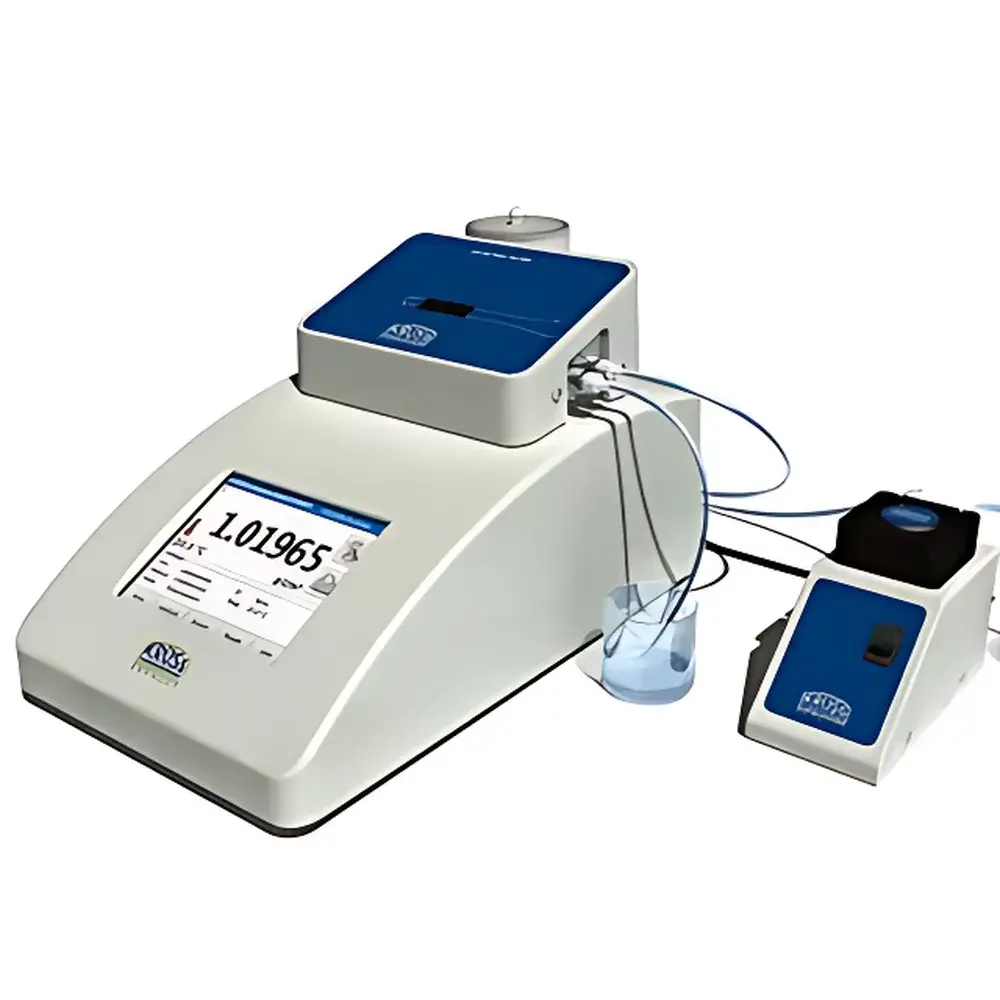
KRUESS DS7000 Series Digital Oscillating U-Tube Densimeter
| Brand | KRUESS |
|---|---|
| Origin | Germany |
| Instrument Type | Laboratory Benchtop Oscillating U-Tube Densimeter |
| Detection Mode | Liquid Density Measurement |
| Density Range | DS7900: 0.00000–1.99999 g/cm³ |
| DS7800 | 0.0000–1.9999 g/cm³ |
| Density Accuracy | DS7900: ±0.00005 g/cm³ |
| DS7800 | ±0.0001 g/cm³ |
| Repeatability | DS7900: ±0.00001 g/cm³ |
| DS7800 | ±0.0001 g/cm³ |
| Temperature Control Range | 10–40 °C |
| Temperature Stability | ±0.02 °C |
| Sample Volume | 2 mL |
| Measurement Time | 30–60 s |
| Calibration Standards | Dry air and distilled water |
| Calibration Points | 4–10, 3rd-order polynomial fit |
| Data Storage Capacity | 999 results |
| User-Defined Methods | 99 |
| Compliance | ASTM D4052, ASTM D5002, NIST-traceable, GLP/GMP-ready, FDA 21 CFR Part 11 compatible (audit trail enabled) |
Overview
The KRUESS DS7000 Series is a high-precision laboratory benchtop densimeter engineered for traceable, repeatable liquid density measurement in regulated and research-intensive environments. It operates on the oscillating U-tube principle—a well-established physical method grounded in the relationship between the resonant frequency of a filled capillary tube and the density of the sample. When a precisely machined U-shaped glass tube is excited to oscillate at its natural frequency, the period of oscillation varies inversely with the square root of the sample’s density. This fundamental physical correlation enables absolute density determination without reliance on reference standards for each measurement—only periodic calibration using dry air and distilled water is required. The DS7000 Series integrates a thermally stabilized semiconductor temperature control system (±0.02 °C stability), ensuring density values are reported at rigorously controlled, user-selectable temperatures within the 10–40 °C range. Designed for compliance-critical workflows, it delivers NIST-traceable measurements and supports full auditability under GLP and GMP frameworks.
Key Features
- High-stability U-tube oscillation sensor with borosilicate glass capillary, optimized for minimal thermal drift and mechanical hysteresis
- Integrated drying unit and peristaltic pump for automated, bubble-free sample introduction and purge cycles
- Active semiconductor-based Peltier temperature regulation with real-time feedback control and digital setpoint resolution of 0.01 °C
- 5.7-inch VGA LCD touchscreen (320 × 240 pixels) with intuitive interface supporting six languages (English, German, French, Spanish, Italian, Chinese)
- 32-bit embedded processor enabling concurrent operation of measurement, data logging, temperature control, and network communication
- Triple-tier password protection system (operator, supervisor, administrator) with configurable access rights for method editing, calibration, and data export
- Ethernet (RJ-45), USB 2.0, and RS-232 interfaces for seamless integration into LIMS, SCADA, or centralized lab networks
- Embedded SQL database storing up to 999 measurement records with timestamp, temperature, operator ID, method name, and raw oscillation period data
- 99 programmable measurement methods—including customizable units (g/cm³, kg/m³, °Brix, % w/w, API gravity, specific gravity), auto-zero routines, and multi-point calibration profiles
Sample Compatibility & Compliance
The DS7000 Series accommodates a broad spectrum of low-to-medium viscosity liquids—including aqueous solutions, organic solvents, acids, bases, alcohols, hydrocarbons, and suspensions—provided they are chemically compatible with borosilicate glass and fluoropolymer wetted components. Samples requiring degassing (e.g., carbonated beverages, volatile solvents) benefit from the integrated drying-air purge cycle, which eliminates microbubble interference prior to filling. The instrument complies with ASTM D4052 (Standard Test Method for Density, Relative Density, and API Gravity of Liquids by Digital Density Meter) and ASTM D5002 (Standard Test Method for Density and Relative Density of Crude Oils by Digital Density Analyzer), making it suitable for petroleum, biofuel, and refinery QC labs. Its architecture supports 21 CFR Part 11 requirements through electronic signatures, immutable audit trails, and role-based data integrity controls—fully aligned with pharmaceutical, food, and chemical manufacturing under ISO/IEC 17025 and ICH Q7 guidelines.
Software & Data Management
Data acquisition, storage, and reporting are managed via an embedded real-time operating system with native SQL support. Each measurement record includes raw oscillation period (µs), calculated density (g/cm³), temperature (°C), method ID, operator code, and calibration status flags. Export options include CSV via USB drive, direct Ethernet transfer to FTP or SMB servers, and serial printing via RS-232 to dot-matrix or label printers. Firmware updates and method backups are performed securely over USB or Ethernet. Optional PC software (KRUESS DensControl Suite) provides advanced statistical analysis, trend charting, SPC chart generation, and automated report templates compliant with ISO 10012 and EURACHEM/CITAC guidelines. All data modifications are logged with timestamps, user IDs, and pre-/post-change values—enabling full forensic traceability during regulatory inspections.
Applications
- Chemical manufacturing: concentration monitoring of HCl, NaOH, H₂SO₄, and other process streams
- Pharmaceutical QC: excipient solution density verification, syrup formulation control, and alcohol content validation in tinctures
- Fermentation & brewing: real-time tracking of wort gravity, ethanol yield, and final beer density
- Fruit juice & soft drink production: Brix/density correlation for sugar content certification and blend consistency
- Petroleum refining: API gravity determination for crude assay, distillate fraction verification, and blending stock qualification
- Electrolyte formulation: battery-grade LiPF₆ solution density profiling and water content estimation
- Wastewater treatment: salinity and TDS estimation via density–conductivity cross-validation
- Pulp & paper: coating slurry solids content quantification and retention aid dosing optimization
FAQ
What calibration standards are required for daily operation?
Dry air and double-distilled water are the only two required calibration points. Multi-point calibration (4–10 points) is optional and implemented via third-order polynomial fitting.
Can the DS7000 be integrated into a LIMS environment?
Yes—via Ethernet or RS-232, using ASTM E1384-compliant message framing or custom ASCII protocols. Full LIMS synchronization includes sample ID forwarding, result auto-posting, and status flag exchange.
Is temperature control active during measurement or only during equilibration?
Temperature regulation is continuous and dynamic throughout the entire measurement cycle, including oscillation, data capture, and post-processing.
How does the instrument handle viscous or particulate-laden samples?
Viscosity up to 10,000 mPa·s is supported with extended damping compensation; particulates <5 µm are tolerated if suspended—larger particles require filtration prior to injection.
Does the DS7000 support 21 CFR Part 11 compliance out of the box?
Yes—when audit trail, electronic signature, and user access controls are enabled, the system meets baseline technical requirements for Part 11 adherence, pending site-specific procedural validation.



