
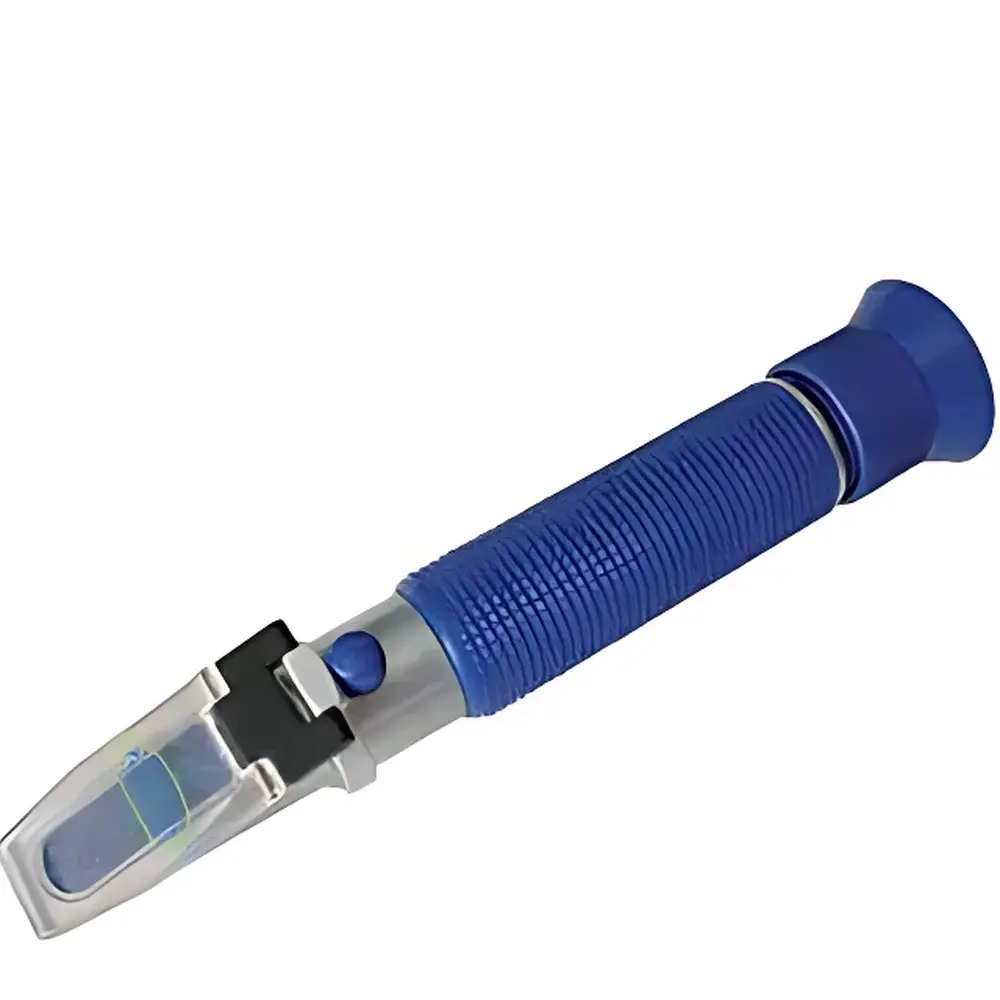
KRUSS HR-Serie Manual Portable Refractometer
| Brand | KRUSS |
|---|---|
| Origin | Germany |
| Product Type | Handheld Refractometer |
| Model Series | HR-Serie |
| Measurement Principles | Critical Angle of Total Internal Reflection |
| Calibration | Distilled Water or Certified Calibration Plate |
| Temperature Compensation | Manual or Automatic (model-dependent) |
| Optical System | Abbe-type Prism Assembly with High-Grade Optical Glass |
| Compliance | Designed per ISO 21748 (Refractometry — Guidance for the Determination of Repeatability and Reproducibility) and ASTM D1218 (Standard Test Method for Refractive Index of Hydrocarbon Liquids) |
Overview
The KRUSS HR-Serie Manual Portable Refractometer is a precision optical instrument engineered for rapid, field-deployable measurement of refractive index (nD) and derived concentration units—including Brix (%w/w sucrose), Oechsle (°Oe), Baume (°Bé), salinity (‰ or %), alcohol content (%v/v), urine specific gravity (UG), plasma protein (g/dl), water content in honey (%H2O), and battery acid density (g/cm³). Based on the physical principle of total internal reflection at the prism-sample interface, the HR-Serie determines refractive index by locating the critical angle boundary between light transmission and cutoff—converted directly into calibrated scale readings via high-stability optical geometry. Each model features an Abbe-type prism assembly fabricated from optically homogenous, scratch-resistant BK7 or SF2 glass, ensuring long-term dimensional stability and minimal thermal drift. The instruments require no external power for basic operation; all readings are visual, eliminating dependency on batteries or electronics—making them ideal for GLP-compliant routine QC in environments where portability, robustness, and traceable calibration are essential.
Key Features
- Manual, eye-based reading system with high-contrast etched scales and adjustable eyepiece diopter for operator-specific focus
- Optically optimized prisms with anti-reflective coatings to maximize light throughput and minimize parallax error
- Model-specific dual- or triple-scale dials (e.g., Brix/Oechsle/Alcohol; nD/Salinity/UG) enabling cross-unit interpretation without recalculations
- Automatic temperature compensation (ATC) available on select models (e.g., HRT32, HROT32, HRMT18) using bimetallic thermal expansion elements integrated into the prism housing—validating measurements across 10–30 °C without external thermostats
- Interchangeable prism covers and sample plates compatible with viscous, opaque, or particulate-laden samples via indirect illumination mode (HR900/HR901 series)
- IP54-rated housing with rubberized grip and shock-absorbing end caps for industrial durability and drop resistance
- Calibration traceable to NIST-traceable reference standards; includes certificate of conformity per DIN EN ISO/IEC 17025 requirements
Sample Compatibility & Compliance
The HR-Serie accommodates aqueous solutions, syrups, oils, coolants, glycol-based antifreezes, battery electrolytes, honey, urine, plasma, and saline process streams. Sample volume requirement is ≤0.1 mL; surface tension and viscosity up to 500 mPa·s do not impair meniscus formation on the prism. All models comply with ISO 21748 for uncertainty estimation in refractometric analysis and support audit-ready documentation under FDA 21 CFR Part 11 when used in conjunction with controlled laboratory procedures (e.g., defined calibration frequency, logbook entries, and operator training records). For pharmaceutical applications, HRM18 and HRMT18 meet USP specifications for refractometric determination of urine specific gravity and serum protein concentration. In food and beverage QA, HRKL32 and HRO32 align with AOAC Official Methods 932.12 and 978.02 for Brix and alcohol quantification.
Software & Data Management
While the HR-Serie operates as a fully manual optical instrument, digital integration is supported through optional accessories: the KRUSS Digital Eyepiece Adapter (DEA-HR) enables image capture of the scale for archiving, and paired software (RefractoLink v3.1) provides automated scale recognition, statistical trending (mean, SD, CV%), and export to CSV/PDF formats compliant with LIMS workflows. All calibration events, user IDs, ambient temperature logs, and measurement timestamps are stored locally on the adapter’s secure micro-SD card—meeting ALCOA+ data integrity principles (Attributable, Legible, Contemporaneous, Original, Accurate, Complete, Consistent, Enduring, Available). No firmware updates or cloud connectivity are required for core functionality, preserving operational continuity in regulated settings.
Applications
- Food & Beverage: Real-time Brix verification in juice blending, soft drink formulation, jam production, and wine must analysis
- Pharmaceuticals: Urine specific gravity screening (HRM18), plasma protein estimation, and excipient concentration checks in syrup manufacturing
- Chemical & Lubricants: Glycol concentration in heat transfer fluids, water content in cutting oils, and acid strength in pickling baths
- Agriculture & Viticulture: Must sugar grading (°Oe), honey moisture control (HRH30), and silage fermentation monitoring
- Automotive & Industrial Maintenance: Battery electrolyte density (HRKFZ1), coolant freeze point (HR27-100), and hydraulic fluid contamination assessment
- Wastewater Treatment: Salinity profiling in brine streams and desalination pre-treatment validation (HRS16, HR146)
FAQ
How often should I calibrate the HR-Serie refractometer?
Calibration is recommended before each measurement session using distilled water (nD = 1.3330 at 20 °C) or a certified standard solution. For GMP environments, documented calibration every 4 hours or per batch is advised.
Can the HR-Serie measure opaque or turbid samples?
Yes—models HR900 and HR901 support indirect illumination via external LED source and adjustable prism aperture, enabling reliable readings for cloudy juices, emulsions, and suspensions.
Is ATC (Automatic Temperature Compensation) available on all models?
No—ATC is built into HRTxx, HRMTxx, and HROTxx variants only. Non-ATC models require manual correction using published temperature coefficient tables (e.g., +0.00045/°C for sucrose solutions).
What is the typical lifetime of the prism surface?
With proper cleaning (lint-free cloth + lens-grade ethanol), the BK7 prism maintains optical integrity for >10,000 measurements. SF2 prisms (used in high-precision nD models) exhibit equivalent longevity under identical handling protocols.
Does KRUSS provide metrological certification for HR-Serie units?
Yes—each instrument ships with a factory calibration certificate referencing DKD/DAkkS-accredited standards. Optional UKAS-endorsed calibration (ISO/IEC 17025) is available upon request.





