
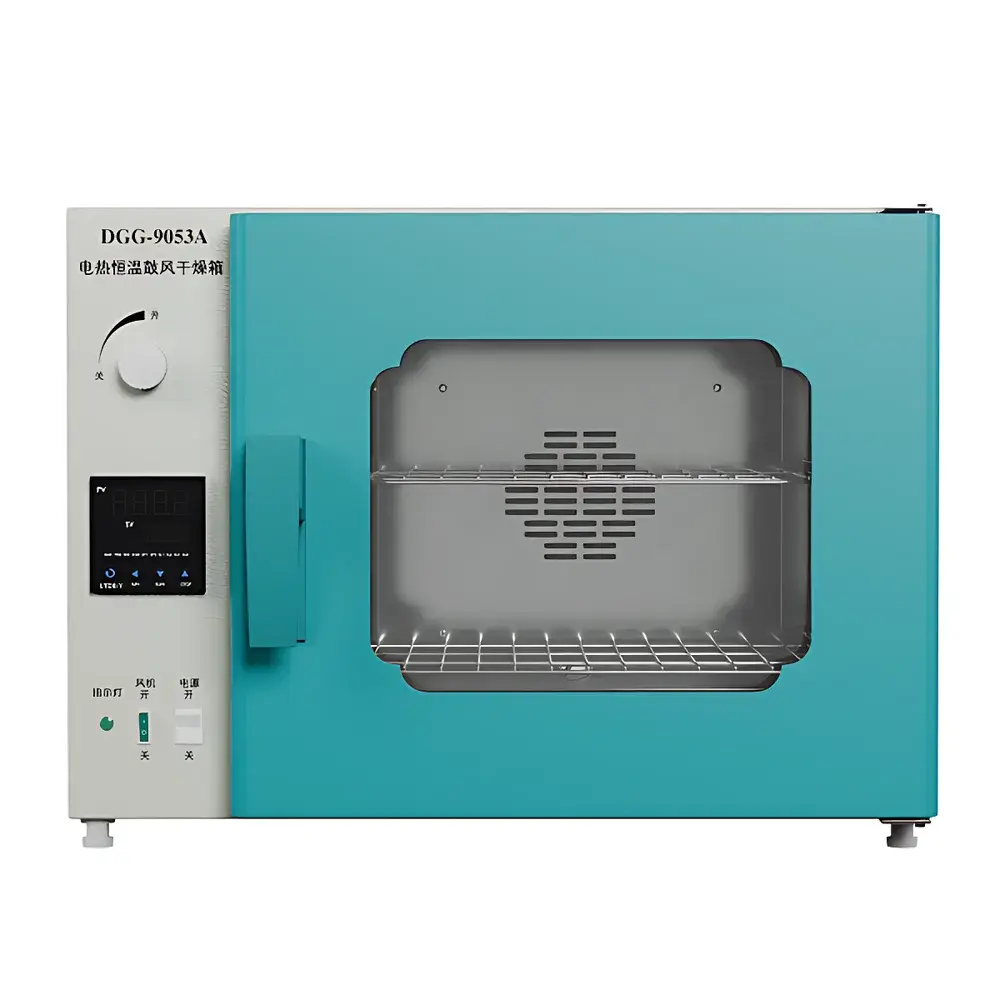
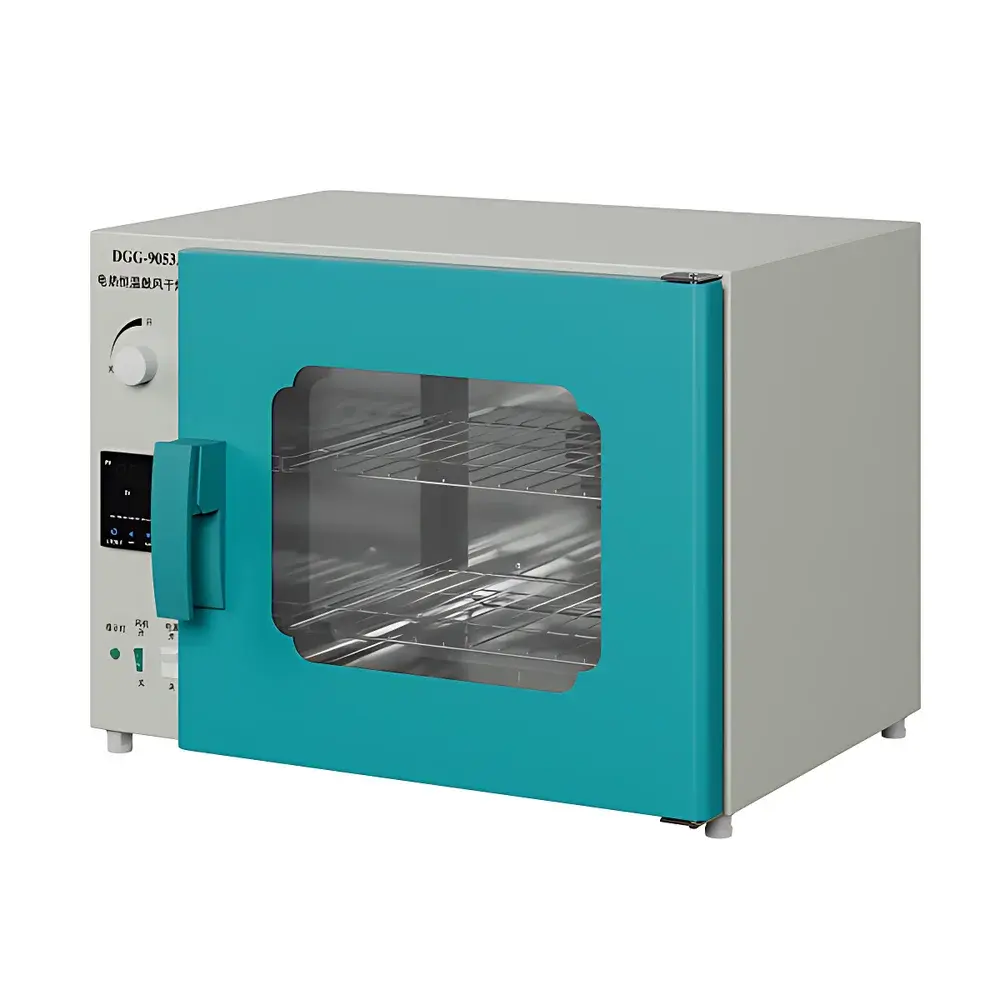
Zhuochi 3DHG Desktop Forced-Air Annealing & Drying Oven for 3D Printed Parts
| Brand | Zhuochi |
|---|---|
| Origin | Zhejiang, China |
| Model | 3DHG |
| Temperature Range | RT +10°C to 250°C |
| Temperature Uniformity | ±2°C |
| Temperature Fluctuation | ±0.5°C |
| Temperature Resolution | 0.1°C (display), ±0.5°C (control accuracy) |
| Chamber Dimensions (W×D×H) | 300 × 300 × 270 mm |
| External Dimensions (W×D×H) | 510 × 500 × 440 mm |
| Inner Chamber Material | Mirror-finish 304 stainless steel |
| Heating Element | Stainless steel sheathed heater |
| Air Circulation | Adjustable rear inlet + top/bottom outlet, horizontal forced convection via long-shaft fan with aluminum alloy impeller |
| Power Supply | 220 V AC, 50 Hz |
| Rated Power | 500 W |
| Net Weight | 29 kg |
| Compliance | Designed per IEC 61010-1 safety standards for laboratory equipment |
Overview
The Zhuochi 3DHG Desktop Forced-Air Annealing & Drying Oven is a purpose-engineered thermal processing system optimized for post-processing of additive-manufactured polymer components—including ABS, PLA, PETG, PC, and nylon-based prints. Unlike general-purpose drying ovens, the 3DHG integrates precision temperature control, uniform convective airflow, and geometrically optimized chamber architecture to support two critical thermal treatments: stress-relief annealing (to enhance dimensional stability and mechanical integrity) and moisture removal (for hygroscopic resins or filament-dried preforms). Its operation relies on a PT100 platinum resistance thermometer coupled with a PID-controlled microprocessor algorithm, ensuring stable setpoint maintenance within ±0.5°C fluctuation across the full 10–250°C range. The oven’s forced-air circulation—driven by a low-noise, long-life axial fan and calibrated air inlets/outlets—establishes laminar horizontal flow patterns that minimize thermal gradients, achieving ±2°C uniformity throughout the 300 × 300 × 270 mm working chamber.
Key Features
- Mirror-polished 304 stainless steel interior with seamless, radius-rounded corners—resistant to corrosion, easy to clean, and compliant with ISO 14644-1 Class 8 cleanroom-compatible surface requirements.
- Double-layer tempered glass observation window with high-temperature silicone gasket seal—enables real-time visual monitoring without compromising thermal integrity or operator safety.
- Modular microprocessor controller with dual-display interface: simultaneous readout of set temperature, actual chamber temperature, and remaining time; supports programmable ramp-soak profiles up to 9999 minutes.
- Comprehensive safety architecture: independent overtemperature cutoff (mechanical backup), heater failure detection, fan current monitoring, and automatic power cutoff upon sensor disconnection or deviation >5°C from setpoint.
- Energy-efficient insulation: high-density fiberglass fill in all six cavity walls—reducing standby heat loss and improving thermal recovery time after door opening.
- Adjustable ventilation system: rear-mounted intake port and top-mounted exhaust vent, each fitted with rotary dampers for fine-tuned atmospheric exchange during solvent-laden or outgassing processes.
Sample Compatibility & Compliance
The 3DHG accommodates standard 3D-printed build plates (up to 280 × 280 mm), SLA resin supports, SLS nylon parts, and FDM thermoplastic assemblies requiring controlled thermal relaxation. It is compatible with ASTM D618 (conditioning of plastics), ISO 291 (standard atmospheres for conditioning), and USP (plastic packaging systems)—particularly where thermal history affects crystallinity, residual stress, or moisture content. While not certified for GMP manufacturing environments, its design supports GLP-aligned documentation: all temperature logs (via optional RS485/Modbus output) include timestamped data with audit trail capability when integrated with validated third-party data acquisition software. The unit conforms to IEC 61010-1:2010 for electrical safety in laboratory equipment and meets CE marking requirements for EMC (EN 61326-1) and low-voltage directive (2014/35/EU).
Software & Data Management
The built-in controller does not require external software for basic operation but supports optional serial communication (RS485) for integration into centralized lab management platforms. When paired with compliant SCADA or LIMS systems, the oven transmits real-time temperature, elapsed time, and alarm status codes—enabling automated batch record generation. All internal event logs—including door-open intervals, temperature excursions, and fault resets—are stored in non-volatile memory for ≥10,000 cycles. For regulatory traceability, users may enable password-protected parameter locking (with three-tier access levels) and configure calibration offset compensation directly via front-panel interface—eliminating need for hardware recalibration between routine verifications.
Applications
- Dimensional stabilization of FDM-printed jigs, fixtures, and functional prototypes through controlled annealing below material Tg.
- Moisture desorption from hygroscopic polymers prior to mechanical testing or secondary bonding operations.
- Post-curing of UV-sensitive SLA resins where thermal energy augments photopolymer crosslink density.
- Pre-baking of printed circuit board (PCB) substrates and solder paste stencils in rapid prototyping labs.
- Controlled drying of powder-bed residues after SLS part depowdering—reducing ambient humidity interference in subsequent metrology.
FAQ
Is the 3DHG suitable for annealing carbon-fiber reinforced nylon (e.g., PA12-CF)?
Yes—its 250°C maximum temperature and ±2°C uniformity meet recommended annealing conditions (150–180°C, 60–120 min) for semi-crystalline composites, provided parts are supported on low-conductivity ceramic stands to prevent localized warping.
Can the oven be validated for IQ/OQ protocols?
Yes—the PT100 sensor location, accessible calibration port, and stable thermal performance allow execution of installation and operational qualification per ASTM E2500 and ISO/IEC 17025 guidelines using third-party thermocouple mapping probes.
Does it support nitrogen purging?
No built-in gas inlet—but the rear ventilation port can be adapted with a custom flange for inert gas introduction, subject to user-modified pressure regulation and O₂ monitoring.
What maintenance is required for long-term accuracy?
Annual verification of PT100 sensor drift against NIST-traceable reference thermometer; biannual inspection of door gasket compression and fan bearing noise; no lubrication required for brushless motor assembly.
Is remote monitoring possible without additional hardware?
Not natively—the base model lacks Ethernet/Wi-Fi; however, RS485 Modbus RTU output enables connection to industrial gateways or Raspberry Pi-based telemetry nodes running open-source logging firmware.
Related Products



