
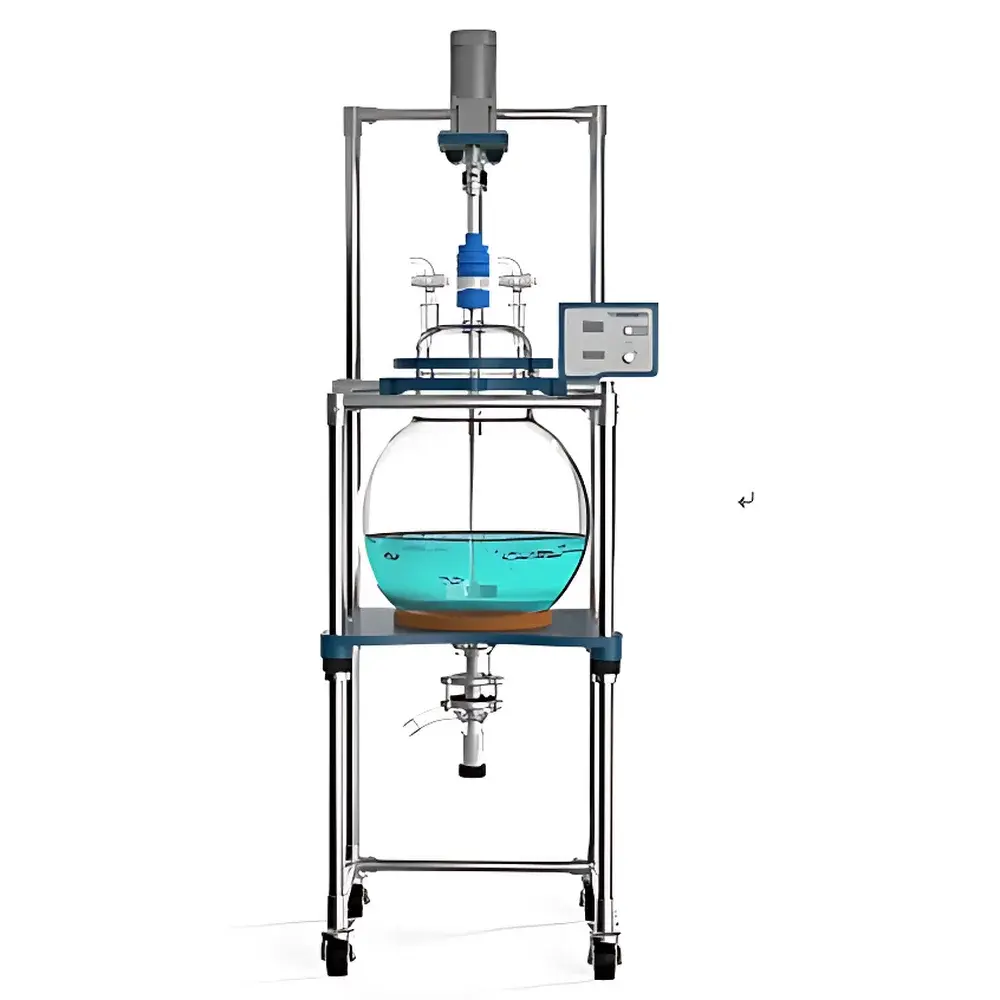
The Great Wall GFY-20L Glass Separatory Funnel
| Brand | The Great Wall |
|---|---|
| Model | GFY-20L |
| Capacity | 20 L |
| Material | Borosilicate Glass 3.3 (DURAN®-grade) |
| Frame | SUS304 Stainless Steel |
| Operating Pressure Range | −0.1 to 0.0 MPa (Vacuum to Atmospheric) |
| Temperature Range | −80 °C to +200 °C |
| Max ΔT Between Interior and Exterior | ≤80 °C |
| Stirring Motor Power | 90 W |
| Speed Control | Frequency Inverter |
| Speed Range | 50–500 rpm |
| Stirring Port | 50# Flange |
| Liquid Feed Port | 34/35 Standard Taper Joint |
| Vent Port | 34/35 Standard Taper Joint |
| Power Supply | 220–240 V~, 50 Hz |
| Drain Valve Mounting Height | 460 mm |
| Overall Dimensions (W×D×H) | 650 × 650 × 1720 mm |
| Vacuum Rating | −0.1 MPa (absolute) |
Overview
The Great Wall GFY-20L Glass Separatory Funnel is a precision-engineered, vacuum-rated laboratory separation and reaction apparatus designed for controlled liquid–liquid extraction, phase separation, solvent recovery, and small-scale batch synthesis under inert or reduced-pressure conditions. Unlike conventional stopcock-based separatory funnels, the GFY-20L integrates a fully sealed, jacketed glass vessel with a motor-driven overhead stirrer, dual standard-taper feed ports, and a bottom-mounted drain valve—enabling reproducible, operator-safe handling of volatile, air-sensitive, or thermally labile systems. Its core architecture follows the Couette–Taylor flow principle during agitation, ensuring uniform mixing while minimizing emulsification and facilitating rapid phase demarcation post-stirring. The unit operates within a validated pressure envelope of −0.1 MPa (i.e., ~10 mbar absolute) to ambient, making it suitable for applications requiring solvent evaporation control, low-boiling-point extractions (e.g., diethyl ether, dichloromethane), or oxygen-sensitive Grignard or organolithium chemistry.
Key Features
- High-purity borosilicate glass 3.3 (equivalent to DURAN® or Pyrex®) construction ensures exceptional thermal shock resistance (ΔT ≤ 80 °C), chemical inertness toward strong acids, bases, and halogenated solvents, and UV transparency for in-situ visual monitoring.
- SUS304 stainless steel support frame provides structural rigidity, corrosion resistance, and grounding compatibility for static-sensitive operations.
- Frequency-inverter-controlled stirring system delivers precise, stepless speed regulation from 50 to 500 rpm, supporting both gentle phase settling and vigorous homogeneous mixing without vortex formation or splashing.
- Dual 34/35 standard taper joints allow modular integration with condensers, drying tubes, gas inlets (e.g., N₂ or Ar), or syringe adapters—fully compliant with ISO 385 and DIN 12905 standards for ground-glass interfaces.
- Bottom-mounted PTFE-coated stainless steel drain valve enables full, residue-free discharge without tipping; valve height (460 mm above base) accommodates standard laboratory carboys and waste containers.
- Vacuum-rated sealing system (tested to −0.1 MPa) includes reinforced silicone O-rings and torque-calibrated clamps, meeting ASTM E2877-22 requirements for leak integrity in Class II vacuum applications.
Sample Compatibility & Compliance
The GFY-20L is compatible with aqueous, organic, and biphasic systems—including but not limited to water/ethyl acetate, hexane/methanol, and chloroform/sodium bicarbonate solutions. It is routinely deployed in QC laboratories performing USP residual solvent analysis sample prep, ISO 17025-accredited environmental labs conducting EPA Method 3510C liquid–liquid extractions, and synthetic chemistry groups adhering to GLP principles. All glass components conform to ISO 3585 (borosilicate glass 3.3 specifications), while electrical components comply with IEC 61010-1:2010 for laboratory equipment safety. The apparatus supports audit-ready operation when paired with calibrated pressure transducers and temperature loggers traceable to NIST standards.
Software & Data Management
While the GFY-20L is a manually operated, non-digital instrument, its mechanical design supports seamless integration into digitally monitored workflows. Optional accessories include a digital vacuum gauge (0–1000 mbar, ±0.5% FS), PT100 immersion probe (−80 to +200 °C, ±0.3 °C), and frequency inverter with RS-485 Modbus RTU output—enabling connection to SCADA or LIMS platforms for electronic batch record generation. When used in regulated environments (e.g., pharmaceutical development per FDA 21 CFR Part 11), the unit’s operational parameters (stir speed, vacuum level, duration) can be recorded manually in bound logbooks or via validated electronic forms, satisfying ALCOA+ data integrity criteria for attributable, legible, contemporaneous, original, accurate, complete, consistent, enduring, and available records.
Applications
- Quantitative liquid–liquid extraction of APIs and impurities prior to HPLC analysis
- Work-up of Suzuki, Heck, and Stille cross-coupling reactions under nitrogen blanket
- Isolation of natural products from plant extracts using pH-dependent partitioning
- Removal of catalyst residues (e.g., Pd/C, NiCl₂) via aqueous wash steps
- Preparative-scale fractional crystallization with controlled solvent evaporation
- Teaching laboratories demonstrating phase equilibria, distribution coefficients (log P), and mass transfer kinetics
FAQ
Can the GFY-20L be used for exothermic reactions?
Yes—its borosilicate glass body and optional external cooling jacket (not included) enable safe operation with moderate exotherms, provided internal temperature remains within −80 to +200 °C and ΔT across the wall does not exceed 80 °C.
Is the drain valve autoclavable?
No—the PTFE-coated valve assembly is not rated for steam sterilization; cleaning is performed via solvent rinse and oven drying at ≤120 °C.
What vacuum pumps are recommended for achieving −0.1 MPa?
A two-stage oil-sealed rotary vane pump (e.g., Edwards RV8) or a dry scroll pump (e.g., Agilent IDP-10) with ultimate vacuum ≤0.1 mbar is required; use of a cold trap is advised when condensable vapors are present.
Does the unit include pressure relief protection?
No—users must install an external rupture disk or pressure-relief valve on the vent line if operating above atmospheric pressure (e.g., during pressurized gas addition); the design is strictly for vacuum-to-atmospheric service.
Are replacement glass parts available as spare components?
Yes—The Great Wall supplies certified borosilicate 3.3 spares including the main vessel, lid, feed tubes, and stirrer shafts, each laser-etched with batch traceability and supplied with material certification per EN 10204 3.1.



