
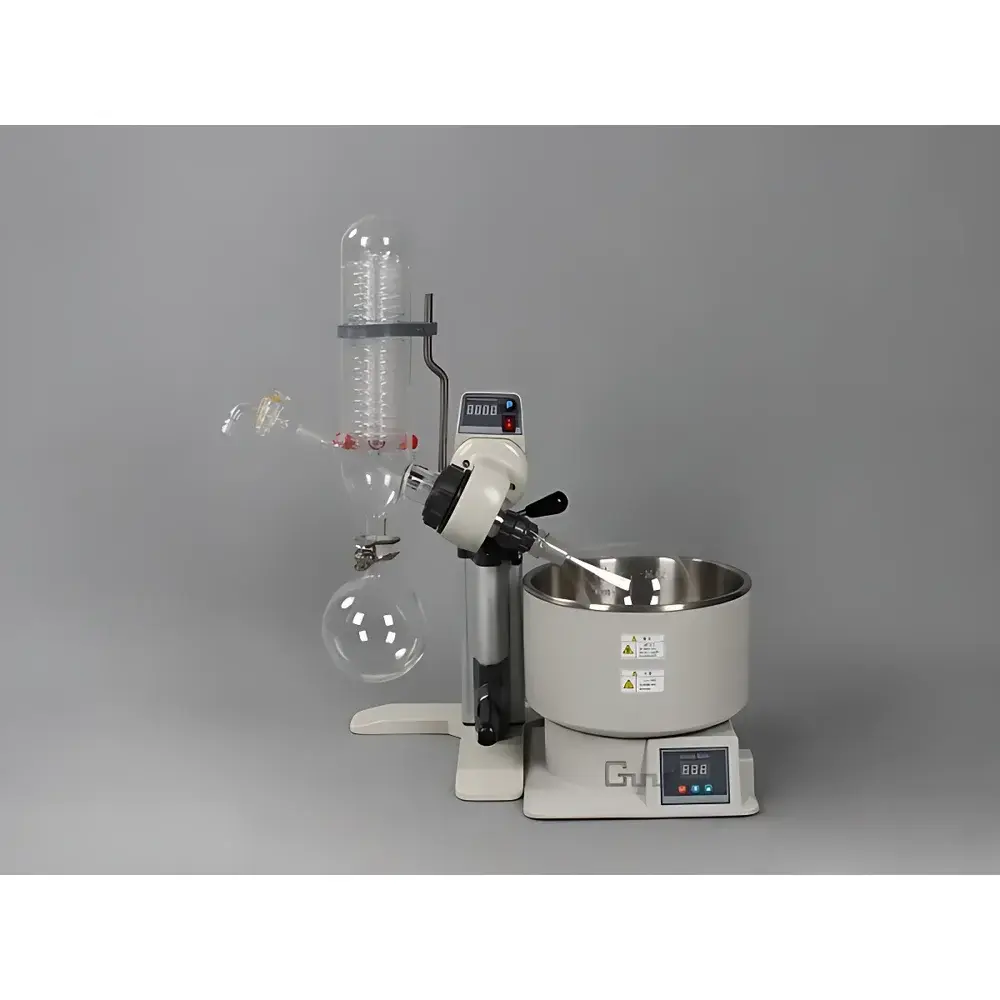
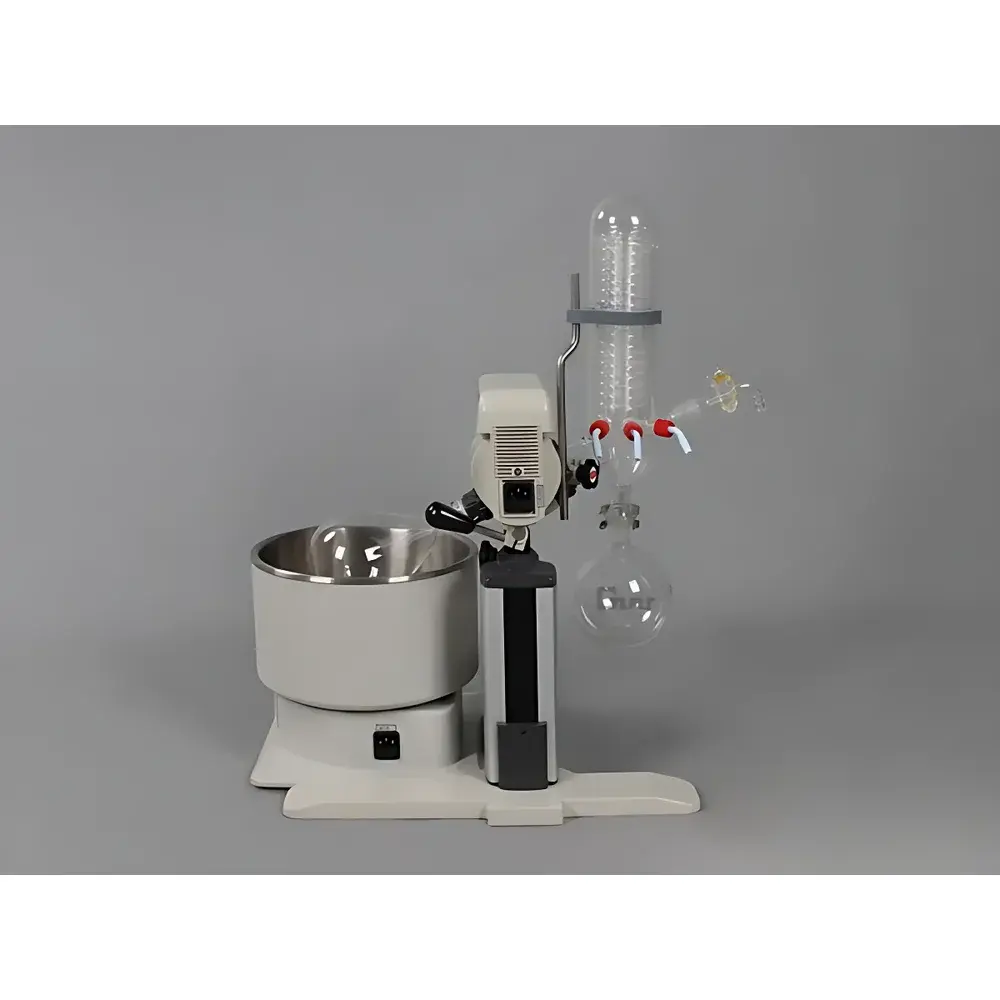
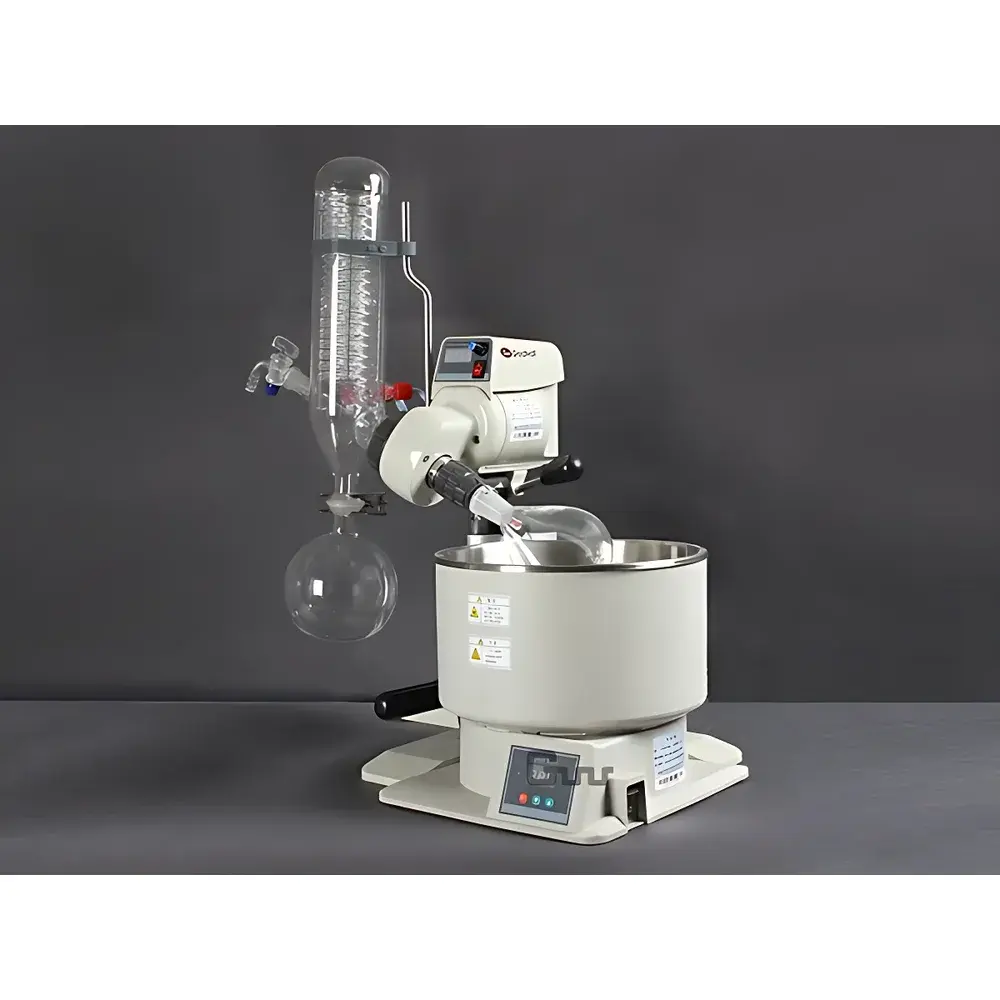
Great Wall R-1001 Rotary Evaporator
| Brand | Great Wall |
|---|---|
| Origin | Henan, China |
| Manufacturer Type | OEM/ODM Producer |
| Origin Category | Domestic (China) |
| Capacity | 2 L |
| Ultimate Vacuum | ≤0.33 kPa/min |
| Rotational Speed Range | 10–280 rpm |
| Temperature Control Range | Ambient +5°C to 95°C |
| Temperature Control Accuracy | ±1°C |
| Condenser Cooling Area | 0.126 m² |
| Motor Power | 25 W |
| Heating Power | 1050 W |
| Evaporation Rate (Water) | 15 mL/min |
| Evaporation Rate (Ethanol) | 20 mL/min |
| Lift Stroke | 100 + 150 mm |
| Bath Dimensions × Volume | 250 × 130 mm × 6.5 L |
| Overall Dimensions (W×D×H) | ~560 × 320 × 660 mm |
| Net Weight | 9.5 kg |
| Power Supply | 110 V~, 60 Hz or 220–240 V~, 50/60 Hz |
| Sealing System | Dual-seal with PTFE + FKM (fluoroelastomer) |
| Safety Features | Overcurrent protection, Ground fault detection, Overtemperature cutoff |
| Condenser Options | Vertical or inclined |
| rotating flask options | 500 mL or 1000 mL |
| receiving flask | 1000 mL |
Overview
The Great Wall R-1001 Rotary Evaporator is an entry-level, benchtop solvent removal system engineered for reliable performance in academic teaching laboratories, QC/QA environments, and small-scale R&D workflows. It operates on the fundamental principle of rotary evaporation—reducing the boiling point of solvents through controlled vacuum application while simultaneously rotating the sample to increase surface area and promote uniform heat transfer. The unit integrates a digitally regulated heating bath, precision-adjustable rotation drive, and a high-efficiency vertical or inclined condenser with a dual-material sealing interface (PTFE and FKM), ensuring long-term vacuum integrity under repeated thermal cycling. Designed for compatibility with standard laboratory vacuum sources—including water aspirators and diaphragm or scroll-type vacuum pumps—the R-1001 delivers consistent evaporation rates: up to 15 mL/min for water and 20 mL/min for ethanol under optimized conditions (e.g., 40°C bath, 200 rpm, ≤0.33 kPa vacuum). Its modular architecture supports integration into larger purification systems when paired with external chillers, vacuum controllers, or inert gas manifolds.
Key Features
- Robust mechanical design with manual lift mechanism based on counterbalanced sliding rail + auxiliary hand-crank adjustment—enabling precise positioning across 250 mm total stroke (100 mm motorized + 150 mm manual fine-tune)
- Dual-seal vacuum interface using PTFE stator rings and FKM (Viton®-grade) rotor gaskets, rated for continuous operation at temperatures up to 95°C and pressures down to ≤0.33 kPa/min leak rate
- Microprocessor-controlled digital temperature display with ±1°C accuracy across ambient +5°C to 95°C range; setpoint entered via membrane keypad with real-time feedback
- Stepless rotational speed control from 10 to 280 rpm, displayed digitally; low-inertia DC motor (25 W) ensures stable torque delivery even with viscous or foaming samples
- Heating bath (6.5 L capacity, 250 × 130 mm footprint) features stainless steel construction, overtemperature cut-off, and 1050 W immersion heater for rapid thermal response
- Comprehensive safety suite including ground-fault circuit interruption (GFCI), overcurrent protection, and automatic thermal shutdown at >105°C
Sample Compatibility & Compliance
The R-1001 accommodates standard jointed glassware (ISO 297, 24/29 taper) and supports interchangeable rotating flasks (500 mL or 1000 mL) and a 1000 mL receiving flask. Its vacuum-tight design meets basic requirements for handling common organic solvents (e.g., acetone, dichloromethane, ethyl acetate, methanol), aqueous solutions, and moderately volatile compounds. While not certified for hazardous area use (ATEX/IECEx), the unit complies with general electrical safety standards applicable to Class I, Division 2 laboratory equipment (IEC 61010-1). Its materials of construction—304 stainless steel bath, borosilicate 3.3 glass components, PTFE/FKM seals—are compatible with GLP documentation practices and support audit-ready operation when used with calibrated thermometers and verified vacuum gauges.
Software & Data Management
The R-1001 operates as a standalone analog-digital hybrid instrument with no embedded firmware or network connectivity. All operational parameters—bath temperature, rotation speed, and vacuum status—are monitored locally via LED displays and tactile controls. For traceability in regulated environments, users may log settings manually or integrate external data acquisition systems via analog output signals (0–5 V or 4–20 mA optional upon request). While not 21 CFR Part 11 compliant out-of-the-box, the device supports ALCOA+ principles when operated within documented SOPs and maintained with calibration records aligned with ISO/IEC 17025 guidelines.
Applications
- Solvent recovery and concentration of natural product extracts (e.g., plant alkaloids, essential oils)
- Removal of low-boiling solvents following column chromatography or solid-phase extraction
- Pre-concentration of environmental water samples prior to GC-MS analysis
- Distillation of heat-sensitive compounds where reduced pressure prevents thermal degradation
- Teaching demonstrations of phase equilibria, vapor pressure depression, and mass transfer kinetics
FAQ
What vacuum pump is recommended for optimal performance with the R-1001?
A two-stage diaphragm vacuum pump capable of reaching ≤0.1 kPa absolute pressure—such as those meeting ASTM D2879 specifications—is recommended for reproducible results. Water aspirators may be used for preliminary trials but lack the stability required for quantitative work.
Can the R-1001 be used under inert atmosphere (e.g., nitrogen or argon)?
Yes—by connecting a regulated inert gas line to the vacuum inlet port via a needle valve, users can maintain positive pressure or perform gentle purging during evaporation to prevent oxidation of air-sensitive compounds.
Is the heating bath fluid-compatible with silicone oil or ethylene glycol mixtures?
The stainless steel bath is chemically resistant to silicone oils and aqueous glycol solutions; however, viscosity and flash point must be evaluated per local safety protocols before substitution of water.
Does the R-1001 include a vacuum controller or pressure sensor?
No—the base configuration relies on external vacuum regulation. Optional vacuum controllers with PID feedback and digital readout are available as accessories for advanced process control.
What maintenance intervals are advised for long-term reliability?
Seals should be inspected quarterly and replaced annually or after 500 operating hours; bath water should be changed weekly if used continuously; motor bearings require no scheduled lubrication but benefit from visual inspection every six months.



