
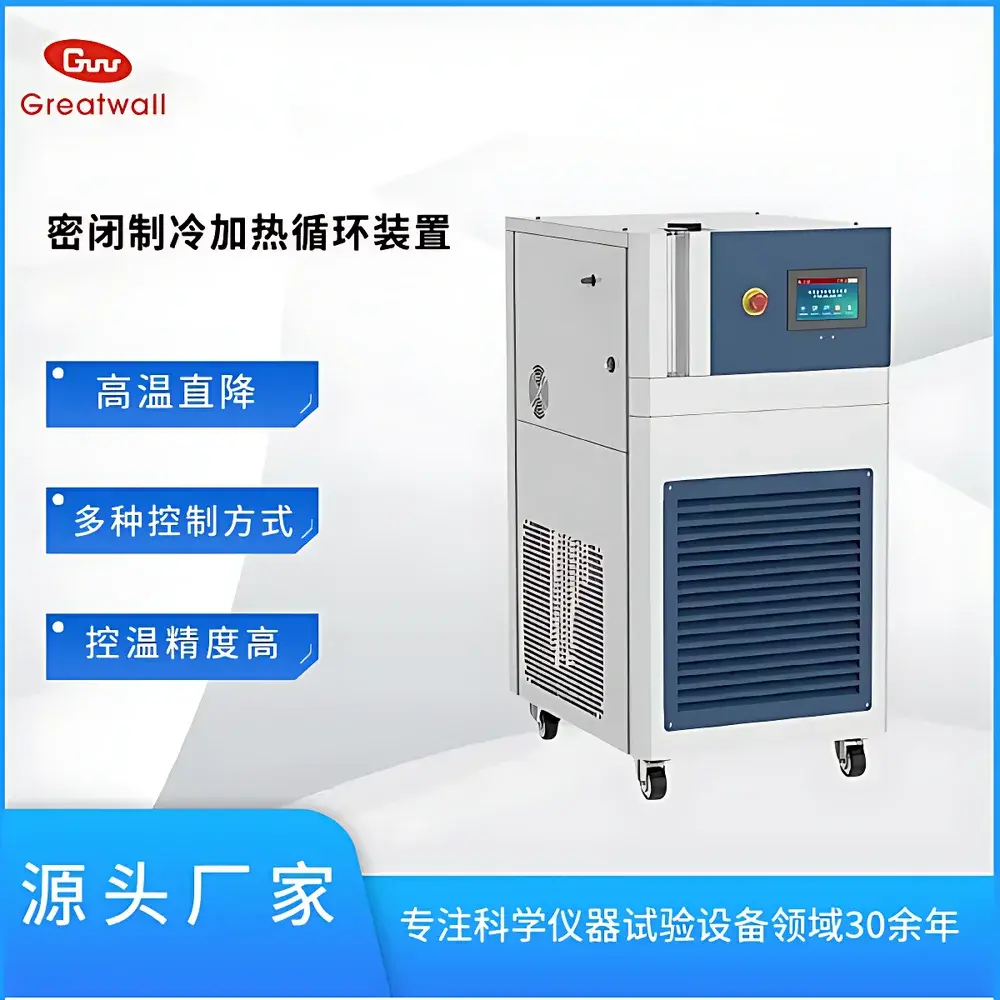
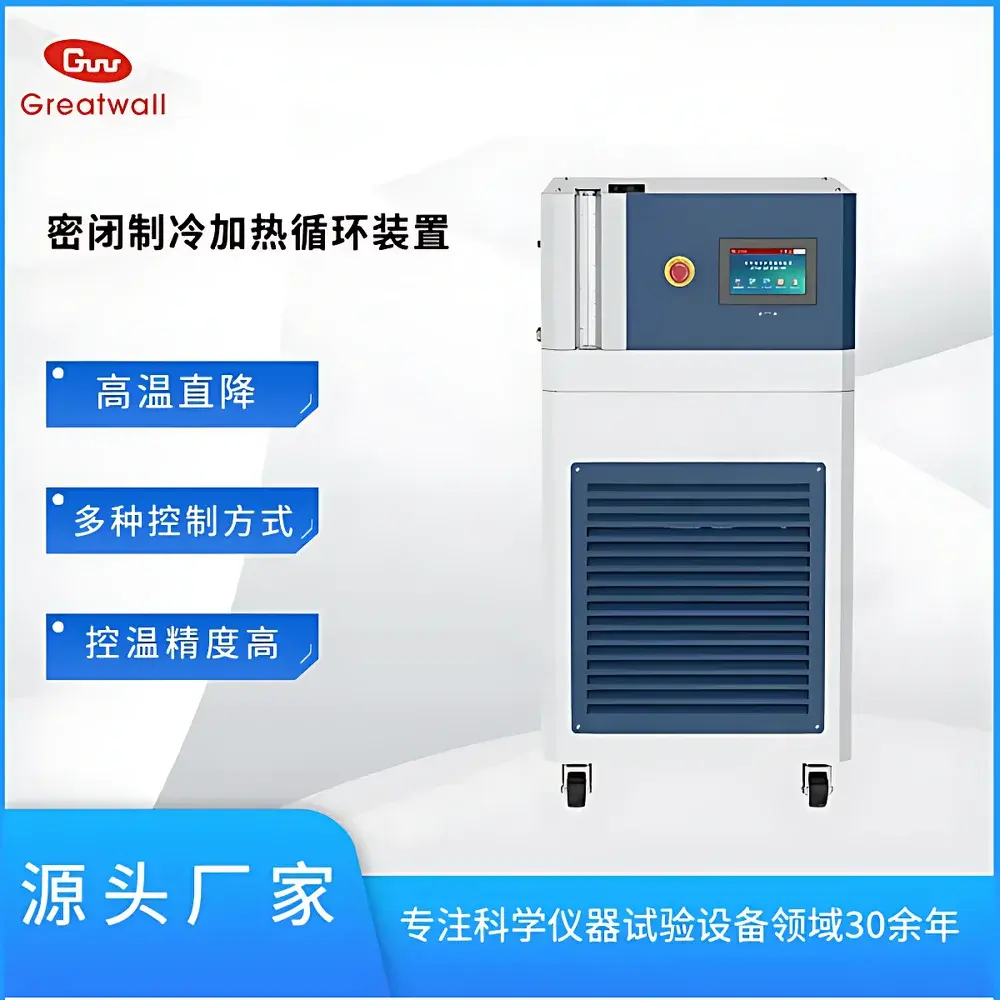
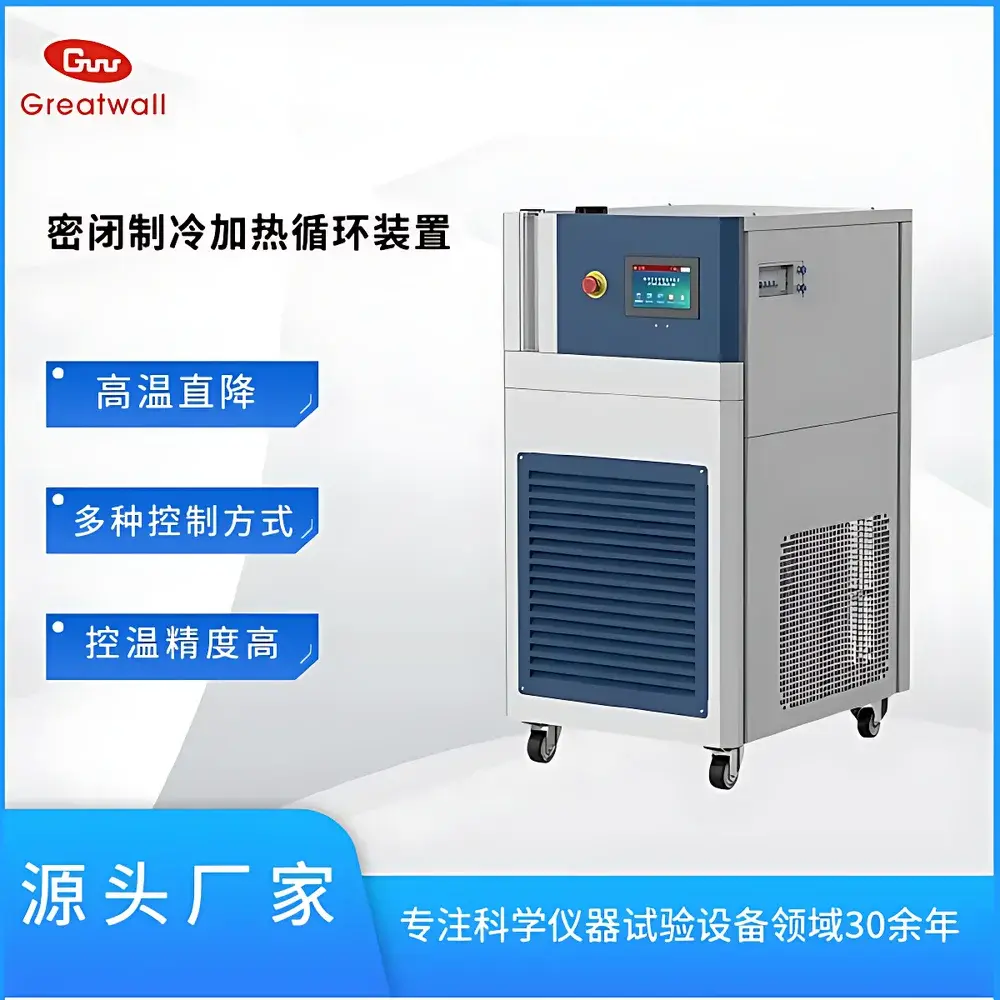
The Great Wall ZTM-20-200-30 Closed-Loop Refrigerated & Heated Circulator
| Brand | The Great Wall |
|---|---|
| Origin | Henan, China |
| Manufacturer Type | Direct Manufacturer |
| Product Category | Domestic |
| Model | ZTM-20-200-30 |
| Instrument Type | Integrated Unit |
| Cooling Method | Air-Cooled |
| Temperature Range | −30 °C to +200 °C |
| Temperature Stability | ±0.5 °C (±0.1 °C in selected subranges) |
| Max Pump Pressure | 1.0 bar |
| Pump Flow Rate | 30 L/min |
| Display | 7-inch Color TFT LCD |
| Communication Interfaces | RS485, USB |
| Control Modes | Constant Setpoint, Programmed Setpoint, Ramp Rate (Slope) Control, Programmed Ramp Control |
| Safety Protections | Independent Overtemperature, High-Pressure Compressor, Leakage Current, Compressor Delay Start, Thermal Overload, Overcurrent, Phase Sequence Monitoring |
| Liquid Level Monitoring | Yes |
| Temperature Sensing Options | Material Temperature, Heat Transfer Fluid Outlet Temperature, or Return Temperature |
| Delta-T Control Logic | Enabled |
Overview
The Great Wall ZTM-20-200-30 is an integrated, closed-loop refrigerated and heated circulator engineered for precision thermal management in laboratory-scale chemical synthesis, reaction calorimetry, material testing, and process development environments. Unlike open-bath chillers or standalone heating/cooling units, this system employs a hermetically sealed circulation loop that isolates the heat transfer fluid (HTF)—typically silicone oil, glycol-water mixtures, or specialized synthetic fluids—from ambient air. This design prevents oxidation, moisture absorption, and volatile loss, thereby maintaining fluid integrity over extended operational cycles and reducing maintenance frequency and consumable replacement costs. The unit operates across a wide thermal envelope of −30 °C to +200 °C using a dual-mode refrigeration-heating architecture: a high-efficiency air-cooled compressor circuit for active cooling, coupled with PID-regulated electric immersion heaters for rapid, stable heating. Its temperature stability of ±0.5 °C (with enhanced stability of ±0.1 °C achievable within narrower operating bands) meets stringent requirements for kinetic studies, crystallization control, and temperature-sensitive catalytic reactions.
Key Features
- Closed-loop architecture: Eliminates HTF degradation by preventing exposure to atmospheric oxygen and humidity—critical for long-duration experiments and high-temperature applications.
- Multi-point temperature control logic: Supports selection of control variable—process material temperature (via external PT100 sensor), HTF outlet temperature, or HTF return temperature—enabling optimal thermal coupling with reactors, jacketed vessels, or analytical instrumentation.
- Advanced ramp & soak programming: Four distinct control modes—including constant setpoint, programmable multi-step setpoints, linear ramp rate (slope) control, and hybrid programmed ramp sequences—facilitate reproducible thermal protocols aligned with ICH Q5C stability guidelines or ASTM E698 kinetic analysis standards.
- Delta-T (ΔT) compensation algorithm: Dynamically adjusts heater/cooler output based on real-time differential between setpoint and measured temperature, minimizing overshoot and improving thermal inertia response—particularly beneficial when interfacing with high-mass reactors or low-flow systems.
- Comprehensive safety architecture: Includes independent hardware-level protections: compressor high-pressure cutoff, thermal overload relays, earth leakage detection, phase sequence verification, and delayed compressor restart to prevent mechanical stress during power cycling.
- Intuitive human-machine interface: A 7-inch color TFT display presents real-time temperature curves, system status icons, alarm logs, and live parameter readouts—including pump flow confirmation, fluid level indication, and compressor duty cycle.
Sample Compatibility & Compliance
The ZTM-20-200-30 is compatible with standard laboratory heat exchange interfaces, including 1/2″–3/4″ NPT or G-threaded ports, and supports integration with jacketed glass reactors (e.g., 1–50 L capacity), rotary evaporators, distillation assemblies, and calorimetric cells. Its closed-loop design ensures compatibility with hygroscopic or oxidation-prone HTFs such as polydimethylsiloxane oils (up to 200 °C) or inhibited ethylene glycol blends (down to −30 °C). From a regulatory standpoint, the unit’s RS485 and USB interfaces support data export for audit trails compliant with GLP (Good Laboratory Practice) and FDA 21 CFR Part 11 requirements when paired with validated third-party SCADA or LIMS software. While not certified to UL/CSA or CE for North American/EU deployment out-of-the-box, its electrical design adheres to IEC 61010-1 safety principles, and documentation packages can be supplemented with factory-issued test reports for regional conformity assessments.
Software & Data Management
Data acquisition and remote supervision are enabled via standard RS485 (Modbus RTU protocol) and USB 2.0 interfaces. The RS485 port permits daisy-chaining multiple ZTM units into centralized control networks—ideal for multi-reactor parallel screening platforms or automated synthesis workstations. USB connectivity allows direct export of time-stamped temperature logs (.CSV format), alarm histories, and system configuration snapshots to external storage devices. Although no proprietary PC software is bundled, the device responds to standard Modbus function codes (e.g., FC03 for holding register reads), enabling seamless integration with LabVIEW, MATLAB, Ignition SCADA, or custom Python-based monitoring scripts. All logged data includes UTC timestamps, sensor ID tags, and event severity flags—supporting traceability in regulated QA/QC workflows.
Applications
- Controlled-temperature synthesis of organometallic compounds requiring cryogenic initiation followed by exothermic ramping.
- Stability testing of pharmaceutical intermediates per ICH Q1A(R3) under accelerated conditions (e.g., 40 °C/75% RH simulated via jacket temperature control).
- Calibration and validation of DSC, TGA, or rheometer temperature sensors using traceable fluid-bath reference points.
- Thermal conditioning of optical components, semiconductor wafers, or battery electrode slurries prior to characterization.
- Support of continuous flow chemistry systems where precise residence time–temperature profiles govern selectivity and yield.
FAQ
What types of heat transfer fluids are recommended for operation across the full −30 °C to +200 °C range?
Silicone-based oils (e.g., Dow Corning DC-200 series) or specially formulated synthetic polyol esters are preferred. Water-glycol mixtures are suitable only up to ~120 °C and require corrosion inhibitors for extended use.
Can the ZTM-20-200-30 be integrated into a PLC-controlled pilot plant?
Yes—its Modbus RTU implementation over RS485 enables direct communication with Allen-Bradley, Siemens, or Mitsubishi PLCs without protocol gateways.
Is external fluid level monitoring supported beyond the built-in visual indicator?
The unit provides a digital level signal output (0–10 V or 4–20 mA optional upon request), allowing connection to building management systems or alarm panels.
Does the system meet noise emission limits for ISO Class 5 cleanroom-adjacent laboratories?
At rated load, sound pressure is ≤68 dB(A) at 1 m distance—within acceptable limits for non-GMP lab corridors but not suitable for laminar flow hood proximity without acoustic shielding.
How frequently should the refrigerant charge and compressor oil be serviced?
Under continuous operation, annual inspection of refrigerant pressure and oil condition is recommended; typical service intervals exceed 15,000 hours due to hermetic compressor design and thermal overload protection.
Related Products



