
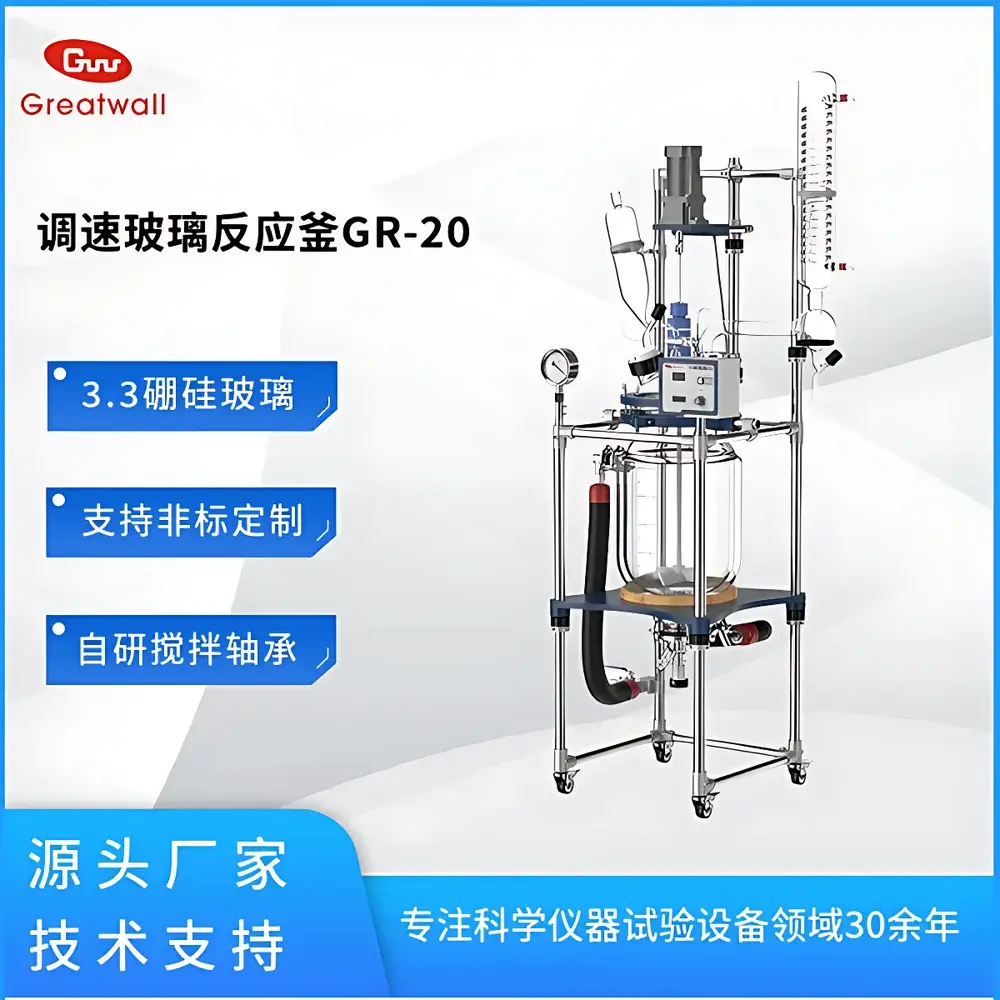
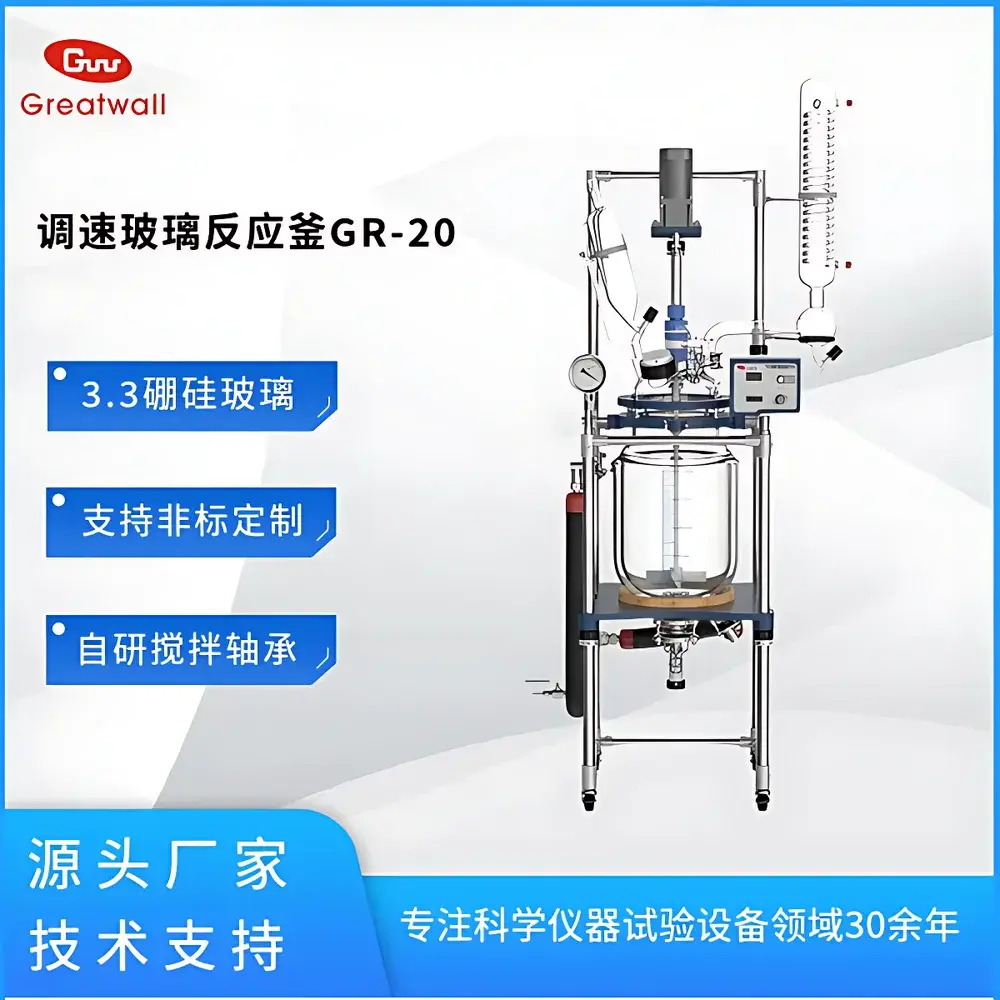
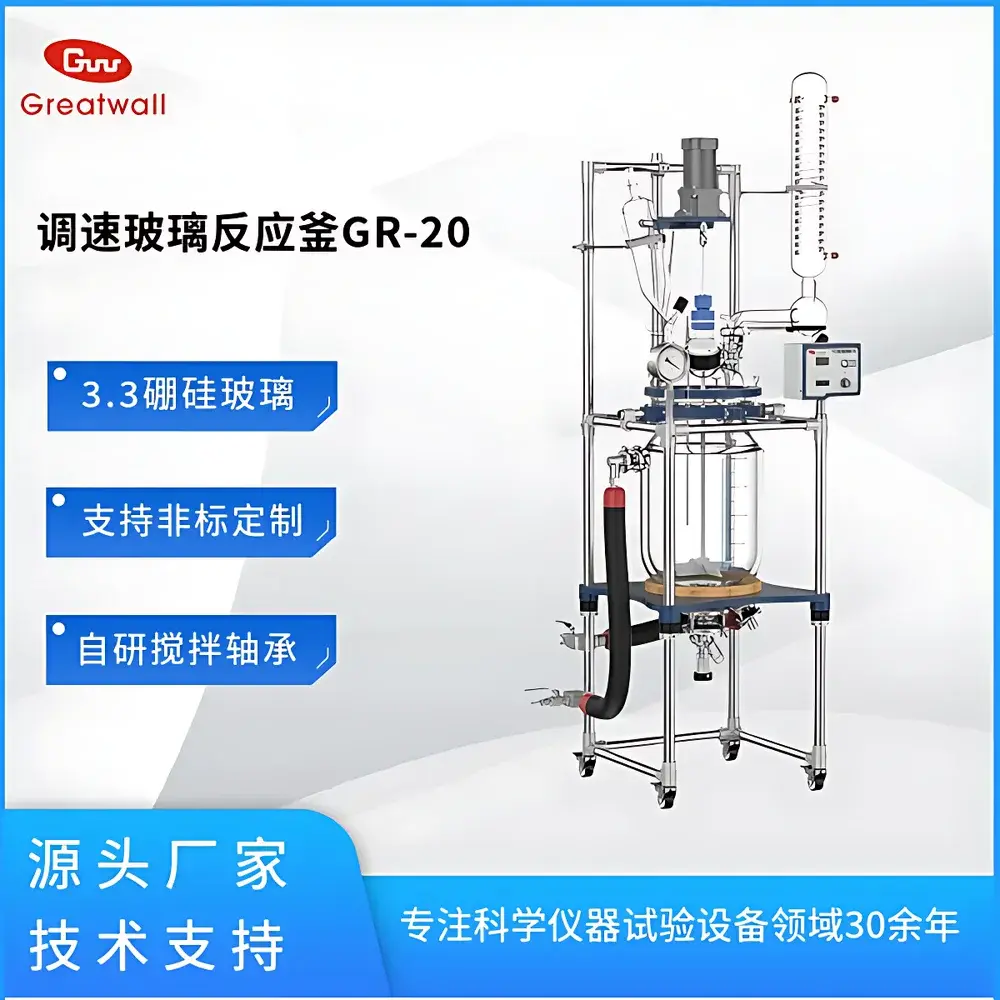
The Great Wall GR-20 Variable-Speed Glass Reactor
| Brand | The Great Wall |
|---|---|
| Origin | Henan, China |
| Manufacturer Type | Direct Manufacturer |
| Origin Category | Domestic |
| Model | GR-20 |
| Instrument Classification | Jacketed Glass Reactor |
| Usable Volume | Medium-Scale |
| Construction Material | Borosilicate Glass 3.3 |
| Operating Pressure | Low Pressure (Vacuum to Atmospheric) |
| Capacity | 20 L |
| Temperature Range | −80 °C to 200 °C |
| Jacket Pressure Rating | ≤ 0.03 MPa |
| Thermal Shock Resistance | 80 °C |
| Stirring Speed Range | 50–500 rpm |
| Speed Accuracy | ±1 rpm |
| Motor Power | 90 W |
| Drive Type | Three-Phase Asynchronous Motor with Frequency Inverter Control |
| Stirring Seal | Vacuum-Compatible Mechanical Seal |
| Stirrer Blade Material | PTFE-Coated 06Cr19Ni10 (AISI 304 Equivalent) |
| Stirrer Configuration | Single-Layer Four-Blade Pitched Turbine |
| Jacket Volume | 9 L |
| Condenser Heat Transfer Area | ~0.341 m² |
| Feed Port Capacity | 2000 mL |
| Main Flange Diameter | 215 mm |
| Bottom Valve ID | φ21 mm |
| Discharge Nozzle ID | φ33 mm |
| Temperature Sensor | PT100 (±0.1 °C accuracy) |
| Frame Material | 06Cr19Ni10 Stainless Steel + Powder-Coated Aluminum Alloy |
| Mobility | Locking Casters |
| Overall Dimensions (W×D×H) | ~825 × 665 × 1960 mm |
| Net Weight | ~67 kg |
Overview
The Great Wall GR-20 Variable-Speed Glass Reactor is an engineered solution for controlled, scalable chemical synthesis and process development under low-pressure and wide-temperature conditions. Designed around the principles of jacketed heat exchange and precision mechanical agitation, the system enables reproducible reaction control in transparent borosilicate glass 3.3 vessels—facilitating real-time visual monitoring of phase behavior, crystallization, emulsification, and exothermic progression. Its operational envelope spans −80 °C to +200 °C with vacuum-to-atmospheric pressure capability, making it suitable for applications requiring cryogenic condensation, reflux, distillation, or gentle solvent removal. The reactor integrates a robust stainless steel–aluminum hybrid frame, vacuum-rated mechanical sealing, and frequency-inverter-driven stirring—ensuring stable torque delivery across the full 50–500 rpm range while minimizing vibration-induced stress on glass components.
Key Features
- Borosilicate glass 3.3 construction (DIN ISO 3585 compliant) for exceptional thermal shock resistance (ΔT ≤ 80 °C), chemical inertness against acids, alkalis, and organic solvents, and high optical clarity.
- Integrated double-jacket design with 9 L jacket volume and Rc 3/4 threaded circulation ports, compatible with external chillers, heating circulators, or dry ice/acetone baths via stainless steel insulated flexible tubing.
- Vacuum-mechanical dual-seal stirring assembly using PTFE-faced rotating elements and stationary ceramic/metal interfaces—rated for continuous operation under dynamic vacuum (−0.1 MPa) without lubricant contamination.
- PTFE-coated 06Cr19Ni10 (AISI 304 equivalent) stirring shaft and four-blade pitched turbine impeller—optimized for radial flow generation and uniform suspension of heterogeneous mixtures.
- Digital speed and temperature readouts (LED display) with ±1 rpm and ±0.1 °C resolution; real-time feedback supports GLP-compliant parameter logging when interfaced with external data acquisition systems.
- Modular top-plate configuration with six standardized ground-glass joints (50#, S51, 35#, 40/38, 34/35, 80#), enabling flexible integration of condensers, dropping funnels, gas inlets, thermowells, and sampling valves.
- Mobility-enhanced structural frame featuring corrosion-resistant 06Cr19Ni10 uprights, powder-coated aluminum crossmembers, and industrial-grade locking casters for safe relocation and alignment within fume hoods or pilot-scale workstations.
Sample Compatibility & Compliance
The GR-20 accommodates batch volumes from 1.6 L (minimum effective stirring volume) up to 20 L nominal capacity, supporting liquid-phase reactions, slurry polymerizations, catalytic hydrogenations (with optional H2-compatible fittings), and solvent-free grinding-assisted synthesis. All wetted surfaces—vessel, condenser, feed funnel, and discharge valve—are constructed exclusively from Class A borosilicate glass 3.3 or PTFE-lined stainless steel, eliminating metal ion leaching risks critical in pharmaceutical intermediate synthesis and catalyst characterization. The system conforms to general laboratory safety standards including EN 61010-1 (electrical safety) and ISO 7207-1 (glass apparatus dimensional tolerances). While not intrinsically rated for explosion-proof environments, its vacuum-compatible design aligns with ASTM E2875 guidelines for low-pressure reaction hazard assessment. Documentation packages support IQ/OQ protocols for academic, industrial QC, and regulated GMP pilot labs.
Software & Data Management
The GR-20 operates as a stand-alone analog-digital hybrid platform. Speed and temperature are locally monitored via front-panel LED displays but lack embedded microcontroller-based data logging or USB/Ethernet connectivity. However, its analog output signals (0–10 V or 4–20 mA optional upon request) are compatible with third-party SCADA systems, LabVIEW-based acquisition modules, or programmable logic controllers (PLCs) used in university teaching labs and small-scale process validation workflows. When deployed in GLP-regulated environments, users may implement manual logbooks or integrate external chart recorders to satisfy 21 CFR Part 11 audit-trail requirements for critical process parameters. Firmware-upgradable digital controllers are available as factory-installed options for enhanced repeatability in multi-step temperature-ramp protocols.
Applications
- Organic synthesis under reflux or reduced pressure (e.g., esterifications, amidations, Grignard reactions).
- Controlled crystallization studies with in-situ observation of nucleation kinetics and polymorph selection.
- Enzymatic and microbial biotransformations requiring precise pH and temperature stabilization (when paired with external pH probe and controller).
- Material science precursor preparation—including sol-gel processing, nanoparticle synthesis, and MOF crystallization.
- Method development for pharmaceutical API manufacturing, aligned with ICH Q5 and Q7 guidance on equipment suitability and process consistency.
- Teaching laboratories demonstrating reaction thermodynamics, mass transfer limitations, and scale-up fundamentals (from bench to pilot).
FAQ
What is the maximum allowable jacket pressure for the GR-20?
The夹套 (jacket) is rated for ≤ 0.03 MPa (30 kPa)—intended solely for circulating heat-transfer fluids, not pressurized steam or high-pressure gases.
Can the GR-20 be used for hydrogenation reactions?
Yes—provided appropriate hydrogen-rated fittings, leak-tested seals, and explosion-proof ancillary equipment (e.g., spark-free stirrer motors, inert gas purging) are integrated per local safety regulations.
Is the PT100 temperature sensor calibrated and traceable to NIST standards?
The sensor is factory-calibrated; full NIST-traceable calibration certificates are available as an optional add-on service at time of order.
Does the system include a vacuum pump or chiller?
No—these are external accessories. The GR-20 provides standard Rc 3/4 ports for connection to user-supplied vacuum manifolds and thermal circulators.
What maintenance intervals are recommended for the mechanical seal?
Under normal use (≤ 8 hrs/day, non-abrasive media), inspect seal faces and O-rings every 6 months; replace PTFE stator components annually or after 2000 operating hours.



