
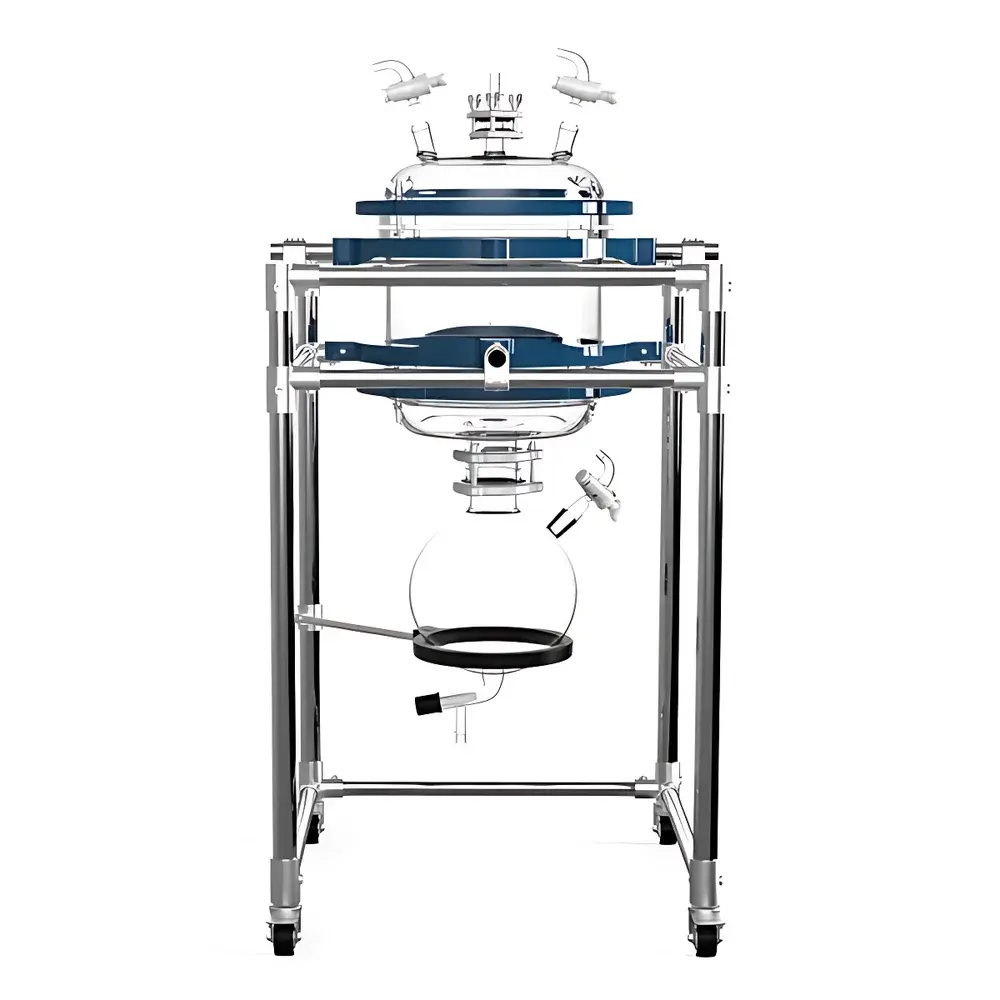
Great Wall CLZZ-30 Bench-Scale Vacuum Filtration Unit with PTFE-Fritted Filter and Stainless Steel Frame
| Brand | The Great Wall |
|---|---|
| Origin | Henan, China |
| Manufacturer Type | Direct Manufacturer |
| Origin Category | Domestic (China) |
| Model | CLZZ-30 |
| Price | Upon Request |
| Usable Volume | Small-Scale |
| Instrument Material | Borosilicate Glass 3.3 |
| Operating Pressure | Low Vacuum to Atmospheric |
| Collection Flask Capacity | 20 L |
| Filter Disc Material | PTFE |
| Filter Pore Size | 20–30 µm |
| Filtration Vessel Diameter | Ø300 mm |
| Temperature Range | –80 °C to +200 °C |
| Internal Pressure Rating | Full vacuum to ambient pressure |
| Lid Port Configuration | 40# Flange (liquid feed), 24/29# Standard Tapered Ground Joints (vacuum & vent), PTFE Stopcock Drain Valve |
| Frame Material | SUS304 Stainless Steel + Anodized 6061-F Aluminum Plate |
| Overall Dimensions (W×D×H) | Approx. 650 × 650 × 1600 mm |
Overview
The Great Wall CLZZ-30 is a bench-scale vacuum filtration unit engineered for reproducible solid–liquid separation in synthetic chemistry, pharmaceutical process development, and materials research laboratories. It operates on the principle of pressure-driven cross-flow filtration under controlled negative pressure, enabling rapid dewatering or solvent removal from crystalline precipitates, catalyst slurries, or polymer suspensions. Unlike disposable filter funnels or simple Büchner setups, the CLZZ-30 integrates a sealed, temperature-rated filtration vessel with a precision-machined PTFE fritted disc, high-integrity ground-glass joints, and a rigid modular frame—supporting scalable operation from lab optimization to pilot-stage process validation. Its design conforms to fundamental requirements for GLP-compliant filtration documentation, including traceable material contact surfaces (borosilicate glass 3.3 and PTFE), non-reactive fluid pathways, and mechanically stable vacuum integrity up to –0.1 MPa.
Key Features
- Robust dual-material support frame: SUS304 stainless steel uprights combined with anodized 6061-F aluminum plate base—optimized for corrosion resistance, static rigidity, and long-term dimensional stability under thermal cycling.
- Borosilicate glass 3.3 filtration vessel (Ø300 mm) rated for service between –80 °C and +200 °C; compatible with cryogenic quenching and mild heating via external jackets or immersion baths.
- PTFE sintered frit disc (20–30 µm pore size) mounted on a precision-machined PTFE support plate—chemically inert across pH 0–14, resistant to halogenated solvents, strong acids, and bases.
- Vacuum-tight lid assembly with standardized 24/29# ground-glass joints for vacuum line connection and venting; 40# flanged port for controlled liquid charging under inert atmosphere or solvent addition during filtration.
- Integrated PTFE stopcock drain valve with calibrated flow control—enabling metered discharge of filtrate into the 20 L borosilicate collection flask without breaking vacuum or exposing solids to ambient air.
- Modular interface design allows seamless integration with optional accessories: vacuum controllers with digital pressure readout, cold traps, inert gas purging manifolds, or peristaltic feed pumps for continuous slurry introduction.
Sample Compatibility & Compliance
The CLZZ-30 accommodates heterogeneous mixtures containing organic crystals (e.g., APIs, intermediates), inorganic precipitates (e.g., metal hydroxides, carbonates), polymeric gels, and heterogeneous catalysts (e.g., Pd/C, Ni/Raney). Its all-PTFE/glass wetted path eliminates metal ion leaching and adsorption artifacts common in stainless-steel or ceramic filter housings. The unit meets general laboratory safety standards for Class I vacuum apparatus (per ANSI Z9.2) and supports compliance with USP , EP 2.2.27, and ISO 13320 particle filtration validation protocols when used with certified reference slurries. All glass components are manufactured to ISO 3585 specifications for borosilicate 3.3, and PTFE elements comply with ASTM D4894 for fluoropolymer performance in chemical service.
Software & Data Management
While the CLZZ-30 is a manually operated mechanical system without embedded electronics, its architecture supports full digital traceability when paired with external instrumentation. Vacuum level can be monitored via third-party digital gauges compliant with FDA 21 CFR Part 11 (audit trail, user authentication, electronic signatures). Process parameters—including filtration time, applied vacuum setpoint, temperature at vessel jacket, and filtrate mass—are recordable in LIMS or ELN platforms using standard OPC UA or Modbus TCP interfaces from compatible peripheral sensors. Documentation workflows align with GMP Annex 11 and ALCOA+ data integrity principles when integrated into validated lab informatics ecosystems.
Applications
- Crystallization workup: Isolation of thermally sensitive active pharmaceutical ingredients after anti-solvent addition or cooling crystallization.
- Heterogeneous catalysis: Recovery and washing of supported metal catalysts without mechanical attrition or metal leaching.
- Polymer synthesis: Removal of unreacted monomers and oligomers from condensation polymer slurries prior to drying.
- Inorganic materials synthesis: Separation of nanostructured metal oxides (e.g., TiO₂, Fe₃O₄) from hydrothermal reaction mixtures.
- Quality control labs: Batch-wise filtration of reference standard suspensions for particle size distribution analysis by laser diffraction.
- Teaching laboratories: Demonstration of vacuum-driven mass transfer kinetics, cake resistance modeling, and filter medium selection criteria.
FAQ
What is the maximum allowable vacuum level for the CLZZ-30 filtration vessel?
The vessel is rated for full vacuum (≤ –0.1 MPa gauge) at ambient temperature; derating is required above 100 °C per ASTM E2877 guidelines for thin-walled glass pressure containment.
Can the PTFE frit be replaced with alternative pore sizes or materials?
Yes—custom PTFE frits (5–100 µm), sintered glass discs (ISO 4793), or stainless-steel mesh supports are available as OEM options upon request.
Is the unit suitable for use under nitrogen or argon inert atmosphere?
Yes—the 40# flanged feed port and sealed ground-joint vacuum/vent ports enable safe inert gas blanketing during filtration and cake washing.
Does the CLZZ-30 meet CE or UL certification requirements?
As a non-electrical, manually operated apparatus, it falls outside mandatory CE/UL scope; however, frame load-bearing capacity and glass mechanical integrity conform to EN 15647-1 for laboratory glassware support structures.
How is cleaning and maintenance performed between batches?
All glass components are autoclavable (121 °C, 2 bar); PTFE parts are cleaned via ultrasonic bath in IPA or acetone, followed by nitrogen purge—no disassembly beyond standard joint separation is required.



