
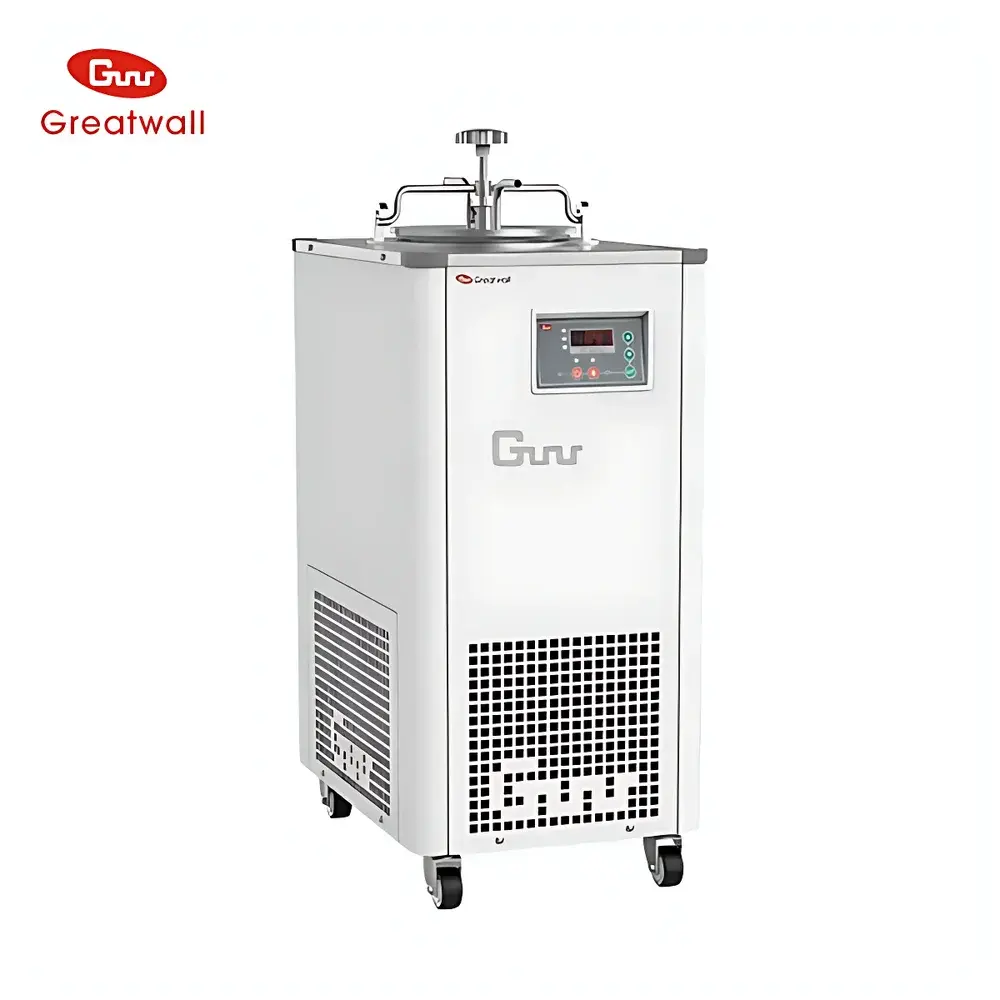
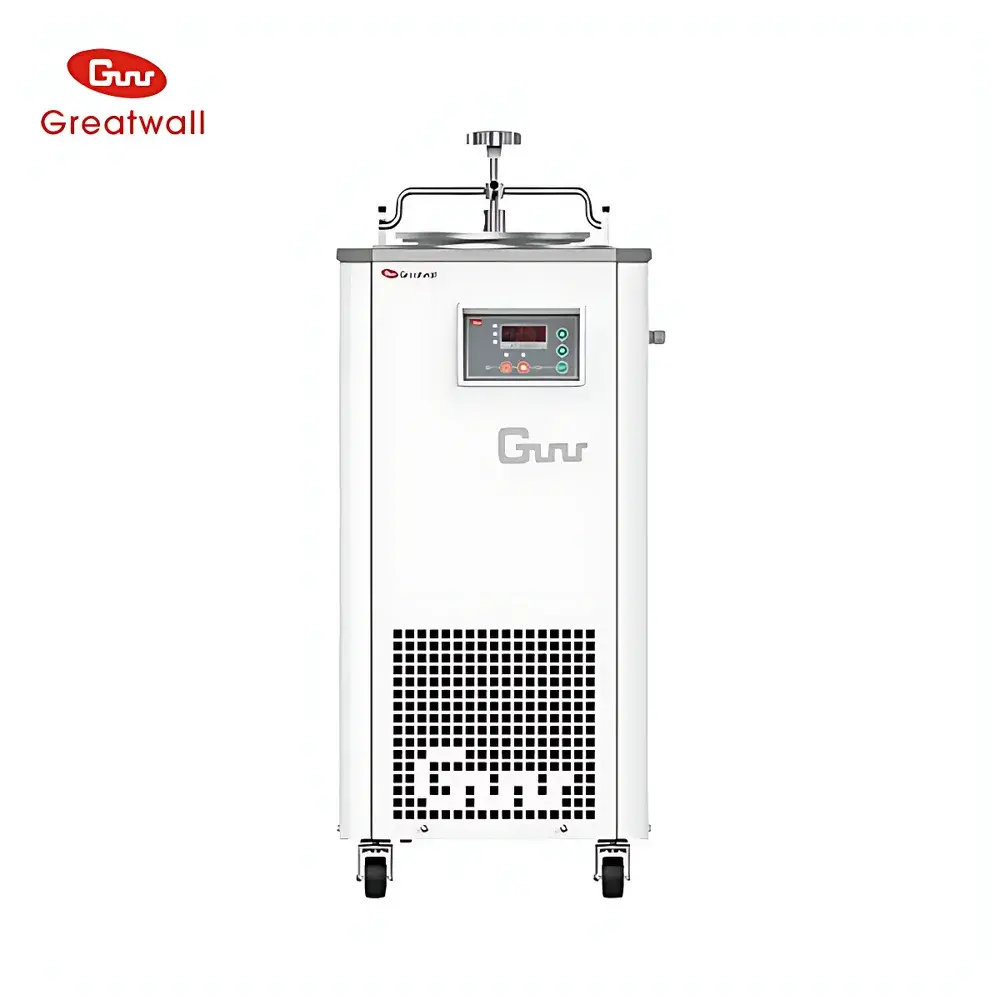
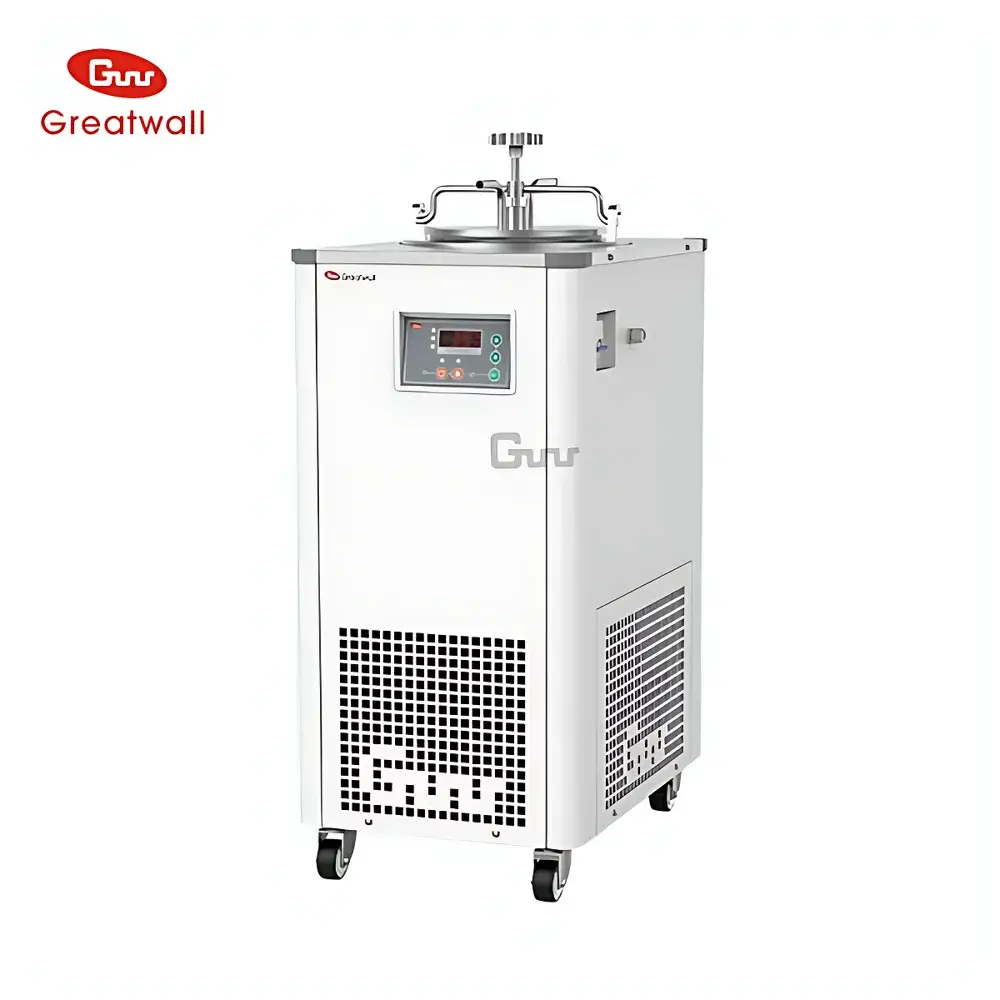
The Great Wall VT-2000H Water Vapor Trap
| Brand | The Great Wall |
|---|---|
| Origin | Henan, China |
| Manufacturer Type | Direct Manufacturer |
| Model | VT-2000H Water Vapor Trap |
| Cooling Method | Direct Contact Cooling |
| Minimum No-Load Temperature | −40 °C |
| Temperature Display | Digital (Pt100 Sensor) |
| Adjustable Setpoint Range | Within Operating Range |
| Safety Protections | Delayed Start, Overcurrent & Overtemperature Protection |
| Dehumidification Capacity | Up to 1 kg (Water-Based Systems) |
| Refrigeration Capacity | 640 W at −10 °C |
| Refrigerant | R404A |
| Trap Chamber Dimensions | Ø160 × 240 mm |
| Chamber Material | 06Cr19Ni10 (AISI 304 Stainless Steel) |
| Vacuum Interface | Flexible Hose Fitting, OD Ø12 mm |
| Ambient Operating Conditions | 5–35 °C, ≤70% RH |
| Power Supply | 220–240 V~, 50 Hz |
| Total Power Consumption | 819 W |
| Input Current | 3.7 A |
| Unit Dimensions (W×D×H) | 360 × 590 × 889 mm |
| Net Weight | 60 kg |
Overview
The Great Wall VT-2000H Water Vapor Trap is a cryogenic condensation-based vacuum protection system engineered for high-efficiency removal of water vapor and volatile contaminants from vacuum lines in freeze-drying, rotary evaporation, and low-pressure drying applications. It operates on the principle of direct-contact cryocondensation—where process vapors contact a thermally stabilized stainless-steel trap chamber cooled by a hermetic refrigeration circuit using R404A refrigerant. Unlike passive cold traps relying on liquid nitrogen or dry ice, the VT-2000H delivers stable, programmable sub-zero temperatures down to −40 °C under no-load conditions, enabling consistent vapor capture across extended operational cycles. Its design supports integration into vacuum systems handling moisture-laden solvents (e.g., water, ethanol), acidic vapors (via optional glass condenser), and organic media—thereby protecting downstream vacuum pumps from corrosion, oil contamination, and performance degradation while reducing atmospheric emissions in compliance with local environmental regulations.
Key Features
- Direct-contact cooling architecture with integrated compressor-based refrigeration system ensures rapid thermal stabilization and precise temperature control.
- Dual-mode configuration: standard 304 stainless steel trap chamber (compatible with aqueous and ethanol-based systems) and optional borosilicate glass condenser (chemically resistant to acids and aggressive organic solvents).
- Digital temperature monitoring via Pt100 RTD sensor with real-time display; user-adjustable setpoints within the full operating range (−40 °C to ambient).
- Robust mechanical safety suite including delayed startup logic, overcurrent cutoff, and dual-stage overtemperature protection to prevent compressor overload and chamber thermal runaway.
- Optimized vacuum interface with standardized Ø12 mm flexible hose connection—ensuring leak-tight coupling with common lab vacuum manifolds and pump inlets.
- Compact footprint (360 × 590 × 889 mm) and modular construction facilitate benchtop installation in QC labs, pilot-scale drying suites, and battery electrode manufacturing cleanrooms.
Sample Compatibility & Compliance
The VT-2000H accommodates diverse sample matrices without cross-contamination risk. The 304 stainless steel chamber (06Cr19Ni10) meets ASTM A240 requirements for corrosion resistance in neutral and mildly polar environments—making it suitable for lyophilization of biologics, solvent recovery in pharmaceutical extractions, and moisture removal during cathode/anode drying in lithium-ion battery production. When paired with the optional glass condenser, the system complies with ISO 8573-1 Class 2 particulate limits and withstands exposure to hydrochloric acid vapors, acetone, THF, and other halogenated or ester-based solvents per IEC 61000-4-30 immunity standards. All electrical components conform to CE/EN 61000-6-3 EMI emission limits and UL 61010-1 safety requirements for laboratory equipment.
Software & Data Management
The VT-2000H operates as a standalone analog-controlled unit with no embedded firmware or network connectivity. Temperature setpoints and status indicators are managed locally via front-panel controls and LED display—ensuring deterministic operation in GMP-regulated environments where software validation overhead must be minimized. For laboratories requiring audit-ready records, external data loggers (e.g., Omega OM-DAQPRO-5300) can be interfaced via the Pt100 sensor output to capture time-stamped temperature profiles. This analog-first architecture aligns with FDA 21 CFR Part 11 guidance for systems where electronic records are generated externally, eliminating the need for complex software qualification protocols while maintaining traceability for GLP/GMP batch documentation.
Applications
- Vacuum-assisted drying of pharmaceutical intermediates and sterile APIs in lyophilizers and tray dryers.
- Condensation trapping in rotary evaporators processing heat-sensitive natural extracts or polymer solutions.
- Moisture scavenging in vacuum ovens used for capacitor dielectric curing and battery electrode pre-drying (per GB/T 36276–2018 specifications).
- Pre-condensation stage upstream of turbomolecular pumps in analytical instrumentation (e.g., mass spectrometry sample introduction lines).
- Low-temperature pre-cooling bath for cryo-microtomy or controlled nucleation studies when operated in open-loop mode.
FAQ
Can the VT-2000H be used continuously for >8 hours without performance drift?
Yes—the compressor and heat exchanger are rated for continuous duty at −30 °C with ambient intake air ≤30 °C and ≤60% RH. Thermal stability is maintained within ±1.5 °C over 24-hour operation.
Is the stainless steel chamber suitable for hydrochloric acid vapor?
No—304 stainless steel exhibits chloride-induced stress corrosion cracking above 60 °C. Use the optional glass condenser for HCl-containing streams.
What maintenance intervals are recommended for long-term reliability?
Compressor oil inspection every 12 months; condenser coil cleaning every 6 months in dusty environments; Pt100 calibration verification annually against NIST-traceable reference.
Does the unit meet UL or CSA certification requirements?
It carries CE marking per EN 61010-1:2010 and complies with RoHS 2011/65/EU. UL/CSA listing is available upon request for OEM integration projects.
Can the trap chamber be sterilized in an autoclave?
No—the internal refrigeration tubing and sensor wiring are not autoclave-rated. Sterilization is limited to surface wiping with 70% ethanol or VHP-compatible disinfectants.



